Has any industrialist since, roughly, Henry Ford, dominated the news like Elon Musk? In the last month or two, he debuted a flying car (of sorts), caught a giant rocket in tweezers to make it reusable, substantially upgraded his self-driving car technology, and announced he will give $18 billion per year in stock to American children.
As you may have noticed, Elon Musk tends to go into heavy industries that obsessed Golden Age science fiction writers like Robert A. Heinlein and Isaac Asimov, such as reusable rockets and self-driving cars, ones that nobody in early 21st Century real world America ever thought about anymore until Musk, because everybody in America knew that the future was all digital bits, boring as that sounded, and we could leave the primitive metal bashing to the Chinese and Germans.
Musk would make a lot of aggressive promises on outrageous timelines that seldom precisely come true … but, then, about the time you you’ve lost interest in Musk’s blunder, he tends to deliver something (although often not quite what he promised) that is truly amazing.
One of Elon’s sci-fi promises is that Tesla will Real Soon Now be building millions of general purpose humanoid robots called Optimus.
Optimus is a 5’8” bipedal robot that can wash your dishes.
This is highly reminiscent of Robert Heinlein’s 1957 novel The Door Into Summer about an inventor in 1970 who invents the first general purpose household chore robot.
But Heinlein prudently cut some corners that Musk eschews cutting.
For instance, Heinlein’s robot wasn’t a walking humanoid robot. That’s too complicated. Instead the inventor started with a motorized wheelchair and added gripping and manipulating hands. (If you want the robot to clean the second floor of your house, don’t worry about it climbing the stairs, just buy another rolling robot.)
As I wrote in 2014, what Heinlein underestimated by five or 10 orders of magnitude is how hard the software would be to program. In the book, when somebody suggests the robot should wash dishes in the sink, the inventor stays up one … entire …. night to program it to wash dishes.
Instead, the world around 1970 simply went with non-mobile single purpose robots and installed them under your counter and called them dishwashers. (Similarly, people didn’t invent all-purpose robots to haul their dirty laundry down to the river and beat it upon the rocks. Insteady, they invented the single-purpose washing machine.)
In 2002, the Roomba vacuum cleaner robot first came on the market: a practical mobile robot. It’s magic trick was not being very smart. It just took its time and semi-randomly wandered around and eventually got the job done. Robot swimming pool vacuum cleaners are even dumber: being underwater, they don’t use any electricity. They just have mechanical gears that will eventually get the whole pool swept.
My older son had long wanted a bunny. But my younger boy is allergic to furry animals, which give him asthma attacks.
My wife determined that he would be all right with a rabbit in the house if we vacuumed the carpets constantly. However, the chances that our family would persist with the needed devotion to cleanliness seemed nil.
Fortunately, my wife had been tracking the evolution of Roomba, the robot vacuum cleaner from iRobot. She deemed the new model worthy of a try as her $200 birthday present.
Soon, a box arrived on our doorstep containing a disk about 13” in diameter and 3” thick. My wife put it in the middle of the floor and pushed its button.
A whooshing noise emerged, but it was significantly quieter than a manually operated vacuum. Roomba started to roll in a tight spiral, slowly circling outward, brushing and sucking up dirt as it went. When it softly bumped into a wall, it changed directions, seemingly at random. Its trial-and-error approach meant it was obviously going to take Roomba an hour or two to finish the entire living room.
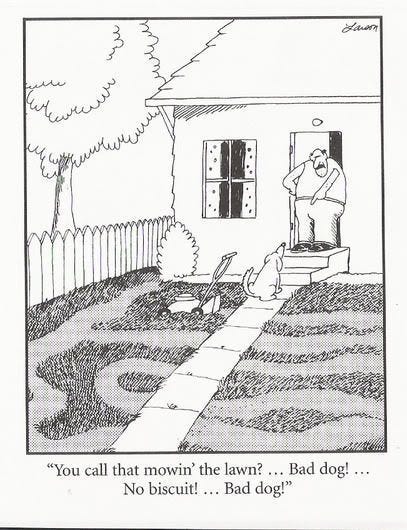
But to complain about Roomba’s random walk style of vacuuming seemed churlish—literally like the ungrateful man in Gary Larson’s Far Side cartoon who looks out at his front lawn, where his panting dog has been pushing a lawn mower in effortful but erratic patterns, and scolds, “Call that mowin’ the lawn? ... Bad dog... No biscuit! Bad dog!”
After all, the dirt was definitely disappearing into the little robot as well as a normal vacuum cleaner could manage.
And we were just sitting on the couch watching Roomba roll.
Indeed, at first the robot consumed more of our time than doing the vacuuming ourselves would have done. He was hypnotic to watch.
Because his behavior was purposeful yet unpredictable, Roomba seemed to have a personality. It was easy to think of him as a dutiful family retainer, rather like a sheep who keeps the lawn cropped on a Scottish estate, although his low center of gravity made him seem more like a groundhog or horseshoe crab. (As you may have noticed, we soon started referring to Roomba as “him” rather than as “it.”)
After a week of increasing delight in our robot, especially with how he cleans under beds where we can’t reach with a normal vacuum, we felt confident enough to acquire Frank the Rabbit. Although less productive than Roomba the Robot, Frank is more fun to pet.
After my wife told a lady on her bowling team, she bought a Roomba too. She now says “Roomba is my new best friend.”
VDARE.com doesn’t exist to review appliances, so if you are interested in buying one, please read the reviews carefully on Amazon.com and other sources. There are situations Roomba can’t handle well, and durability may still be a problem.
Nonetheless, it’s safe to say that Roomba is a revolutionary product.
On a moral level, I take some pride in that I’m paying the whole cost of Roomba, unlike so many Americans with more money than me who nevertheless offload much of the expense of their illegal immigrant cleaning ladies on the rest of the country.
One lesson of history since the start of the Industrial Revolution 250 years ago is that countries don’t advance economically by importing unskilled workers to “do the jobs that natives won’t do,” but by substituting machines for human labor.
For example, because the Roman Empire exploited countless slaves conquered in foreign wars, it lacked incentives to increase labor efficiency through mechanization. Productivity never took off, and eventually the civilization collapsed into poverty.
As Anthony Faiola recently reported in the Washington Post:
“Though perhaps years away in the United States, this long-awaited, as-seen-on-TV world—think “The Jetsons“ or “Blade Runner“—is already unfolding in Japan, with robots now used as receptionists, night watchmen, hospital workers, guides, pets and more… Officials compiled a report in January predicting that every household in Japan will own at least one robot by 2015, perhaps sooner.” [Robot swarms invade Japan!, March 12, 2005]
In part, this is because the Japanese think their mountainous islands are quite crowded enough, thank you, without admitting millions of immigrants.
In contrast, the U.S., although once famous for its commitment to higher productivity, has shown less interest in labor saving in recent years. It has focused instead on sending manufacturing jobs to China and white collar jobs to India, while importing millions of uneducated workers to perform rudimentary service jobs here.
For example, although previous generations of Americans had vastly increased the productivity of workers on Midwestern grain farms, efforts to mechanize California fruit and vegetable farms were largely abandoned, as VDARE.COM reported five (!) years ago, because immigrants were cheaper … to the corporate farmer, although not to the country.
Admittedly, robotics has proven slower to develop than science fiction writers had imagined. In Robert A. Heinlein’s 1957 novel The Door into Summer, the narrator invents a robot vacuum cleaner he calls Hired Girl that’s quite similar to Roomba … but he builds it in 1970, not 2005.
Of course, despite all his prescience, Heinlein didn’t anticipate the 1965 Immigration Act, which would make unskilled labor often cheaper than automation. (In Heinlein’s defense, I must point out that in his Future Historystories written from 1939 through 1942, he correctly prophesied that the 1960s would be “The Crazy Years.”)
Back in 1957, Heinlein had simply assumed that cheap servants were a thing of the past due to immigration restrictions, which Congress had legislated in 1924. The inventor in The Door into Summerexplained the economic logic and marketing psychology behind his Hired Girl robot:
“Housewives were still complaining about the Servant Problem long after servants had gone the way of the mastodon. I had rarely met a housewife who did not have a touch of slaveholder in her; they seemed to think there really ought to be strapping peasant girls grateful for a chance to scrub floors for fourteen hours per day and eat table scraps at wages a plumber’s helper would scorn. That’s why we called the monster Hired Girl—it brought back thoughts of the semi-slave immigrant girl whom Grandma used to bully.”
Heinlein, who embodied the can-do spirit of mid-century America, loved dreaming up “gadgets to replace the extinct domestic servant.”
I don’t believe he would have been pleased to see his country instead resurrect the “semi-slave immigrant girl.”
Particularly when Roomba the Robot is available.
And here’s my review of the 2012 movie Robot & Frank:
Robot & Frank is a clever little sci-fi dramedy about a semi-senile old coot whose concerned son buys him a robot as a valet and minder. The film is well crafted and timely because robophobia is once again in fashion. Americans, faced with a rapidly growing population, fear robots will arrive soon and take what jobs are left.
In contrast, the Japanese, faced with a shrinking population, fear that robots won’t get here fast enough to spare them from finally having to let in poor foreigners to care for their elderly. While Westerners traditionally fear that robots are plotting to take over (e.g., Terminator), the Japanese welcome our new robot overlords.
Quite conveniently for those of us whose memories aren’t what they used to be, Frank is played by Broadway star Frank Langella.
Allow me to pause to commend this title to filmmakers. This slightly twee art-house flick could have been given a twee art-house name like Automata or Quiddity. Instead, they chose to dub their Frank Langella-starring robot movie Robot & Frank.
Please, filmmakers, try naming your characters after the movie stars who play them. I’ve read at least 20,000 movie reviews, and I’ve been able to comprehend the plot summaries of maybe a half-dozen. That’s because I always forget how to match the characters’ made-up names with the famous faces portraying them.
Therefore, if you paid a lot of money to get, say, Tom Cruise in your movie, call his character “Tom” so we can keep track of what’s going on. If you’ve signed Tom Hanks to costar with Tom Cruise, call his character “Hank.” In short, keep it simple for us. I know it hurts to hear this, but we don’t actually care as much about your movie as you do.
In fact, putting “Tom” in the title would probably help us when we get to the ticket window and can’t remember your film’s name. Your audiences aren’t getting any younger. Bad Guy & Tom would work fine.
OK, where was I?
Oh, yeah…in Robot & Frank, Frank (who, as I may have mentioned, is played by Frank Langella) initially objects to his upbeat new companion.
But you can tell that the robot isn’t your standard evil movie robot because his voice, furnished by the opaque but likable Peter Sarsgaard, isn’t quite as gay as such helpful but murderous automated valets as 2001‘s HAL 9000 and Michael Fassbender’s Lawrence of Arabia-worshiping robot (who was the only non-derisible thing in this summer’s Prometheus). Sarsgaard’s robot sounds more like an unusually sedate Mormon camp counselor. (Also, the robot is only four feet tall and appears to have been designed by a Japanese child.)
Frank soon finds, however, that his robot’s photographic memory is useful in resuming his old career of casing joints. Frank is actually an involuntarily retired cat burglar. With the robot as his aide-mémoire, he can burgle the lake house of an annoying consultant, a Future Yuppie. The Fuppie is repurposing Frank’s beloved small-town library as a post-print theme attraction venue…well, it’s never clear exactly what the Fuppie is doing, but Christopher Ford’s dialogue reminds us how baffling the fashionable notions of 2040 will seem to us codgers.
The Japanese tend to be extremely sensitive to other humans’ emotional discomfort, which makes social interaction for them exhausting unless expensively lubricated by alcohol and professional hostesses. (That’s one reason that fewer and fewer young Japanese men bother to come out of their rooms.)
Back in 1931-1945, the Japanese attempted to get around their empathy excess by defining all non-Japanese as subhuman, but that didn’t end well for them. Ever since, they’ve been looking forward to robots as their ideal non-Japanese servants.
Americans don’t make good servants (Thomas Jefferson, Abe Lincoln, and all that). So Americans have been importing huge numbers from more submissive Third World cultures for elder care and the like. The immigrants’ children tend to grow up assimilated to American norms of non-servility, requiring more Third Worlders to be hauled in.
I can’t say the Japanese have the wrong idea, but they have to get robots working first. The main discovery of attempts at robot design over the last half-century is that general-purpose mobile robots are inferior to specialized stationary robots. Instead of inventing a robot that walks over to your kitchen sink and washes your dishes, it makes more sense to permanently install a dishwashing robot (i.e., a “dishwasher”) under your counter. Similarly, rather than design a robot to help frail people climb into bathtubs, it makes more sense to redesign the tub from the ground up to be safe for the old.
Yet I believe the classic mobile robot (rolling, not walking) will eventually emerge to serve a specific and limited role for the ambulatory old: full-time caddy. Rich golfers find they enjoy the game most when they can stroll the fairways with an attentive servant to hand them whatever they need, advise them on its proper use, and then take it off their hands again.
When I’m old and wobbly, I’d like to have a caddy follow me around the house and around the block, holding my things and keeping me on task. (In fact, I need one now.)
But it would drive me crazy to have a human assistant whom I would alternately bore and pester. I lack Bertie Wooster’s aristocratic sense of entitlement. When I’m old, I’ll want guilt-free servile companionship, which means a robot.
Robot & Frank raises the metaphysical question of what makes something human. Can simulacra easily manipulate our emotions? Can we actually care about things that can only pretend to care back?
The answer is yes. For instance, people who buy Roomba vacuum-cleaner robots frequently develop parental feelings toward their faithful—if often inept—servitors. Why do humans feel more warmly toward their Roombas than toward their dishwashers? The key emotional triggers are that Roombas move on their own, try hard, aren’t very bright, and they need much guidance and grooming. They’re like small children who love doing their chores.
Or consider the movies. For example, onscreen Frank Langella (who plays Frank) is whatever he feels like being. If he’s supposed to be a retired tough guy romancing Susan Sarandon (the librarian) in the manner of Burt Lancaster in Sarandon’s 1980 breakout Atlantic City, well, sure, he can do that.
Frank (who, in case I forgot to mention it, is played by Frank Langella) is actually a nasty criminal, but we’re all rooting for him because it’s easy to push our buttons.
But then from around 2017 onward …
Paywall here.
Continue reading this post for free, courtesy of Steve Sailer.