

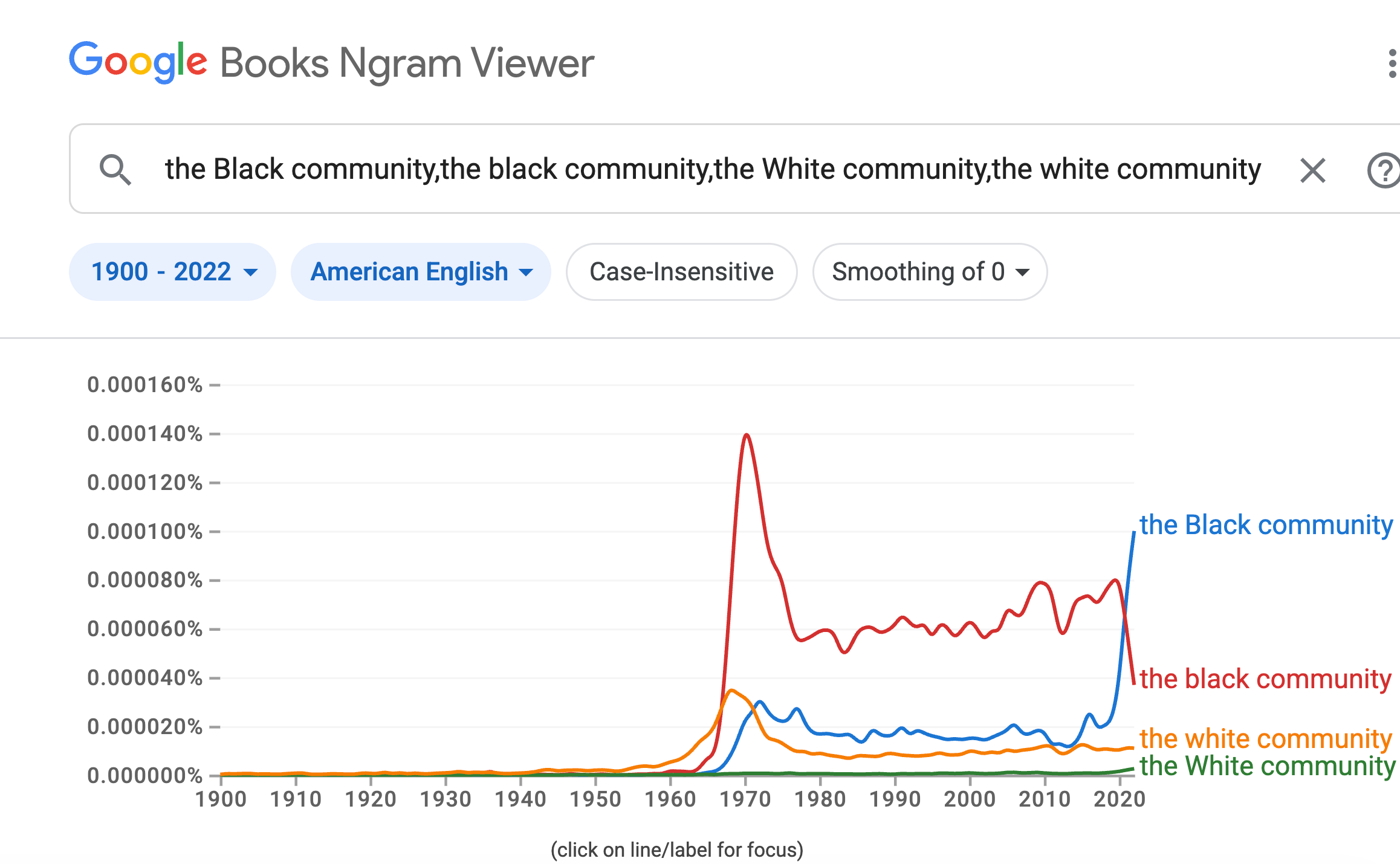
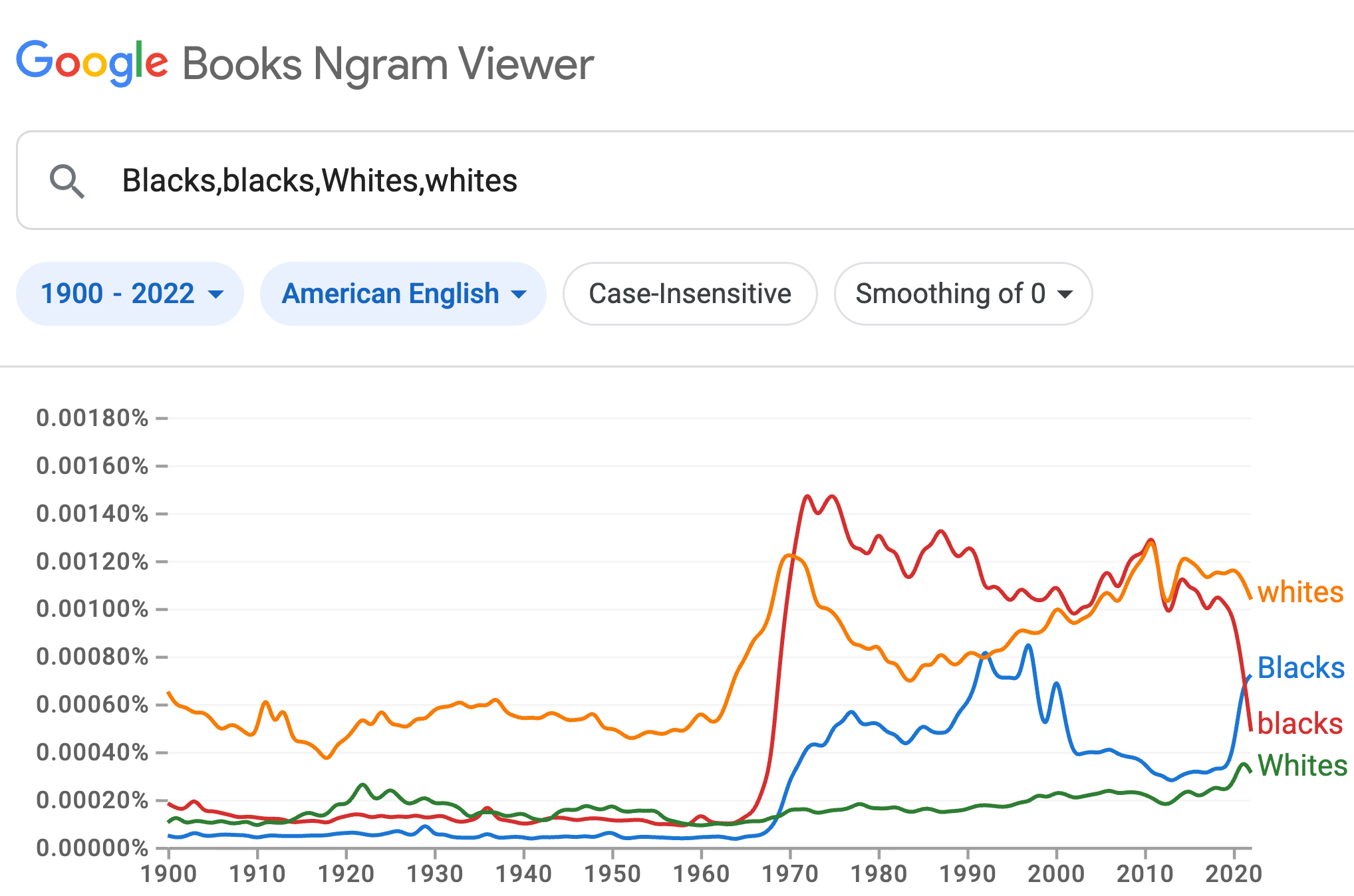
In the crazed weeks following George Floyd’s demise on May 25, 2020, much of the American news and publishing industries chose to switch their copyediting rules from even-handedly lowercasing “both blacks and whites” to pointedly uppercasing one race but not the other: “both Blacks and whites.”
Despite recent talk of a vibe shift, virtually no media institution has apologized for its 2020 act of racist animus and shifted back to equal capitalization.
In that memorable (and thus frequently memoryholed) Summer of 2020, black Princeton history professor Nell Irvin Painter explained why, instead, she would capitalize “Whites:” as an act of hostility toward the oppressor race:
The ups and downs of racial identity
by Nell Irvin Painter
So momentous, so dark yet hopeful, these times have turned our world upside down.
Police brutality brought into the light. Masses in the streets confronting American history, toppling the Confederacy after years—decades—of well-mannered but vain protest. We are left to grapple with the conventions of American public life.
Restructuring policing in ways that matter will take months, years—and many more Confederate monuments remain standing than have come down. But one change has been implemented quickly: translating this social upheaval into print has suddenly and all but unanimously restored a capital “B” to “Black.” I say “restored,” because that capital “B” appeared in the 1970s. I used it myself. Then copyeditors, uncomfortable with both the odd combination of uppercase “Black” and lowercase “white” and the unfamiliar, bumpy “Black and White,” took off both capital letters. In one of many turns in the history of racial capitalization, “Black” returned to “black.” There’s a history to issues of capitalization.
No doubt some books would capitalize “Blacks” in the 1970s, but most did not:
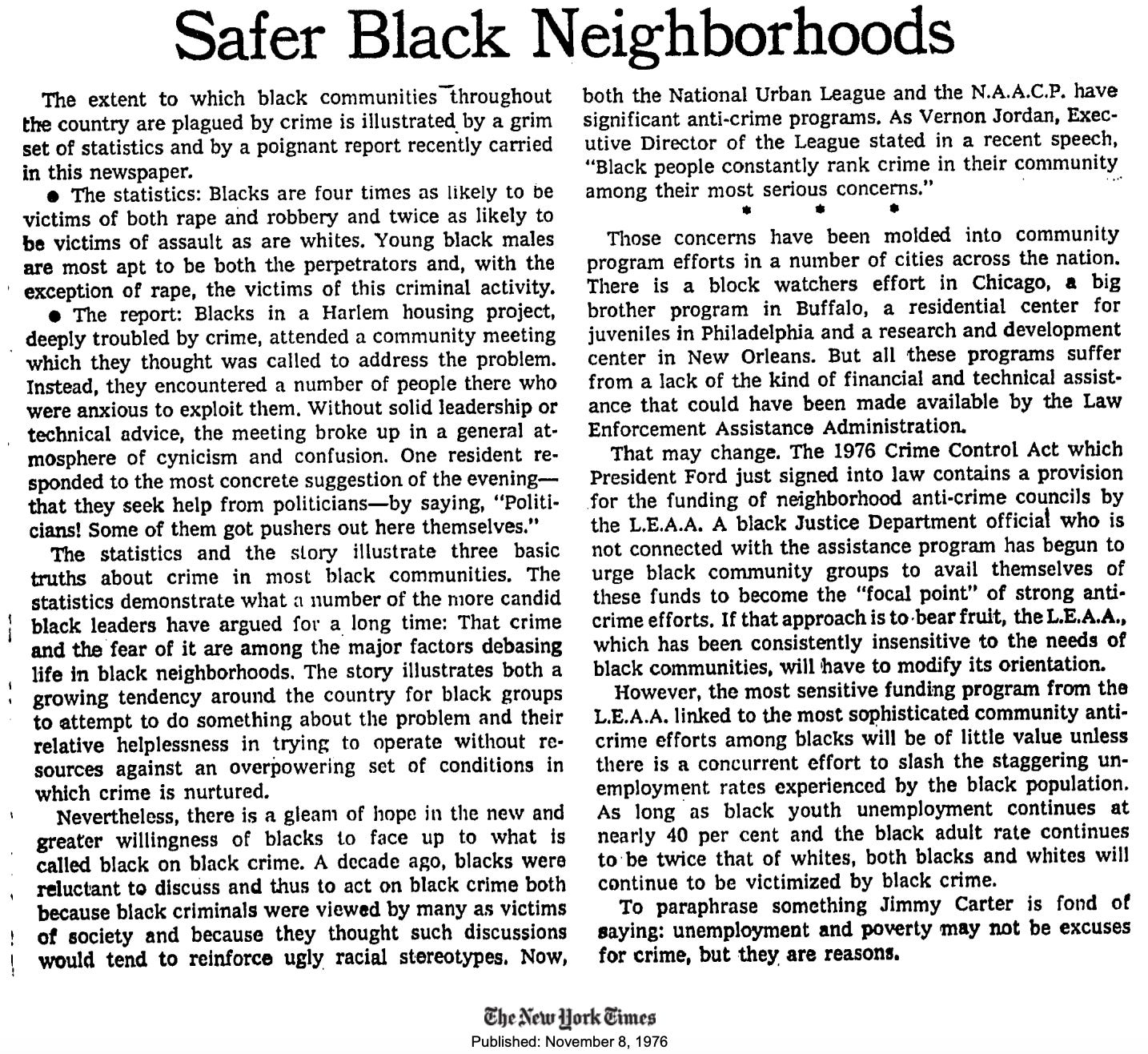
The major news outlets did not capitalize “blacks” in the 20th Century. For example, here’s a screenshot of a New York Times editorial from 50 years ago in 1976 in which the phrase “both blacks and whites” is lowercased same as the New York Times would have done on the day before George Floyd died (the content of the editorial is more frank, though):
“Spell It with a Capital,” exhorted the Chicago Conservator in 1878. This pioneering Black weekly newspaper was founded by Ferdinand Lee Barnett, the husband of the crusading anti-lynching journalist Ida B. Wells. For the Conservator, as for journalists in the succeeding half century, the letter in question was “N,” for “Negro,” the then progressive name for Americans of African descent.
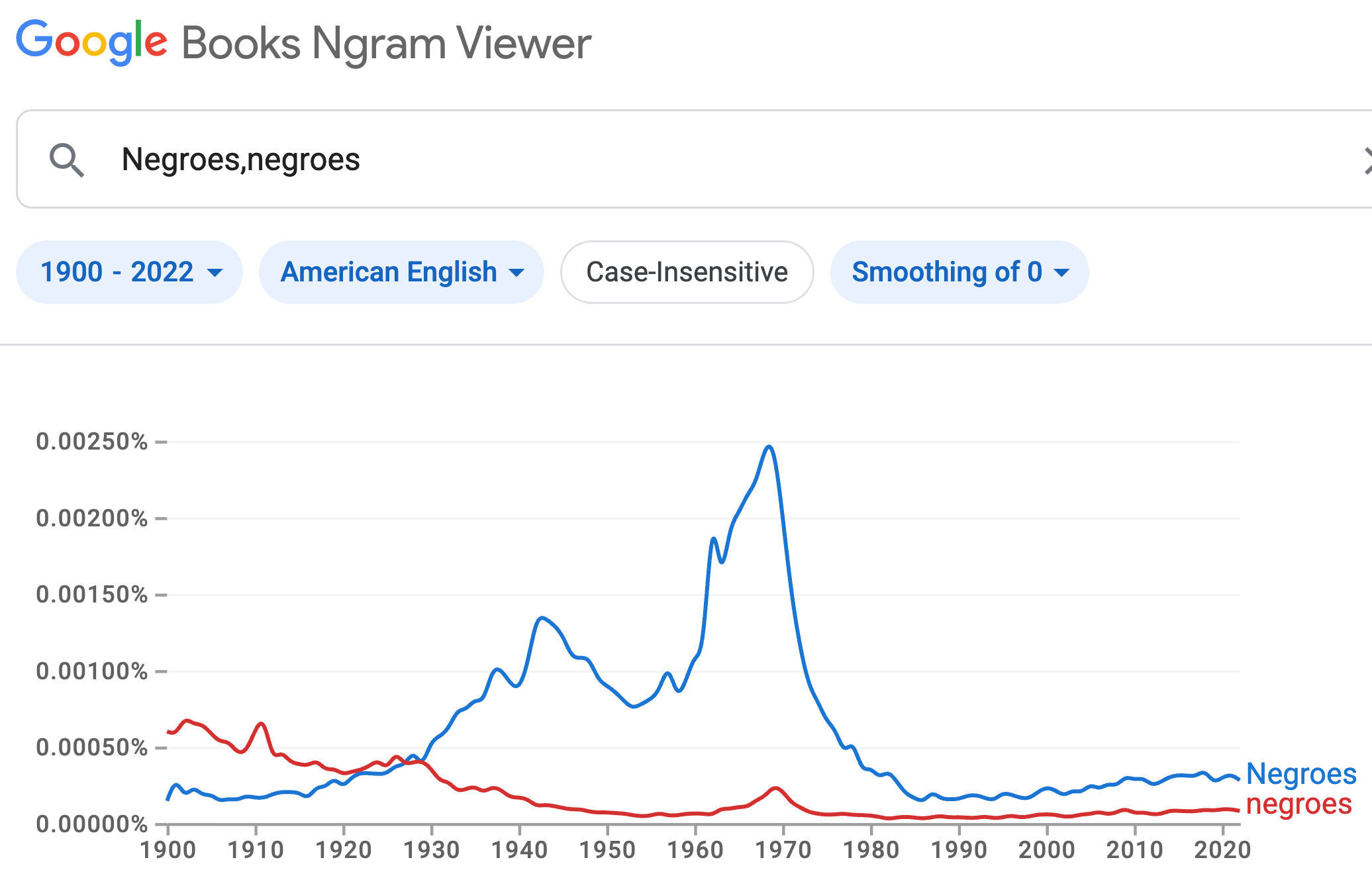
As part of an extensive letter-writing campaign, W.E.B. Du Bois asked the New York Times in 1926 to capitalize “Negro” because the lower-case “N” inflicted “a personal insult.” The Times refused, although the New Republic had agreed years earlier. By 1930, all Black and several important White newspapers, including the New York World, New York Herald Tribune, Chicago Tribune, and New York Times, had adopted the capital “N.” Capital-N “Negro” was standard usage by the 1950s.
In the 1960s, “Black,” formerly considered derogatory, gained acceptance as a sign of race pride, thanks to Malcolm X, the Nation of Islam, and Black Power coming out of the Civil Rights movement. In the 1970s, capital “B Black” emerged in Black writing, sometimes but not always along with a corresponding capital “W White.” …
In the wake of massive George Floyd and Black Lives Matter protests, Black people and their allies now regard capitalizing “Black” as a badge of honor. By mid-June 2020, prominent newspapers and journalists’ associations were embracing the capital “B.” Even Fox News has joined the crowd. The most common motive for change was summed up as respect. As I started thinking about racial capitalization, I asked my multiracial, multiethnic Facebook friends for their views. They variously mentioned cultural identity, pride, and a shared “ethnicity,” meaning Black American ethnicity, skipping over the various cultural backgrounds of Black people from around the Western Hemisphere and beyond. The case for capitalizing “Black” seemed obvious, whether as an ethnicity (a minority view) or a racial designation.
I thought The Science of genetics had proven that blacks were the most diverse?
The assertion that you hear sometimes rationalizing “both Blacks and whites” that “Blacks” are capitalized to represent one distinct American ethnicity flounders on the fact that the capitalized word is also used for blacks around the world. For example, during this year’s World Cup, the New York Times ran an opinion piece by a black woman entitled:
Why Brazil vs Haiti is the perfect World Cup match to mark Juneteenth
Brazil is home to the largest population of people of African descent outside of Africa, while Haiti became the first sovereign Black nation in the world, …
My decision not to explain myself in that initial piece was to honor those who did not require explanation; who, like me, are constantly searching for the gatherings within the glittering soirée of the World Cup that create space to celebrate Blackness in all its expansive cultural and geographic representation. …
It does not matter how many players on Brazil’s World Cup squad are or identify as Black; a passing glance at the titans of Brazilian football reveals its roots: Pelé, Ronaldo, Formiga, Ronaldinho, Sissi, Cafu. Gabriel, Neymar, Endrick, Kerolin, and Vinicius Junior.
Back to Professor Painter in 2020:
So what about “wWhite”? Perhaps the lowercase “w” for “White” mainly signals an unwillingness to poke the fiery hornet’s nest of the White nationalism of people like the Charleston church assassin, who capitalized “White.” Besides, says the New York Times, White “doesn’t represent a shared culture and history in the way Black does.” …
Eh, come on … that’s just dopey. The reason we don’t have a white history month is because, since the 1400s, every month is white history month.
When I compare the cultural, intellectual, and historical heft of the three categories, Black comes out well ahead of the other two.
For sheer intellectual heft? Really?
We have whole libraries of books and articles about Blackness, world-beating traditions of Black music and literature, even entire academic departments thirty to fifty years old specializing in African American/Black studies. Compared to Blackness, Whiteness and brownness are severely under-theorized. …
Now, Professor Painter explains why white people should be forced to bear the Scarlet Capital Letter of Whiteness:
“White” should be capitalized in order to unmask Whiteness as an American racial identity as historically important as Blackness. No longer should White people be allowed the comfort of racial invisibility; they should have to see themselves as raced. These Facebook friends said being racialized makes White people squirm, so, yes, racialize them with a capital “W.” Make them squirm. …
Like I’ve been saying, publishing “both Blacks and whites” is an act of racist animus.
The popularity of this tweet:
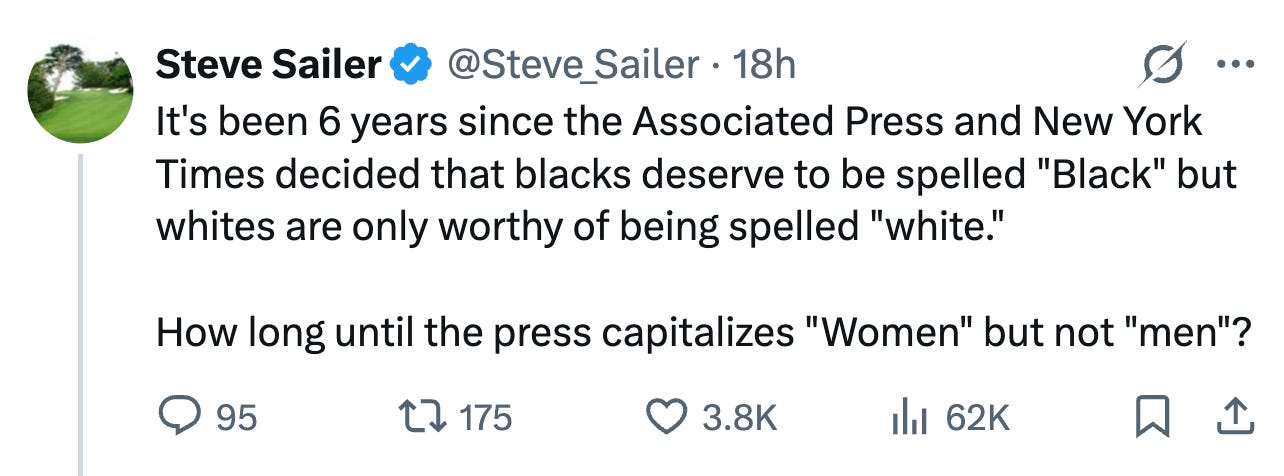
got me thinking about other examples of people using uppercase or lowercase to signal whom they respect or despise.
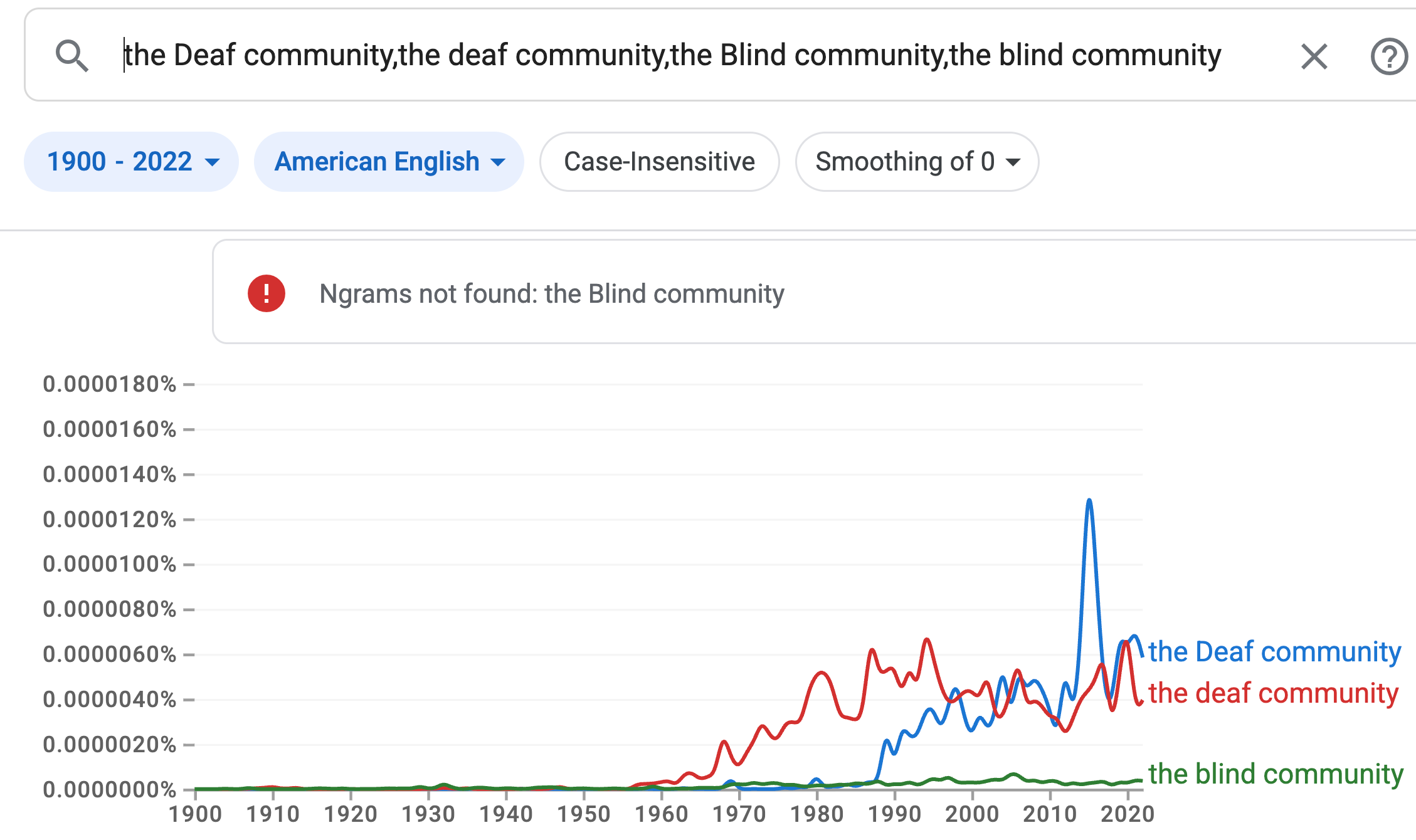
One example is the growth of the term “the Deaf Community,” which is now seen in Americans books more than “the deaf community.”
On the other hand, “the Blind community” has never appeared in any American book known to Google.
(The reason deaf people act more like an ethnicity than do blind people is because those who use sign language have their own language. American Sign Language is not an offshoot of English, but of French sign language. In contrast, schools for the blind just use English, same as other schools. So, schools for the deaf have had more episodes of radical activism than schools for the blind.)
What about new horizons in typographical ass-kissing?
In the future, perhaps flouncy drag queen M to Fs will be not just be capitalized but also italicized, while dominance-demanding autogynephilic M to Fs will require boldface: “both Trans Women and Trans Women.”
You can also get clues about writers by how they capitalize:
“Both Laplanders and Swedes are indigenous” — normal
“The Sami are Indigenous, but Swedes are settler colonialists” — Ph.D. candidate
Or:
“This redheaded lawyer from Bondi Beach named O’Hallihan whose great-great-great-great-grandmother was a hunter-gather has become the first Aboriginal law school professor” — every newspaper in Australia
“This redheaded lawyer from County Kerry named O’Hallihan whose every single great-great-great-great-grandparent was born in Ireland is not aboriginal. Why do you even ask? What kind of nativist question is that?” — every newspaper in Ireland
Likewise:
"both Jews and Nazis" -- normal
Paywall here.
