

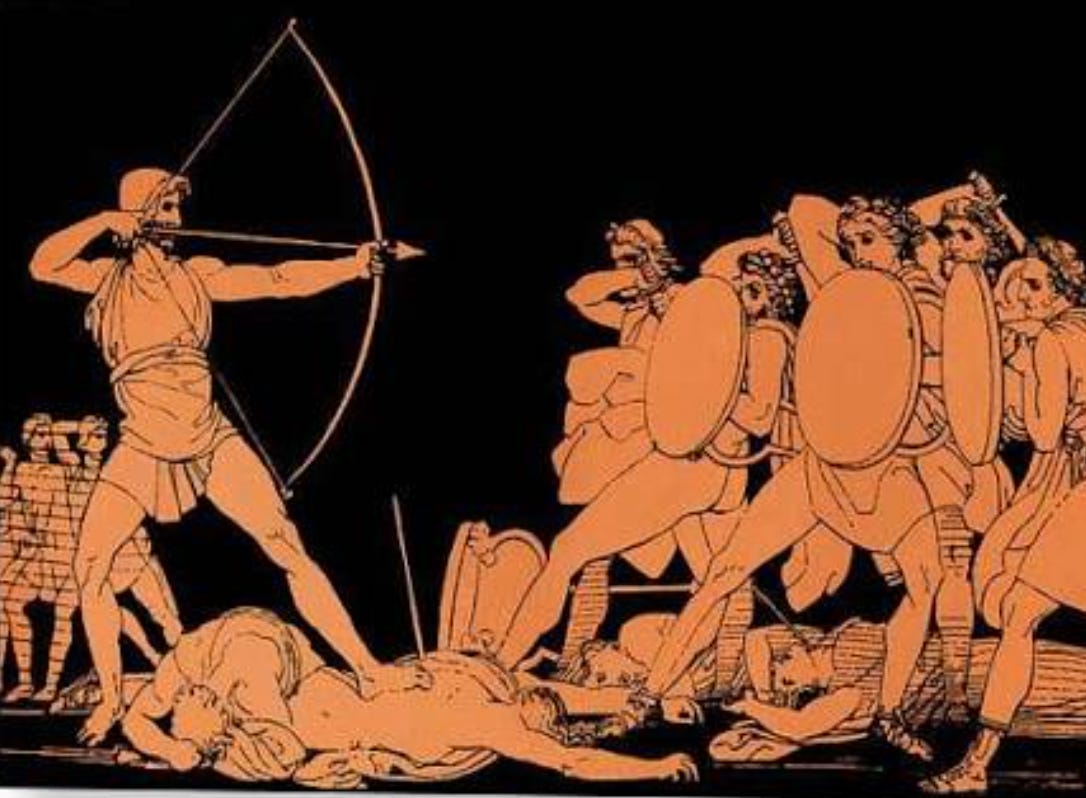
We haven’t had any Odyssey gab in awhile, so here’s Ross Douthat in the New York Times with the best summing up I’ve read:
It Is Banal, Bland, Thin and Didactic. We Can’t Stop Talking About It.
Aug. 1, 2026
By Ross Douthat
Opinion Columnist
Christopher Nolan’s “The Odyssey” is the blockbuster that launched a million takes. The interpretations crowd my social media feed like Agamemnon’s assembled ships at Aulis. They keen in my ears like the Sirens’ seductive voices. They … OK, look, I’m just saying people have a lot of opinions about the biggest movie of the year.
And for good reason, because Nolan’s film is perfectly calibrated for the contemporary culture war. First, because its source material is a story that everybody wants to claim: woke and anti-woke, masculinists and feminists, film bros and classicists, professional defenders of Western civilization and its would-be revisers and subverters. Other classics are similarly claimed and counterclaimed, but not everyone wants ownership of “The Iliad” (too male), Jane Austen (too female), the Greek tragedies (too depressing), the New Testament (too Christian) or the plays of Shakespeare (too hard to follow the dialogue). But in life as in Homer’s epic, everyone wants a piece of Odysseus.
Then, having plucked the ripest fruit, Nolan proceeded to serve it in the blandest form. Gone are the sex and sensuality, the warring deities, the hero’s outsize ego and charisma. In their place is a story that’s very American, with tropes familiar from war movies and westerns, dialogue that belongs in a contemporary Y.A. novel and a moralism that’s at once extremely didactic and extremely general. “Civilization collapses when you violate Zeus’ law” is the teaching of Nolan’s story, and while you could imagine that Zeus’ law is some arcane instruction requiring the castration of a black bullock on the highest peak on the darkest night, it turns out to just be the golden rule applied to houseguests, dogs and Trojans.
This is a critique, but it’s also a key to the film’s cultural cachet. If you just want to like “The Odyssey,” if you just want to have a good time at the movie, the bland version still has all the good stuff — the Trojan horse! the Cyclops! a bloody homecoming! — stitched together by a director with a gift for propulsion and spectacle. If you have a great enough story, you can reduce the spice level and still satisfy millions of customers with the meal.
Then if you want to claim “The Odyssey” for your own worldview, to insist that the dominant movie of the summer is speaking directly to your concerns, the banal didacticism of Nolan’s script is unusually amenable to personalized interpretations. …
Finally, if you want to critique and hate the movie (and under algorithmically driven conditions, haters are hype artists, too), the same rule applies: The banality can be interpreted for maximal dislike. Part of the fun of the “Odyssey” wars is seeing that happen in all kinds of different ways, with an original anti-woke critique of the movie, fixated on colorblind casting, giving way to left-tilting academic takedowns and then bespoke right-wing critiques riding in their wake. (Four thousand-plus words from the best-selling translator Emily Wilson in The London Review of Books on a movie she dismisses as “an entertaining way to hide from the high temperatures for a few hours,” then the pseudonymous online reactionary Bronze Age Pervert responding with 6,000-odd words on a movie he calls “undeserving of a serious intellectual, ideological or aesthetic review.”)
And here I am doing much the same thing, accusing Nolan of banality and then devoting all my column inches to his cultural achievement. So let’s give the man his due: He grasped that what this moment demanded was an adaptation of one of Western civilization’s foundational texts, reworked around the widely shared assumption that Western civilization might be finished or foredoomed, in a style that allowed everyone, fans and haters alike, to blame whatever crime or curse or group of malefactors (including Hollywood directors!) they held responsible for the doom already.
His reward will be a billion dollars in box office, a blank check for next time and the absolute power to determine what we’ll all be arguing about in the summer of 2029.
By the way, Ross is leaving off writing his column at the New York Times to become a TV correspondent on CBS’s Sixty Minutes. These days, you make a lot more money as a face than a name, and Ross has five kids, so I wish him well.
Meanwhile, Ezra Klein opines in the New York Times:
Nolan has smuggled the core of Judeo-Christian ethics into “The Odyssey.” Zeus’ law, in Nolan’s “Odyssey,” echoes Leviticus 19:34: “The foreigner residing among you must be treated as your native born. Love them as yourself, for you were foreigners in Egypt.” …
But the problem with adherents of the modern right is not just that they don’t live up to it; the issue is that they detest it. To treat the foreigner residing among us as well as we treat our native born is derided as suicidal empathy. The Trump administration glorifies cruelty toward the immigrant, the stranger, the weak and the poor.
I wrote about the ancient world’s theories of hospitality in VDARE:
The Open Borders Crowd at the WSJ Gets Religion
By Steve Sailer on August 14, 2005 at 1:00am
The Wall Street Journal’s Editorial Page has long been notorious for making a religion of Open Borders. Now it has tried to enlist religion on the side of its obsession. On Aug. 12th, the WSJ ran an essay by the deputy editor of its “Taste” page, Naomi Schaefer Riley, called “Welcoming the Stranger: Faith-based groups say it’s time to reform immigration.” (In WSJ-speak, “reform” means “more of the hair of the dog that bit us.”)
Ms. Schaefer Riley writes:
Jihad Turk, the director of religious affairs at the Islamic Center of Southern California, believes that Muslims, “as people of conscience and faith, have to protect those in need of protection.” And his religious community is practicing what it preaches, most recently helping several families of Bosnian refugees to resettle here.
Isn’t it wonderful that Mr. Jihad Turk is importing more people like himself into America? In fact, I think the U.S. should try extra hard to attract from the Muslim world more gentlemen just like Mr. Turk, men whose parents chose as their monikers, out of all the possible first names in the world, “Jihad.”
“’Family reunification should be the cornerstone of immigration policy,’ says Mark Franken, executive director of migration and refugee services for the U.S. Conference of Catholic Bishops.”
Uh, if family unity was so important to these immigrants, why did they abandon their families and move to America in the first place? And couldn’t they now reunify their families by going home? If living near relatives is so important, perhaps family reunification should be the cornerstone of deportation policy.
“’Atithi devo bhava: Look upon the guest as God.’ That’s the Hindu principle that should guide our policies toward immigrants in this country, says Suhag Shukla, legal counsel for the Hindu American Foundation.”
Maybe I’m just crazy, but for some reason I think American principles should guide our policies toward immigrants in America.
Yet, perhaps we could learn from Hindu-dominated India about a sensible immigration policy. As Peter Brimelow discovered, if you inquire about immigrating to India, the first thing you’ll hear from the Indian consular official is, “Are you of Indian origin?” [VDARE.COM NOTE: This means “Do you have Indian blood?’—not “Where were you born?”]
Further, India, under both the Hindu nationalist BJP and the currently ruling Congress Party, has been building a fence along its 2,485 mile border with Bangladesh to keep out illegal immigrants. India Daily reported:
“India has categorically made it clear that it will not tolerate illegal immigration into India and covert militant bases in Bangladesh that try to export terrorism into India.”
Nonetheless, if we are going to adopt Hinduism as our guide, we should show it the dignity of not tendentiously distorting its meaning for political benefit the way this Wall Street Journal employee does. An immigrant is not a guest because …
Paywall here.
