

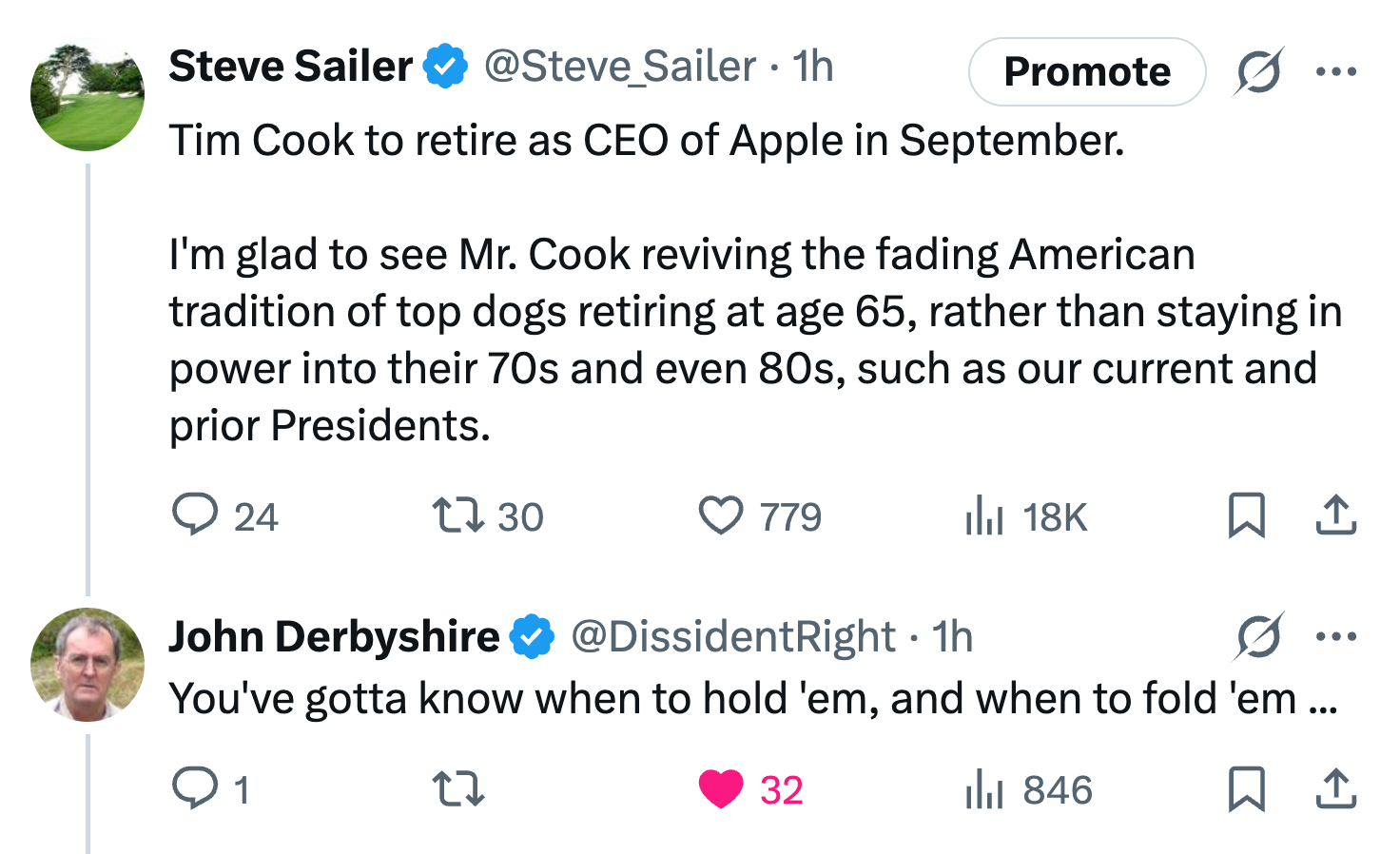
That line of course is from Kenny Rogers’ hit song “The Gambler,” with lyrics and music by Don Schlitz, who died at 73 this month after composing 20 number one country hits.
Anyway, that got me thinking again about a question: What was last-written poem without music to become well-known in the English-speaking world?
Is poetry more alive in other languages than in English? (English-language popular music has been world-conquering over the last 100 years.)
More broadly, have songs (and quasi-songs like raps) completely overwhelmed the popularity of poems without musical accompaniment?
But how much has the quality of lyric-writing declined due to the needs of music?
There seemed to be a general trend in the rock era away from professional specialists in lyric writing like composer Richard Rodgers’ partners Lorenz Hart and Oscar Hammerstein II. The Grateful Dead and Elton John used lyric specialists who didn’t perform, but they were increasingly rare exceptions. Gerry Himes wrote in Paste in 2014:
[Gerry] Goffin [Carole King’s ex-husband and lyricist] died on June 19 at age 75. Coming on the heels of Hal David’s death in 2012 and Jerry Leiber’s in 2011, Goffin’s passing highlights the near extinction of a once-common role in pop music: the non-performing lyricist. Through the late ‘60s, lyricists such as Goffin, David, Leiber, Cynthia Weil, Eddie Holland, David Porter, Willie Dixon, Doc Pomus and Tony Asher willingly handed over their words for someone else to sing. They knew what they were good at—and what they weren’t. And American music was better for it.
Today, almost all lyrics are written by the lead singer of the original recording.
This is less true in Nashville, where specialized professionalism is still honored as well as Dylanesque authenticity.
A question that comes to mind is: Would “The Gambler,” clearly one of the better-crafted lyrics of the post-Beatles age, have been a hit poem in 1900 if it had never been a song?
On a warm summer’s evening
On a train bound for nowhere,
I met up with a gambler.
We were both too tired to sleep.
So, we took turns a-staring
Out the window at the darkness,
‘Til boredom overtook us
And he began to speak:He said, “Son, I’ve made a life
Out of reading people’s faces
And knowing what their cards were
By the way they held their eyes.
So, if you don’t mind my saying
I can see you’re out of aces.
For a taste of your whiskey
I’ll give you some advice.”So, I handed him my bottle
And he drank down my last swallow.
Then he bummed a cigarette
And asked me for a light.
And the night got deathly quiet
And his face lost all expression,
Said, “If you’re gonna play the game, boy
You gotta learn to play it rightYou got to know when to hold ‘em,
Know when to fold ‘em,
Know when to walk away,
And know when to run.
You never count your money
When you’re sitting at the table.
There’ll be time enough for counting
When the dealing’s done.Every gambler knows
That the secret to surviving
Is knowing what to throw away
And knowing what to keep.
‘Cause every hand’s a winner
And every hand’s a loser,
And the best that you can hope for
Is to die in your sleep.”And when he finished speaking,
He turned back toward the window,
Crushed out his cigarette,
And faded off to sleep.And somewhere in the darkness,
The gambler he broke even.
But in his final words
I found an ace that I could keep:You got to know when to hold ‘em,
Know when to fold ‘em,
Know when to walk away,
And know when to run.
You never count your money
When you’re sitting at the table.
There’ll be time enough for counting
When the dealing’s done
For contrast, here’s an advice poem written in c. 1895 that was published in 1910: Rudyard Kipling’s “If,” composed in tribute to Leander Jameson, leader of the Jameson Raid in South Africa. In a BBC poll in 1996, it was the runaway winner for Britain’s favorite poem:
If you can keep your head when all about you
Are losing theirs and blaming it on you;
If you can trust yourself when all men doubt you,
But make allowance for their doubting too:
If you can wait and not be tired by waiting,
Or being lied about, don’t deal in lies,
Or being hated don’t give way to hating,
And yet don’t look too good, nor talk too wise;
If you can dream—and not make dreams your master;
If you can think—and not make thoughts your aim,
If you can meet with Triumph and Disaster
And treat those two impostors just the same:
If you can bear to hear the truth you’ve spoken
Twisted by knaves to make a trap for fools,
Or watch the things you gave your life to, broken,
And stoop and build ‘em up with worn-out tools;
If you can make one heap of all your winnings
And risk it on one turn of pitch-and-toss,
And lose, and start again at your beginnings
And never breathe a word about your loss:
If you can force your heart and nerve and sinew
To serve your turn long after they are gone,
And so hold on when there is nothing in you
Except the Will which says to them: ‘Hold on!’
If you can talk with crowds and keep your virtue,
Or walk with Kings—nor lose the common touch,
If neither foes nor loving friends can hurt you,
If all men count with you, but none too much:
If you can fill the unforgiving minute
With sixty seconds’ worth of distance run,
Yours is the Earth and everything that’s in it,
And—which is more—you’ll be a Man, my son!
Kipling’s advice sounds even harder to implement than “The Gambler’s” advice.
What do you think? How much better is “If” than “The Gambler” purely as a poem for reading and speaking aloud?
Not surprisingly, Kipling’s “If” has been set to music several times. But I’m not aware of a famous musical adaptation.
In general, there have been very few new musical adaptations of old verses that have become famous during the rock era. (T.S. Eliot’s light verse Old Possum’s Book of Practical Cats provided the lyrics that Andrew Lloyd Webber set to music in 1981’s huge hit musical Cats, but that’s from an older musical tradition.)
The Byrds’ “Turn! Turn! Turn!” from the Book of Ecclesiastes is perhaps the best known exception. Also, “Golden Slumbers” from Abbey Road was composed by Paul McCartney from old lyrics. Sitting down at his sister’s piano, he found the sheet music for an old song entitled “Golden Slumbers.” Paul couldn’t read music, but, being 20-something Paul McCartney, he simply invented on the spot a now famous new melody to fit the old words.
There are a number of deep cuts like Iron Maiden’s “Rime of the Ancient Mariner” that combine old words with new music. But my guess is that dozens of teen metal bands have started to try to set Shelley’s “Ozymandias” to music, only to realize there’s no verse-chorus-verse-chorus-bridge-chorus structure to work with.
So, back to my earlier question: What is the last plain poem (no music) to get really famous?
Paywall here.
