

Everybody has been talking lately about how major league baseball, long considered in terminal decline, is suddenly more exciting than the NBA.
Last night, on schedule, rightfielder Joe Adell turned in one of baseball’s all-time greatest defensive games in his Los Angeles Angels’ 1-0 victory over the Seattle Mariners in which Adell leapt and snagged over the outfield fence three long would-be homers, any one of which would have sent the game to extra innings. The third catch was particularly crazy.
Note that Adell, a massive North Carolinian who last year batted .236-37-98, is far from the most nimble big league outfielder.
But even a below-MLB-average defender like Adell is awfully good objectively.
Was this the first three Home Run Robbery game in big league history?
Quite possibly.
But keep in mind that the term “Home Run Robbery” was coined only fairly recently in this century and there’s no official count. Sports Info Solutions reported in 2024 that Mike Trout had the most Home Run Robberies since they started in 2004 with 14 for his career.
On the other hand, I wouldn’t be surprised that there are now a lot more Home Run Robberies since that the term exists and somebody keeps track of it.
For example, when I was a little kid in the 1960s, I didn’t hear about outfielders reaching over the fence to take away homers. For instance, here is perhaps the most famous outfield catch of the 1940s, Al Gionfriddo of the Brooklyn Dodgers tracking down a long blast by Joe DiMaggio of the New York Yankees in the 1947 World Series a couple of strides before the low fence:
I mean … DiMaggio’s blast might have bounced off the pipe on top of the waist-high fence for a homer … But for athleticism it’s not exactly Gary Matthews Jr.’s 2006 Home Run Robbery:
Similarly, here’s perhaps the second most famous outfield play of the 1950s after Willie Mays’ Catch in the 1954 World Series about 15 feet in front of the fence:
Here’s Sandy Amoros running a mile to flag down a Yogi Berra slice in the 7th game of the 1955 World Series:
That was a terrific play, but Amoros wasn’t close to either the outfield or foul territory fences.
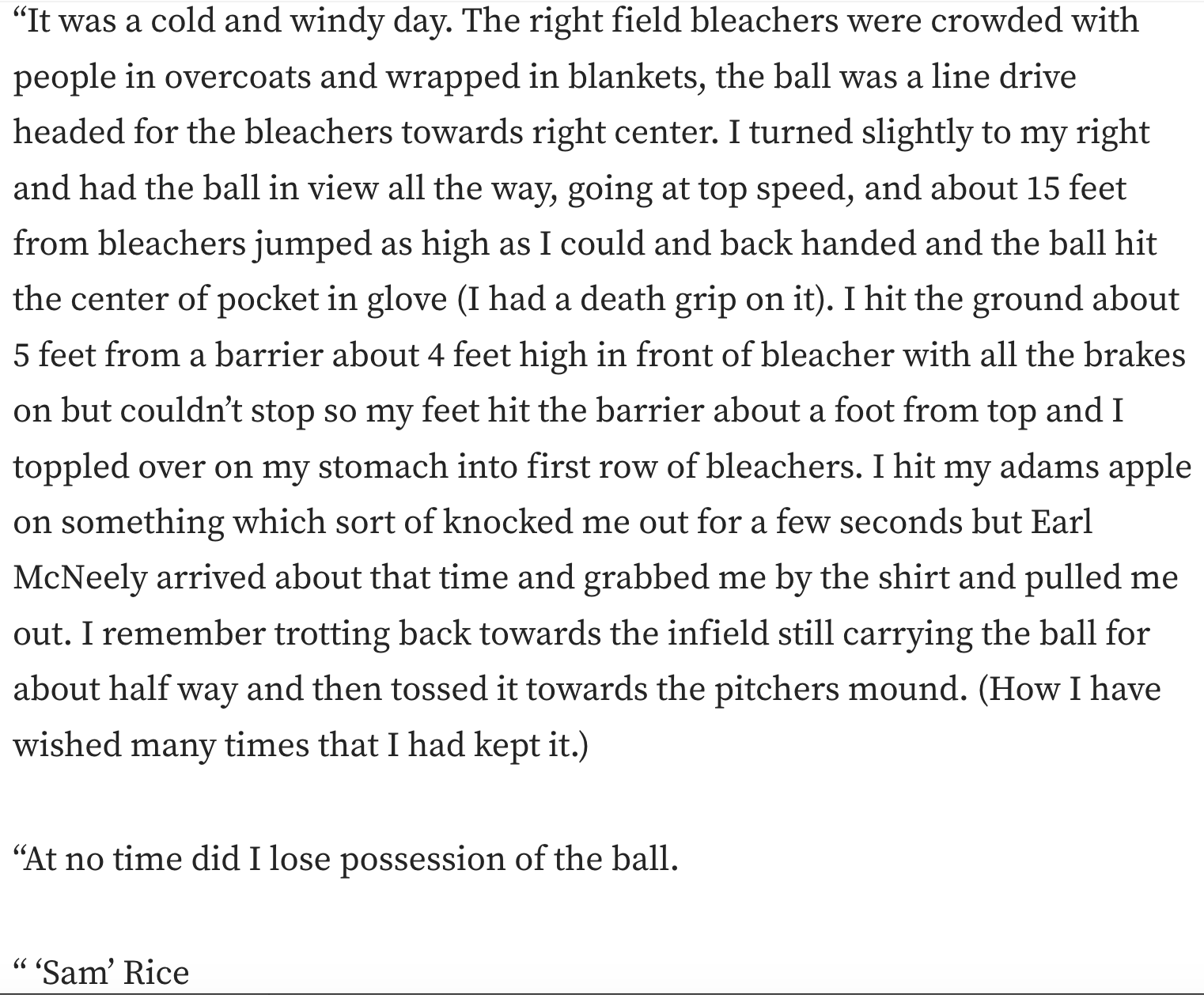
Likewise, one of the most controversial outfield plays of the 1920s didn’t happen over the fence but well short of it. Sam Rice sent the Hall of Fame a letter to be revealed posthumously in which he attested that in the 1925 World Series, he had caught the ball a few feet short of the fence:
When did Home Run Robberies begin?
Nobody much seems to know.
The 4th game of the 1966 World Series featured two: one by Willie Davis of the Los Angeles Dodgers
and one by Paul Blair of the Baltimore Orioles:
Home Run Robberies seem to me to be an African-American innovation.
I’m always fascinated by the weak version of the Sapir-Whorf theory that George Orwell argued for in “Newspeak” appendix to 1984: that if we lack a word for something, it’s harder to think about it. Thus, The Party is getting rid of vocabulary:
Take for example the well-known passage from the Declaration of Independence:
We hold these truths to be self-evident, that all men are created equal, that they are endowed by their creator with certain inalienable rights, that among these are life, liberty, and the pursuit of happiness. That to secure these rights, Governments are instituted among men, deriving their powers from the consent of the governed. That whenever any form of Government becomes destructive of those ends, it is the right of the People to alter or abolish it, and to institute new Government. . .
It would have been quite impossible to render this into Newspeak while keeping to the sense of the original. The nearest one could come to doing so would be to swallow the whole passage up in the single word crimethink.
Fortunately, our vocabularies tend to expand rather than shrink over time.
For example, the basketball term “dunk” …
Paywall here.
