

From the Wall Street Journal op-ed page:
An Award for Scholars Who Tell the Truth
The Carob Trust Prize for Academic Courage will honor social scientists who face unjustified attacks.
By Roland Fryer and Bill Ackman
Mr. Fryer, a Journal contributor, is a professor of economics at Harvard, a founder of Equal Opportunity Ventures and a senior fellow at the Manhattan Institute. Mr. Ackman is CEO of Pershing Square Capital Management.
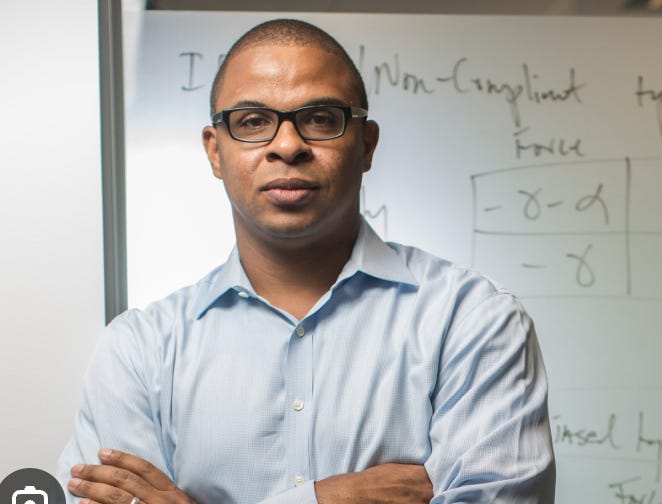
Dr. Fryer was for awhile the highest paid professor at Harvard College (some of Harvard’s professional schools have higher pay) because he’d bring in lots of funding for research projects from hard-headed rich guys like Mayor Michael Bloomberg. But a lot of people at Harvard found him a loose cannon who’d report findings that didn’t agree with Black Lives Matter orthodoxy. He got Me-Tooed and suspended without pay for two years by Claudine Gay.
Sept. 7, 2026 4:22 pm ET
One of us (Mr. Fryer) released a study in 2016—later published in the Journal of Political Economy—finding that police aren’t more likely to shoot black Americans than white Americans, after accounting for the relevant context.
My impression is that planned-ahead suicide-by-cop is more of a white thing than a black thing, so whites get shot by cops disproportionately more often than whites shoot cops or civilians.
Colleagues who read the draft warned him not to publish: “You’ll ruin your career.” The paper was denounced on social media within minutes of release, and Mr. Fryer needed armed protection for more than a month. Privately, scholars who read the study called it rigorous, honest work. Publicly, many of the same scholars said nothing. No single study settles a question this large—but silence isn’t how science advances.
That silence is the problem—a cultural and an economic one. When the professional cost of publishing an unwelcome finding exceeds the cost of suppressing it, rational scholars suppress it. The result is that social-science literature reflects what researchers are permitted to say rather than what they actually discover. The scope of the problem is difficult to measure, because its most important effects are invisible—though the data we have suggest it is getting worse. In a 2024 survey of more than 6,000 professors by the Foundation for Individual Rights and Expression, 35% said they had toned down their written work for fear of controversy—roughly four times the share of social scientists who admitted the same at the height of McCarthyism.
Over the past decade, Mr. Fryer has met with hundreds of undergraduate and graduate students—careful, talented, serious scholars—who came not to discuss what they had found but to ask whether they were allowed to say it. “Can I publish this?” has become a common question. So has “Can I say this in public?”
These students had results. They had run the regressions, conducted the robustness checks, and done the work. What they lacked was confidence that those results would be received as anything other than a provocation, with their motives impugned. Some buried the findings. Some chose different dissertation topics entirely. We can’t calculate the discoveries that never happened. The papers that were never written. The policies that were never corrected because someone decided the cost of honesty was too high. Deciding which answers are acceptable before the investigation begins isn’t solidarity. It is sentimentality. And sentimentality has never closed an achievement gap, reduced an infant mortality rate, or lifted anyone out of poverty.
Mr. Fryer raised the alarm about suppression of inconvenient findings in a November 2024 Wall Street Journal essay. He called for something like a MacArthur Fellowship or an X Prize for academic truth-telling. The prize should be large enough to matter, prestigious enough to serve as a public credential for scholars who were right when it was costly to be right. Shortly after that piece ran, we found each other and decided to launch the Carob Trust Prize for Academic Courage.
The prize awards $1 million each to as many as five social scientists a year who have demonstrated intellectual independence, published findings that were attacked rather than answered, and been validated by the evidence—despite the professional cost. The selection criteria are designed to distinguish courage from contrarianism: Nominees must show a sustained commitment to following logic and evidence regardless of pressure, a willingness to ask questions others avoid, and work that has shifted academic debate, public discourse or policy—often despite being misread, mischaracterized or vilified at the time of publication.
The inaugural prize is limited to the social sciences; in future years we hope to broaden it to additional disciplines and to add a category for institutional leadership. Nominations are open through Nov. 1, and the first winners will be announced in early 2027.
… The scholars we want to honor include the researcher who finds that systemic racism is the primary driver of a given disparity and is dismissed by colleagues who don’t want to hear it. They include the health economist whose data on genetics and disease are weaponized by people she never meant to arm. They include anyone whose careful social-science work, wherever it leads, has been met with organized suppression rather than organized rebuttal. The test isn’t the conclusion. The test is the quality of the work, the hostility of the reception, and the verdict of the evidence over time.
We have tried to make this structurally resistant to capture from either direction. The selection committee spans the ideological spectrum. Members include the Harvard economist and Nobel laureate Eric Maskin, the Johns Hopkins sociologist Stefanie DeLuca and the Brown University economist Glenn Loury. Many of them have paid a professional price of their own for following evidence to uncomfortable places. They don’t share politics. They share an epistemology: that a finding isn’t made wrong by being unwelcome and isn’t made right by being convenient. Mr. Fryer chairs the committee; no one on it is eligible for the prize, and Mr. Ackman, who funds it, has no vote on winners. A prize that requires consensus among people who disagree about nearly everything is harder to pull toward any one agenda than a prize administered by allies. We view this as a feature, not a complication.
… But we deeply agree on the most important principle: You can’t help people you don’t understand. Bad data have victims, and they are rarely the professors. They are the families who can’t buy their way out of a failing school or an unsafe street. The scientific method isn’t a political position. Treating it as one is how America loses.
We are under no illusion that a prize can change culture overnight. What it can do is change the career calculus at the margin—for the graduate student wondering whether a question is too risky, the junior professor deciding whether to submit a finding that will generate angry emails, the senior scholar who has quietly stopped asking the questions he once did. We aren’t telling them to be brave. We are trying to make doing their jobs less expensive.
Here are the selection criteria:
The Prize is bestowed by an independent committee of leading scholars according to the following criteria:
Intellectual Independence: A proven commitment to following logic and evidence wherever they lead, regardless of academic or political pressure.
Non-Conformist Ideas: Originality and boldness of research agenda. Willingness to ask questions that others avoid—whether uncomfortable, underfunded, or unfashionable.
Impact and Vindication: Work of excellent quality that has shifted academic debate, public discourse, or policy. Evidence that ideas criticized at the time have proven—through data, replication, or influence—to possess enduring value.
Process:
The Carob Trust Prize for Academic Courage will take a nominee’s life’s work into account. Scholars who are earlier in their careers might be considered for a smaller prize.
Nominations for the Prize can be submitted through the Nomination Portal, linked above. Nominators will be asked for short statements on candidates’ fitness as outlined by the selection criteria. Nominators may submit multiple candidates for consideration. Candidates may not nominate themselves.
The scope of the academic work considered for the inaugural 2027 Prize will be limited to the social sciences. The Committee will seek external experts as needed to properly evaluate submissions.
Only living nominees will be considered. Candidates must be citizens or legal residents of the United States.
You can nominate somebody here.
Nominations close November 1, 2026.
Who deserves a prize?
Off the top of my head, I’d say that sexologist Ray Blanchard deserves a prize for making a major discovery of what’s behind much of transgenderism — autogynephilia — for which he has been subjected to decades of abuse by autogynephiliacs trying to keep the public ignorant of the truth.
(Ray is American-born but has been at the U. of Toronto for a long time, so I don’t know if he qualifies. I’d argue that courage in social scientists is rare enough these days that the clause restricting the winners to American citizens or legal residents might be overly restrictive.)
Who would you nominate? List your suggestions in my comments.

If you feel strongly about your candidate, go ahead and nominate him or her to the Carob Trust.
Nathan Cofnas for obvious reasons. He's facing some serious prejudice (career threats, death threats, you name it) for telling the truth. And he's not hiding, he continues to speak. He's courageous.
The willingness of so many of the elite blacks to ruin the lives of average blacks is unbelievable. Claudine Gay who went to Phillips Exeter and then Harvard and Stanford plagiarized the work of Carrol Swain who a black woman from a poor family and so was less adept at playing the status gains. She torpedoed Fryer, whose research was actually working to improve the relation between cops and blacks, while jumping on the George Floyd bandwagon that led to so much chaos and death
Michael Bailey from Northwestern would also deserve the prize (maybe jointly). Deirdre McCloskey's crusade against him was horrible and saddened me since I always respected h er work.