

The pro football regular season starts on Wednesday. I’ll try not to get as sports-obsessed as I did from last year’s World Series through this year’s World Cup.
A year ago, Nate Silver, whom I find to be an admirable statistical analyst, unveiled his new pro football career ranking system for quarterbacks, QBERT, that goes back to 1950. They’re trying to throw everything they can think of into the ratings, including rushing/scrambling and a weather adjustment (it’s easier to complete passes indoors or in San Diego than outdoors in Foxboro, MA).
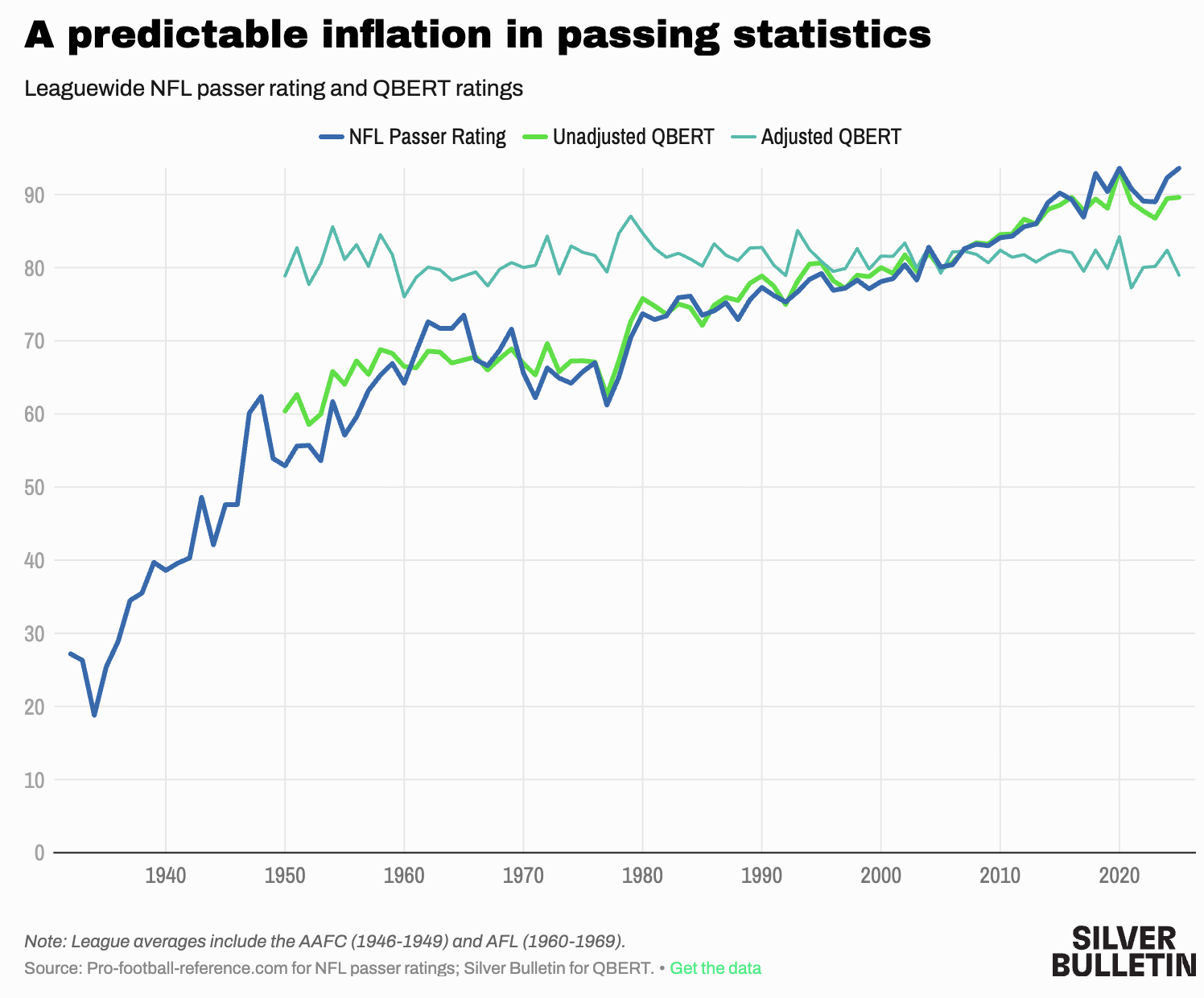
From 1980 to 2020, enhancement was particularly predictable, with a sort of steady Moore’s Law of about 0.55% improvement per year in QB play. (Some of that is due to rule changes better protecting quarterbacks and receivers from injuries.)
Adjusted QBERT takes this bettering into account, so that you can see that your grandpa wasn’t lying to you about Johnny Unitas being a great quarterback (for his era). Same with your dad raving about Fran Tarkenton, even though their raw stats were ho-hum by current standards. Here’s Silver’s data through 2024:
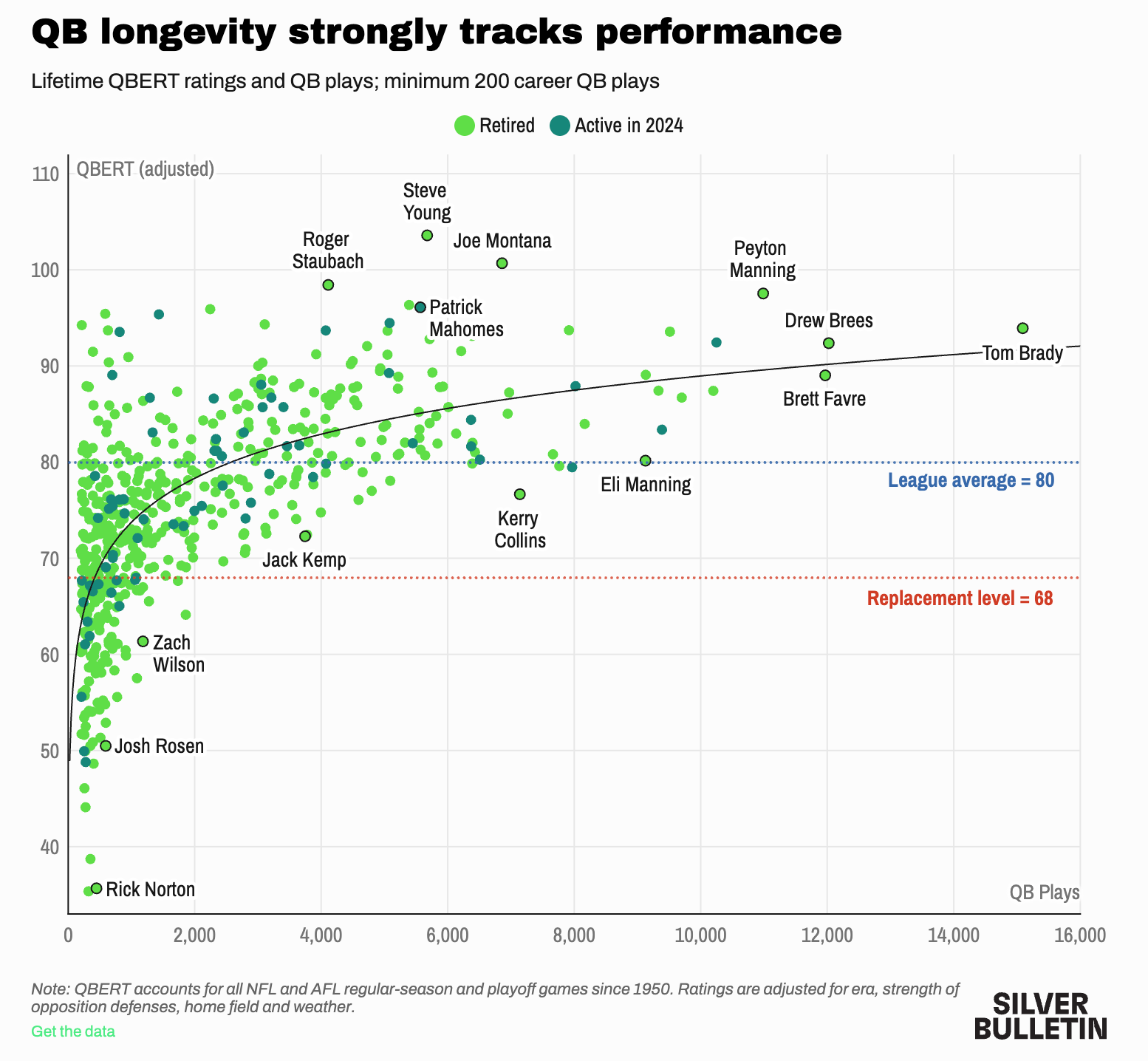
The highest average performance career per play, adjusted for era, belongs to 1990s San Francisco 49er Steve Young. The BYU star (a direct descendant of Brigham Young and one of his couple of dozen wives), was superb both at throwing and running. He had a fairly short career, playing first for the upstart/doomed United States Football League for two seasons, then two for a bad Tampa Bay Bucs NFL team, then four as the back-up for all-timer Joe Montana. And his last game was at age 37 due to recurrent concussions. So most of his stats comes from his early 30s prime. (And note that Young’s replacement, the then-obscure Jeff Garcia, went on to put up some big numbers of his own. This suggests that the system that Bill Walsh built with the 49ers might have been the biggest advance in the offensive state of the art since Paul Brown’s with Otto Graham in the late 1940s.)
Number 2 per play is Montana, and Number 3 is Roger Staubach, who seems kind of forgotten these days despite being obviously the best QB of the 1970s. Like Young, his stats are concentrated in his early 30s prime, after serving four years in the Navy (including, at his insistence, in Vietnam) and then sitting on the bench with the Dallas Cowboys behind Craig Morton.
Number 4 is Peyton Manning, while Tom Brady is Number 10.
In contrast, guys who got to play a lot of QB relative to their production without ever being all that great include Eli Manning, Joe Flacco, Drew Bledsoe, Kerry Collins, 1996 GOP Vice Presidential nominee Jack Kemp, Kerry Collins, Blaine Gabbert, Zach Wilson, and Josh Rosen.
I watched Rosen at UCLA. He had a lot of technique and a lot of heart, but he was built like a skinny tennis player, just as his wealthy parents had wanted him to be. His rival at USC, Sam Darnold, had a terrible throwing motion, but was a hugely wide guy who looked like he might be able to survive NFL poundings. (Darnold won last season’s Super Bowl, while Rosen went to Wharton for an MBA.)
Here are the 20 best careers by average play:
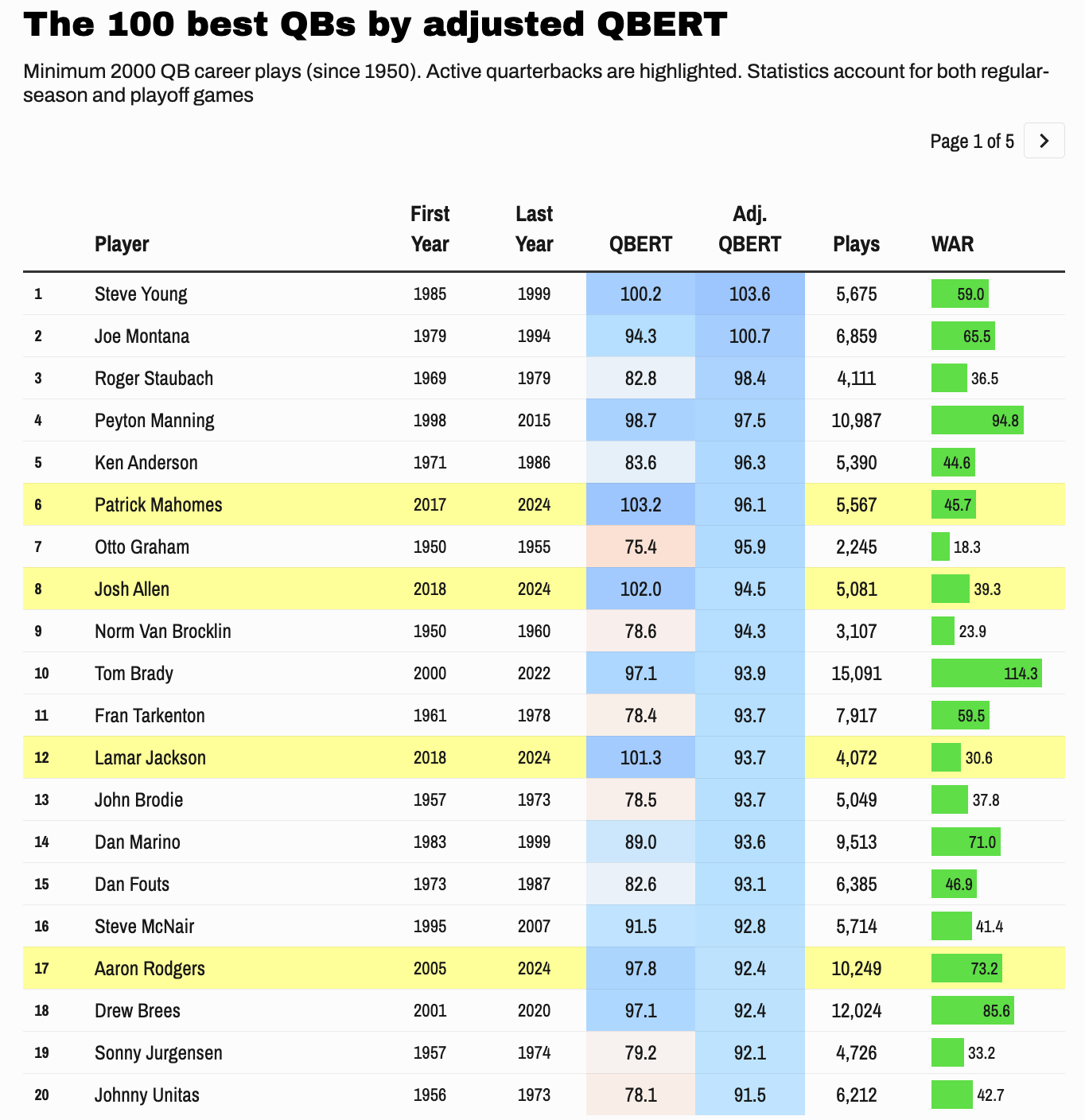
On the other hand, Tom Brady played at a very high level up through age 45.
For total career Wins Above Replacement, …
Paywall here.
