

A Jewish archaeologist came up with the notion of a torch relay for the 1936 Olympic Games in Nazi Berlin.
The first famous athlete to light the torch was the Flying Finn, Paavo Nurmi, at the 1952 Helsinki Games.
Since then, torchlighters have tended to be either celebrities (e.g., the decrepit Muhammad Ali, once the most famous man in the world, stepped out of the shadows in Atlanta in 1996 to rapturous applause) or somebody doing something that somebody had decided would be cool (most famously, the Paralympian archer lighting the torch in Barcelona in 1992 with a flaming arrow).
Presumably, the Los Angeles organizers, currently under the direction of super-agent Casey Wasserman (assuming he’s not fired for Epstein-proximity), will go the celebrity route as befitting L.A.
Of course, who knows what could happen? Trump might invade Denmark the week before and nobody shows up.
But, keep in mind that the 1984 Summer Olympics were widely expected to be a disaster and a giant rebuke to Cold Warrior Ronald Reagan. But instead the Los Angeles Opening Ceremony turned out to be huge hit. Everybody woke up the next morning realizing that, indeed, it was morning in America, so Reagan would be re-elected easily. And, more hazily, the world started to get the sense that capitalism would win the Cold War and that the baleful Soviet Union wasn’t an eternal necessity. It was one of the most remarkable vibe shifts I can recall in my lifetime.
The ultimate 1984 torchbearer was the highly respectable local hero Rafer Johnson, the 1960 decathlon gold medalist who had edged out his UCLA teammate C.K. Yang of Taiwan. Rafer had then hung around L.A., doing some acting and lots of good works. In June 1968, Rafer wrenched the smoking gun from the hand of RFK Sr.’s assassin.
Johnson wasn’t as scintillating a choice as Ali a dozen years later, but he checked off four big boxes: African-American, Olympic hero, Southern Californian, and of fine character.
So, I’ve posted a table below the fold of potential candidates:
On a zero to three scale, celebrities get points for
Global fame
Popularity besides fame (e.g., skateboarder Tony Hawk isn’t hugely famous, but everybody who has heard of him likes him a lot)
Olympic accomplishments (e.g., Michael Phelps gets 3 points for winning all those gold medals in swimming across 5 Olympics)
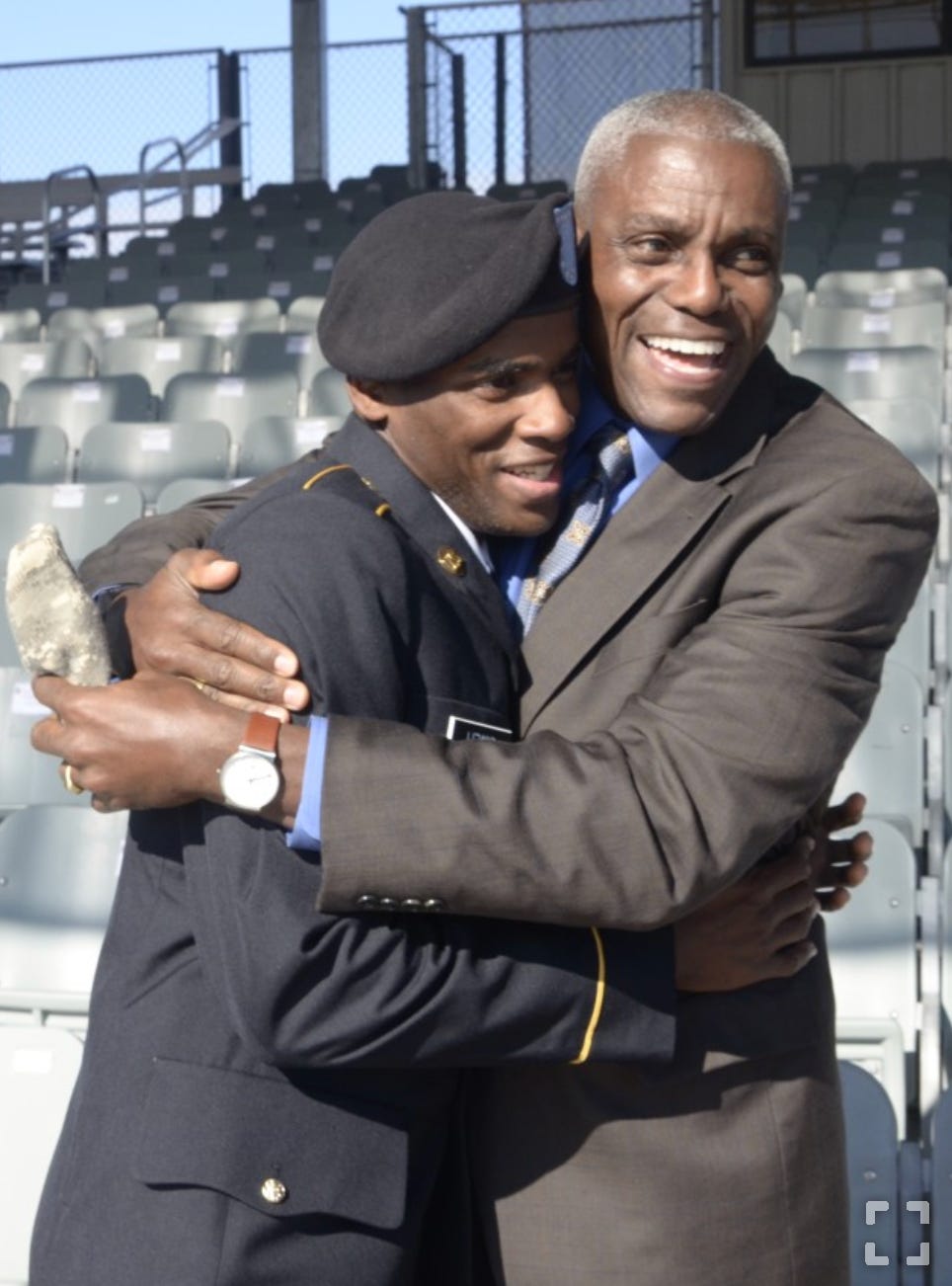
1984 Olympic accomplishments (e.g., Carl Lewis matched Jesse Owens’ four big track & field medals in Los Angeles. Here’s a nice picture of Carl congratulating his son Bakim Lewis upon graduating from US Army basic combat training in 2015:

Being associated with Los Angeles gets you up to 3 points (e.g., Tom Cruise)
Being a woman gets you 2 points
Surviving HIV is worth 1 point
Being gay is worth one point
Being black is two points
Jewish gets one point
Other identity categories like Hispanic, Asian, Pacific Islander or trans: one point
Under age 50 is one point (Rafer Johnson was a month shy of 50 when he chugged up all those steps at the peristyle end of the Coliseum)
All but one name on the list is American, so they each get one point.
Being busy with Olympic or other sports can lose you a point.
Scandals cost you points (e.g., everybody would worry that Southern California-born Tiger Woods would be late and then rush to get to the Coliseum and cause a nine-car pile-up on the 10 Freeway). But getting yourself infected with HIV is not a scandal.
So, under the paywall, here’s the table:
Paywall here.
