

Just a few weeks ago, the conventional wisdom was that this World Cup was going to be a disaster as the world would rise up and righteously boycott Trump’s America.
Well … that didn’t happen.
Instead, the stadiums are brimful of fans paying absurd prices for tickets. For example, here’s a shot of the throngs of happy Ecuador supporters in yellow at MetLife stadium (capacity 82,500) in suburban New Jersey:
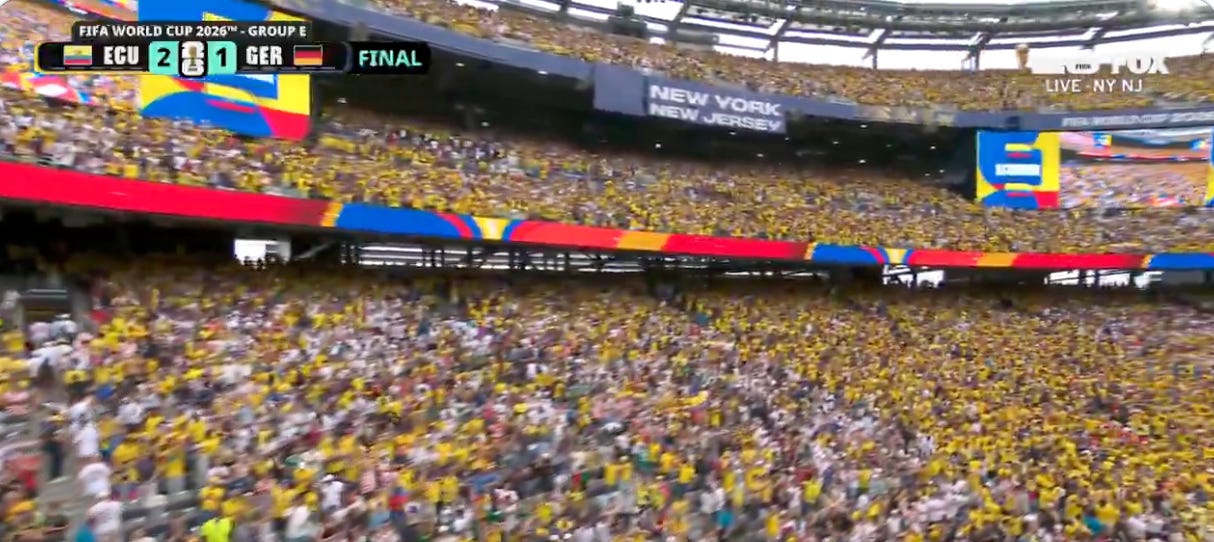
I’m a little vague on who exactly is going to matches such as Ecuador’s 2-1 victory over Germany. Are these affluent Ecuadorians flying in from the Andean highlands? Ecuadorian immigrants tripping from Spain? Or Ecuadorian immigrants living in the United States? (All I know for sure is that the fans in the stands don’t look much at all like the Ecuadorian players on the field, who tend to be blacks from one low altitude coastal province near the Colombian border.)
One interesting aspect of this World Cup have been all the foreigners raving about the American football stadiums hosting the soccer matches. Granted, in these days of The Algorithm, it’s hard to tell whether you are getting a representative sample of opinion. But it appears that Europeans really are wowed by the NFL stadiums where the World Cup is being played.
For example, here are BBC reporters praising various stadiums, and the article doesn’t even include Los Angeles’ spectacular $5.5 billion SoFi stadium.
There are 30 NFL stadiums, ranging from only 60,100 seats at the new Buffalo Bills stadium that will open this year, to 82,500 at the suburban New Jersey stadium shared by the New York Giants and the New York Jets. (MetLife will host the World Cup final on July 19.) The NFL’s median capacity is around 69,000.
24 of the 30 have opened since 1995 — e.g., the NFL is really prosperous.
Three more are under construction in Nashville, Cleveland, and Washington DC, all with translucent roofs. These three will be in the 60,000s in seats — i.e., the NFL finds it profit-maximizing to keep tickets scare.
College football stadiums can be even more immense: there are eight that hold over 100,000 fans. The three biggest are in the Big 10 conference (Michigan, Penn State, and Ohio State) and the other 5 are in the SEC (Texas A&M, LSU, Tennessee, Texas, and Alabama). 35 more college stadiums seat between 60,000 and 99,999.
However, 4 of the 43 college stadiums are shared with NFL teams.
Overall, there are 75 stadiums in the United States with a capacity of 60,000 or higher.
The seating capacity of a number of historic stadiums have been shrunk to accommodate today’s fatter, less hardy, but more deep-pocketed fans: e.g., the Rose Bowl in Pasadena has held up to 106,000 for a classic USC-Ohio State Rose Bowl game in 1973, but now has a capacity of 89,000. The 1973 Super Bowl drew 72,000 to Rice Stadium in Houston, TX, but its current capacity is 47,000.
America also has 28 major league baseball stadiums, 27 with capacities between 34,000 and Dodger Stadium’s 53,000. (In contrast, England’s biggest cricket grounds is Lord’s at 31,000.)
And America has about 20 stadiums built in this century for Major League Soccer, typically with capacities of 18,000 to 30,000. (The MLS has followed an intelligently polite strategy by not megalomaniacally insisting it will displace American football anytime soon, but instead acts happy to be #5 in the mighty USA.)
By way of comparison, current English Premier League soccer stadiums tend to be less capacious than NFL stadiums. The 20 current EPL fields range from 74,200 for Old Trafford, home of Manchester United, down to 11,300 for Dean Court, home of Bournemouth. (Bournemouth was historically a lower division club that first got promoted to the EPL big time about a decade ago, was quickly relegated back to a lower league, but then fought its way back to the big league recently.)
The median is just under 40,000, with four holding over 60,000.
Half of the EPLs current facilities opened before the Great War of 1914-1918, although they’ve no doubt been considerably upgraded since then.
English soccer stadiums up through the 1980s had been notorious for facilities for their most fanatical rooters that had been modeled after slaughterhouses to keep doomed cattle from rampaging too destructively.
The English Premier League was founded in 1992 in order to Americanize the soccer fan’s experience, making a match a genteel, seated event for the more well-heeled members of the community rather than its traditional excuse as incitement for the post-match street brawl against invading supporters of the visiting team.
England also has four other stadiums over 60,000, including rugby stadiums, for a total of eight stadiums in the realm that hold 60,000+.
Other European leagues:
Spain’s La Liga has four stadiums with capacity over 60,000, and the country has one other stadium of that size. When the upgrade to Barcelona’s Camp Nou is complete, it will hold a Big Ten-like 105,000 fans to be the biggest stadium in Europe.
Germany’s Bundesliga also has four stadiums of 60,000 or more.
France has two.
Italy has two.
Russia has two stadiums that hold over 60,000, Ukraine one, Greece one, Turkey one, Ireland one, Wales one, Hungary one, and Scotland has two.
The Netherlands has none, topping out at 56,000. Belgium has none, with the biggest holding 50,000 fans.
So, there are 75 stadiums in the USA that hold at least 60,000 fans compared to 32 in all of Europe (including four in Russia, Ukraine, and Turkey).
So, why does America tend to have such a profusion of monumental stadiums?
Paywall here.
