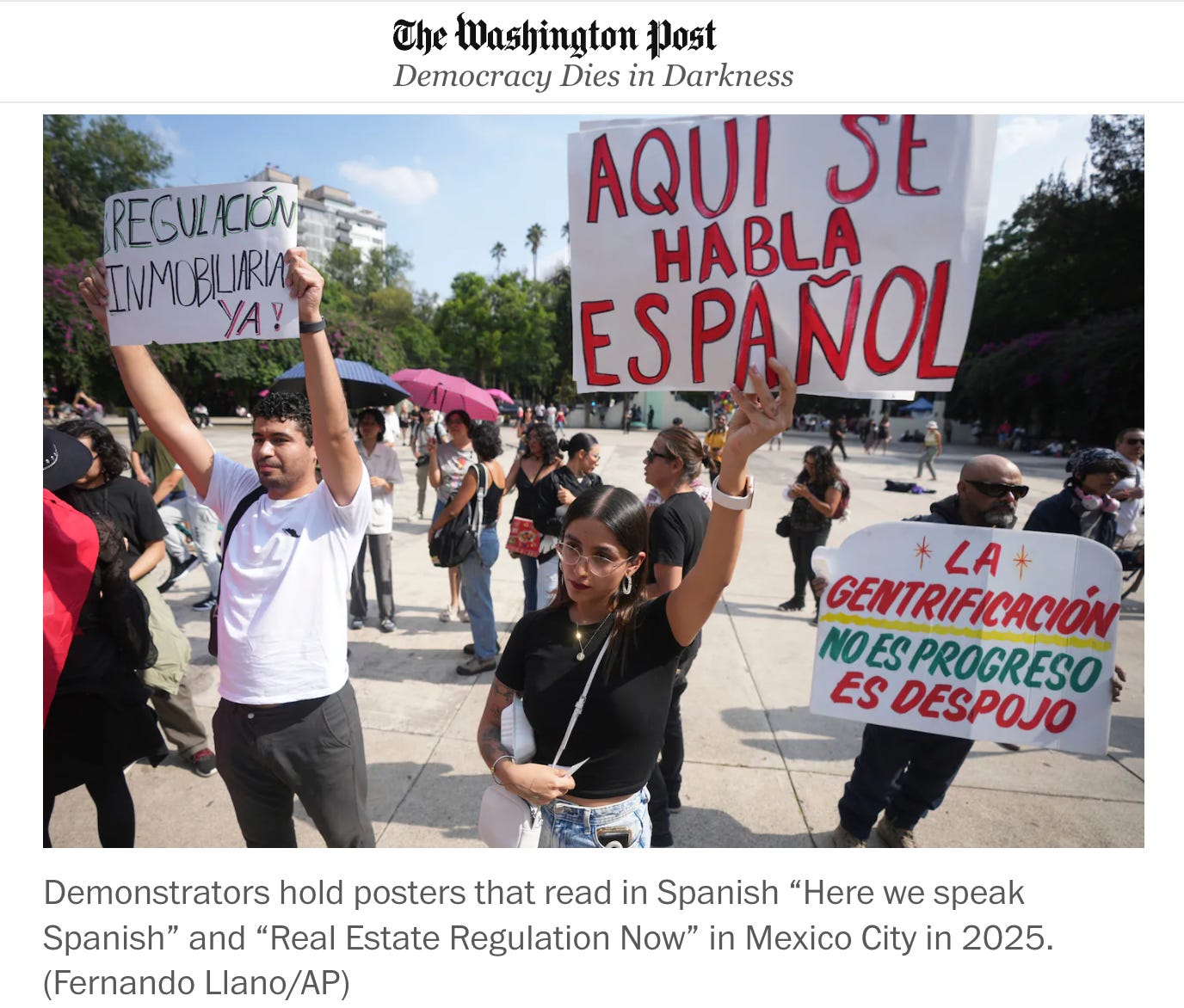
Please note that Mexico City is not seething over the growing number of reported episodes of racism against gringos, but instead of purported examples of gringos being annoying.
The events have inflamed a wider debate over skyrocketing rental prices, gentrification and a flood of tourism.
November 28, 2026
By Terrence McCoy
MEXICO CITY ― One video showed an apparently American man accosting a Mexican influencer in the posh Mexico City neighborhood of Polanco, telling him, “We’re in Polanco. Speak English.”
Another depicted a woman with an American accent abusing and belittling the workers of a famed taqueria: “What’s your big check? What, $500 a year, U.S.? Amazing!”
A third showed an apparently American woman accused of telling a Starbucks barista to remove her tricolor diadema — a Mexican headband — on the grounds that the garment was “offensive” in what she called an “American place.”
In recent years, as foreign and largely American tourists and transplants have deluged Mexico City, upending the culture, economy and even cuisine of some of the city’s most touristed neighborhoods, locals have increasingly voiced discomfort over skyrocketing rental prices, gentrification and what many have viewed as insensitive and disrespectful attitudes by some visitors.
Anti-immigrant xenophobia!
A spate of viral videos showing such behavior in recent weeks has rekindled that emotional debate, leading to a slew of newspaper articles, social media commentary and the condemnation of what people here call “gringo racism.”
Editorial cartoons published this month by La Jornada Morelos showed an apparently American woman yelling at frowning taqueria workers. Another depicted a foreign man hollering at two Mexican women at a cafe: “Be quiet! You’re not in a public place.” A third showed a man in an American flag hat screaming at people in Polanco.
“This is the type of foreigner we don’t want here, in Condesa, Roma, Polanco, Coyoacán — neighborhoods so gentrified that the foreigners feel as though they are their property,” said one Mexican woman in a widely seen social media post. “They don’t like it when we make noise.”
For decades, according to census data, Mexico City has grown in popularity among foreign transplants. Their number nearly doubled between 2000 and 2020, rising to 105,000 residents.
Mexico City proper has a population of 9,000,000 and the metropolitan area is around 25,000,000, so it’s not like foreigners, American or non-American, are overrunning this vast city.
That growth then took off during the coronavirus pandemic, when many businesses encouraged remote work, and “digital nomads,” as they’re called, flocked to the Mexican capital, primarily from the United States.
In 2022, the number of Airbnb long-term stays in Mexico City was up by more than 30 percent compared with 2019, according to Airbnb reporting. Local officials were keen to supercharge the trend, announcing a partnership with Airbnb and UNESCO to remake Mexico City into a “global hub for remote workers.” If a walk through the touristed neighborhoods is any guide, they succeeded.
As much as one-fourth of all housing options in the trendy neighborhoods of Condesa, Roma Norte and Hipódromo
I’m told 50,000 people live in those three neighborhoods.
are now short-term rentals available on platforms like Airbnb. Rent, meanwhile, has also spiked, nearly doubling in touristy areas over the last decade, according to a real estate analysis by Propiedades.com, a prominent Mexican listing website. This week, the newspaper El Heraldo de Mexico reported that establishments in Condesa, Roma and Juárez wouldn’t hire workers unless they spoke English.
It’s hard to get a helpful count of the number of true gringos in Mexico City. Some foreigners who speak English but not Spanish are from third countries in Europe and elsewhere. For example, a Swede living in Mexico City might speak English but not Spanish.
And many American citizens in Mexico are Mexican-Americans. The 2025 Mexican Census counted 669,000 residents of Mexico (the entire country, not just the capital) who were born in the U.S., down from 797,000 in the 2020 census. About two-thirds of those were dual nationals, typically the children of Mexican parents. So that would leave only about 225,000 true gringos in all of Mexico.
Similarly, the U.S. Social Security Administration only counts 62,000 American retirees receiving Social Security checks in Mexico (although others likely have the SSA deposit their monthly pensions in their American banks).
But there are likely a fair number of snowbirds who spend less than 180 days per year in Mexico and thus don’t count as official residents.
Other estimates of Americans in Mexico are higher. The US State Department figures 1.6 million (many of those being Mexican Americans with dual nationality). The population of Mexico as a whole is said to be 133 million, so if, say, there are 800,000 true gringos in all of Mexico, that would be well under 1% overall.
So, the question I’ve been asking for decades is: Why aren’t there more Americans in Mexico? Mexico is a fine piece of real estate adjoining the U.S.. It’s in the Central Time zone like Chicago, so there aren’t the time zone inconveniences for doing business in New York by phone like there are in Hawaii.
I can recall visiting with my parents the American retirement colony in Lake Chapala 59 years ago. But, on the whole, since 1967 there hasn’t been much of an influx of gringos into Mexico.
Why not?
As locals have struggled to adapt to the rapid social changes, anger has built. Protesters have swept the neighborhoods to denounce international gentrification and the rising cost of living in a city where the average monthly salary is lower than $400. It’s not uncommon to see anti-foreigner graffiti. “GREEN-GO,” said one marking in Condesa. “Learn Spanish, dog,” said another in Roma.
Last year, a video on TikTok excoriated a man in northeast Mexico for running off a Mexican construction worker from a city sidewalk, garnering 13.5 million views. “This is how Americans treat our people,” the social media user said, pleading for “justice!!!” in the caption. But the man in question, José Ignacio Lizárraga Pérez, turned out to be Mexican.
On the streets of Condesa, where apartment rental signs are often in English and housing costs can rival a coastal American city, Marco Antonio Perez Valle, 77, was sitting on a bench on a chilly Friday afternoon, watching foreigners stream by along Amsterdam Avenue.
He said he’d lived in the area for more than 50 years and could understand the frustrations over the neighborhood’s head-spinning changes. …
Moisés Carreto, who works as a waiter at the elegant cafe, Maque, off Parque Mexico, said he agreed.
“I make most of my money off tips,” he said. “And foreigners tip well.”
Back in 2011, I took a semi-serious crack at figuring out why so few Americans move to Mexico in …
Paywall here.
Continue reading this post for free, courtesy of Steve Sailer.