

How do you win a Nobel Prize in Economics? (Yeah, I’m aware the Econ prize is kind of a semi-quasi-pseudo Nobel, but, still, it’s a prestigious prize.)
Make up an obviously contrived politically correct all-purpose theory that will drive me crazy. That worked in 2024 for Nobel laureates James A. Robinson, Daron Acemoglu, and Simon Johnson for their theories that some countries (e.g., USA) are richer than other countries (e.g., Haiti) because the former have inclusive and the latter extractive institutions.
Robinson’s now back with a paper explaining that Africa was actually a success story until those nasty white people showed up after 1880.
First, though, why did nobody, internal or external to Africa, bother conquering Africa and its perhaps 45,000 states until the late 19th Century. For example, here’s their estimate of Nigeria’s “polities” in 1880:
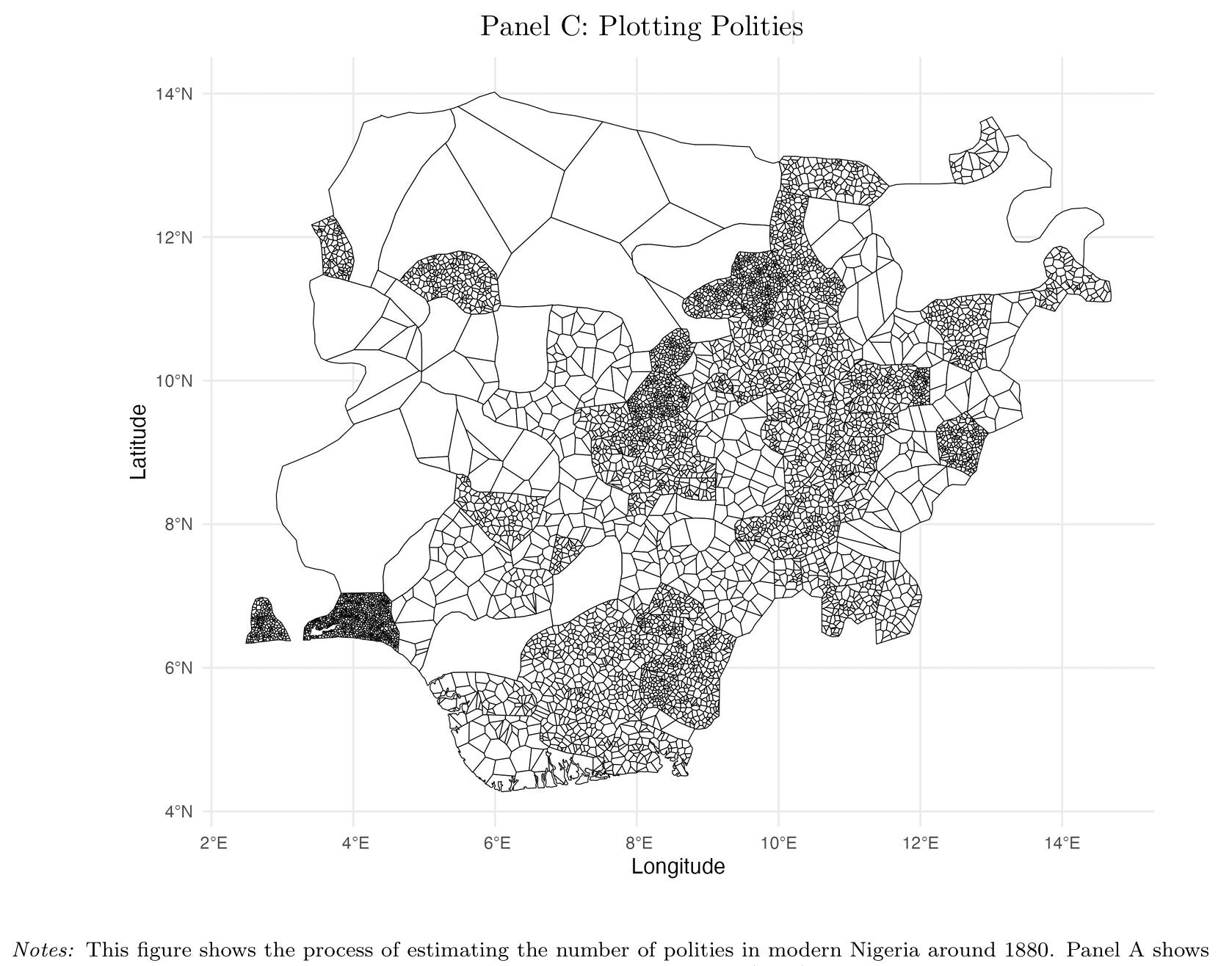
So, some parts of Nigeria in c. 1880 were organized on the scale of a tiny state today such as Togo, while other places were simply self-ruling villages.
But there were basically no empires in Africa in 1880, although Menelik expanded his holdings in Ethiopia over the course of the decade and had himself crowned Emperor of Ethiopia in 1889.
Likewise, the Zulus had conquered a lot of territory in southeastern Africa in the early 19th Century.
Still, there were only a few polities impressive enough to be considered kingdoms, such as Buganda on the shore of Lake Victoria, which impressed Burton and Speke when they reached it in the 1860s.
Africa as a Success Story: Political Organization in Pre-Colonial Africa
Soeren J. Henn, James A. Robinson
December 2, 2025
Abstract: We provide an overview of the explanations for the relative lack of state formation historically in Africa. In doing so we systematically document for the first time the extent to which Africa was politically decentralized, calculating that in 1880 there were probably 45,000 independent polities which were rarely organized on ethnic lines.
I don’t know what Robinson means by “rarely organized on ethnic lines.” Perhaps he means they tended to be organized on sub-ethnic lines: e.g., Nuers in South Sudan were organized on lines of me against my brother, me and my brother against my cousin, me and my brother and my cousin against the world.
Estimates of the population of sub-Saharan Africa in 1880 are vague, but most seem to be in the range of 90,000,000 to 135,000,000. If there really were 45,000 polities, then we are talking about a mean population per political sovereignty of 2,000 to 3,000 people, which is awfully small.
At most 2% of these could be classified as states. We advance a new argument for this extreme political decentralization positing that African societies were deliberately organized to stop centralization emerging. In this they were successful. We point out some key aspects of African societies that helped them to manage this equilibrium. We also emphasize how the organization of the economy was subservient to these political goals. …
Why so few larger polities? Why didn’t anybody bother conquering a whole bunch of tiny polities?
First, note that Sub-Saharan Africa was not a stone age hunter-gatherer region. Instead, it was dominated by iron age farmers and herdsmen. That’s why African slaves could be plugged into farm work in the American south so easily, unlike local American Indians.
Generally speaking, over the last 10,000 years, conquering farmers has paid off well enough that ambitious men have often tried it.
Why in Egypt or Mesopotamia but not in Africa?
Paywall here.
