

From The New Yorker:
WE’RE LEARNING TO LIVE WITH WAYMOS. IT’S GOING WEIRD
A view from the back seat.
By Molly Fischer
October 12, 2026
Much of this article is belletristic prose, but it includes a number of quantitative facts about Waymo robot taxis that could be of interest:
… Waymo has a fleet of more than four thousand cars in fifteen cities across the U.S.
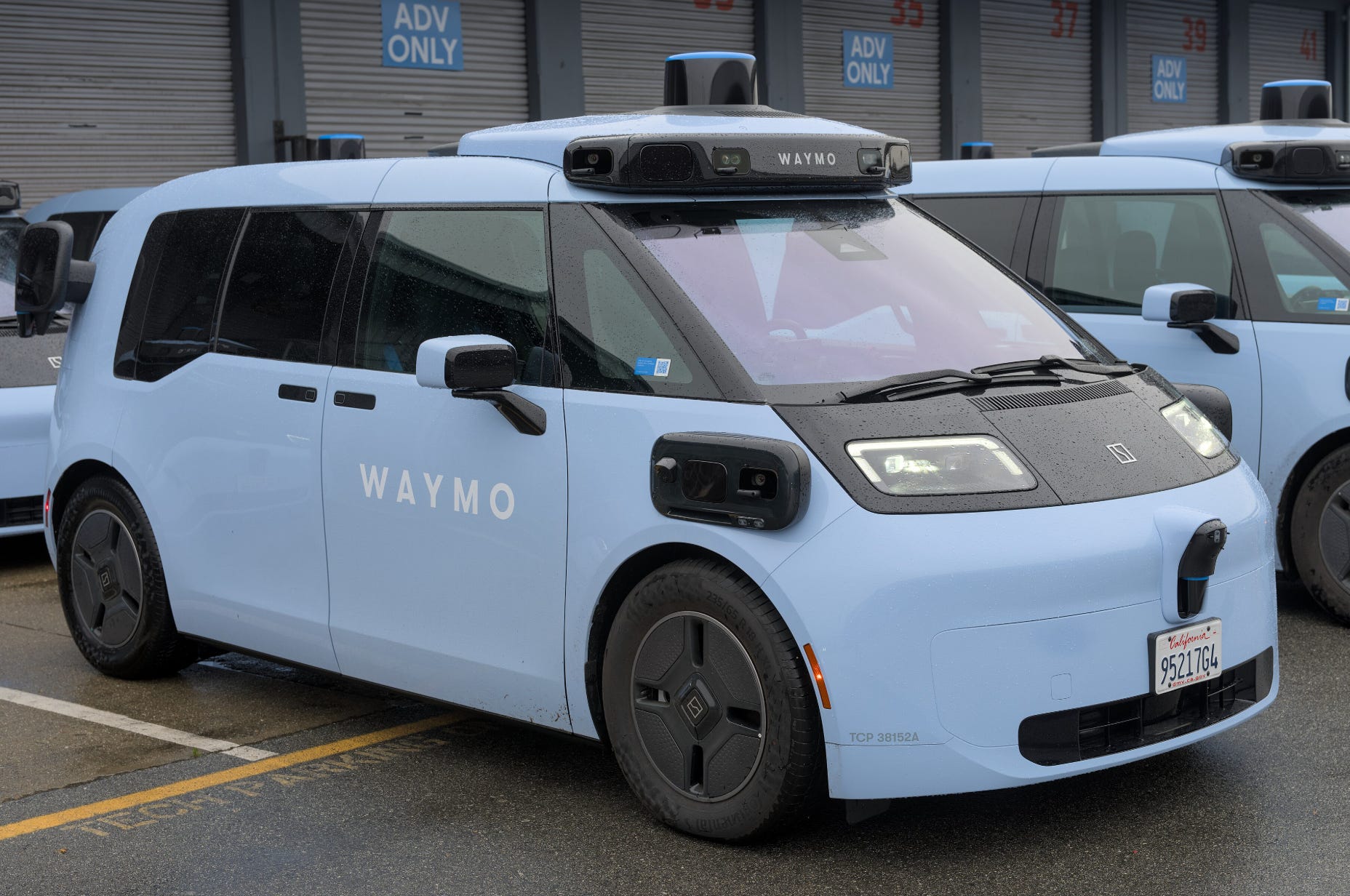
In San Francisco, the company recently surpassed Lyft in market share. … More than thirteen hundred Waymos whir and glide in the region, the lidar sensors that spin in hat-like domes atop their roofs giving them an air of busy importance.
In June, Waymo unveiled its first national campaign, called “Because.” The ad opens with the red flash of emergency lights. “Car crashes injure over a million of us every year,” a voice-over explains. “Because we’re human.”
There are many things humans do that are difficult to imagine any machine improving upon, but driving is not one of them. Human drivers possess abundant and obvious shortcomings. The ad touts “a driver that never blinks, never gets tired or angry or has a few too many.” Waymo’s cars are “ten times safer” than those with human drivers, the ad declares—a crisp figure that recurs throughout company materials. … The figure refers to a ninety-two-per-cent reduction in crashes causing “serious injury or worse.” This is a remarkable achievement, and although outside evidence is limited, researchers generally view it as promising. …
The lower serious crash rate is promising, but it’s not entirely clear that it’s valid. I see a lot of empty Waymo robot taxis going past at 10 PM on 6 lane Venice Blvd., which is likely among the safest streets in L.A. This seems a bit like stat-padding to me, although it also makes sense to cruise up and down to get more miles in to learn from.
In February, the company announced a new valuation of a hundred and twenty-six billion dollars. …
But whose start-up isn’t worth one hundred billion dollars these days?
I can recall congratulating my old boss in 1991 because he had a second start-up break the $100 million barrier, which was phenomenal 35 years ago.
Nowadays, $100 million isn’t worth getting out of bed for.
Waymo sells its service as a remedy for prejudice (because robot drivers won’t discriminate against Black people) and for transit deserts (a claim Uber and Lyft also used to make).
But it’s almost as if taxi drivers in 2006 weren’t irrational white supremacists from Sierra Leone or Laos.
… In June, I visited a Waymo maintenance depot on Toland Street, in San Francisco. … Outside, Waymos puttered around a parking lot. Two hundred cars were on site, variously charging, awaiting their turns to charge, and enjoying the ministrations of human maintenance workers. The cars need to charge for about fifty minutes every six to eight hours—a cycle under way twenty-four hours a day, because a Waymo does not sleep at night.
This suggests that Waymos have a capacity of about 75% per 24 hour day.
On the other hand, there are currently 1,300 Waymos in San Francisco. If 200 were recharging when Molly Fischer visited, that suggests about 800 were in service, and 500 were …?
But on the other hand, who knows what the total capacity was when she visited last summer. New Yorker writers take their time.
On the other hand, does a Waymo really need to drive around all night? Isn’t it more likely that it’s most in demand from 8 to 10 AM and 4 to 9 PM, or about 25% of the day?
“Waymo promises its riders two things that, while related, are distinct: automation and driverlessness. Automation is the source of the traffic-safety potential that the company touts. Driverlessness, though, is the quality that users praise first, almost without exception. They want to put on their own music and control their own temperature; they don’t want to make conversation. …
But where will Tom Friedman go to get his insights into public opinion if there are no more drivers to interview on his way to the airport?
Recently, The Atlantic published a piece of sponcon from Waymo … The headline, in this case, was “Why Autonomous Vehicles Are a Lifeline for Neurodiverse Adults.” …
But, as is often the case, the illusion of self-sufficiency depends on other people. Waymo has approximately seventy “remote assistance” agents on duty at any given time, working at call centers in the U.S. and the Philippines, who advise the Waymo Driver on confusing situations. …
So, Waymo employs about 300 people working 40 hours per week to be ready to intervene and remotely take the wheel if one of its 4,000 robot taxis gets itself in a jam.
So, it appears to take a total of about one emergency drivers per 13.3 Waymos.
That’s about one worker overseeing for 40 hours per week every 50 to 60 Waymo robots deployed.
But what fraction of the 4,000 vehicles have passengers on average? And what fraction are cruising without passengers? (In west Los Angeles, the majority of Waymos I pass, usually at night, have no passengers.)
The company also has “rider support” agents, who respond to customer requests.
A human driver both drives and responds to his passengers requests. Waymo splits this job in two, apparently. No estimate on the numbers of the latter.
Plus it has humans working at the charging stations, humans retrieving Waymos that break down, and so forth and so on.
The lack of a driver can have unexpected consequences. Say someone is out drinking and prudently summons a Waymo: so far, so safe. But suppose, as sometimes happens, he falls asleep in transit. When he fails to exit upon arrival, a Waymo agent will attempt to rouse him—but, if he snoozes on, the agent will need to call 911, and ambulances and fire trucks will be dispatched.
Does Waymo get billed?
According to Bloomberg, San Francisco saw two hundred and fifty such incidents last year. It’s good that our hypothetical passenger wasn’t driving. Still, his evening seems like a less than unalloyed triumph for public safety.
I can’t imagine that a human Uber driver recently arrived from Tajikistan is going to need to call 911 to get a drunk out of his backseat. Tajikistanis aren’t good at everything, but I suspect they are perfectly adequate at rousting sleeping SF AI zillionaire drunks from their backseats.
One big question that I haven’t seen much discussion of yet is whether …
Paywall here.
