

From the Wall Street Journal opinion page:
Surprise: Racial Crime Disparities Have Narrowed a Lot
In 2000-19, the prison-admission rate for violent crime dropped 20% for whites, 43% for blacks.
By Jason L. Riley
Sept. 22, 2026 5:22 pm ET
Did you know that incarceration rates and racial disparities in the prison population declined in the U.S. for the first two decades of the 21st century?
You’d have heard about it if the reverse were true, but mainstream media have little interest in highlighting racial progress when Republicans control the White House. Moreover, this trend undermines the left’s insistence that our criminal-justice system—from police officers to prosecutors to the sentencing guidelines—is stacked against black people.
Nevertheless, a study published last month in the academic journal Nature Human Behaviour, “Why America’s Prisons Are Shrinking and Racial Gaps Are Closing,” deserves more attention. The authors, Jason Robey of the University of Iowa and Michael Light of the University of Wisconsin, analyzed data on crimes, arrests and prison admissions between 2000 and 2019.
Uh, what happened in 2020?
The state imprisonment rate in 2019 was the lowest it had been since 1988, and it had shrunk by 20% since 2007.
As noteworthy, black-white gaps in arrests and imprisonment have narrowed due to significant decreases in black criminal behavior. “For violent and property offences, the reduction in prison admissions corresponds primarily with substantial declines in crime rates, not changes in policing or case processing,” the authors note. “This was particularly true for Black individuals, for whom the substantial reduction in violent prison admissions can be entirely attributed to a large reduction in violent crime.”
Or substantial reduction in the percentage of violent crime that was reported to the police, solved, prosecuted, convicted, sentenced to prison, and reported to federal bureaucracies.
There are a lot of ways that the actual number of violent crime and the reported number of admissions to prison for violent crime can trend in different in different directions.
From 2000 to 2019, the overall violent-crime rate fell 32%. The prison admission rate for violent offenses declined 20% among whites. For blacks, it decreased 43%, which was driven “exclusively” by a 47% reduction in black violent crime, according to the study.
The trends in drug arrests tell a similar story of narrowing racial inequality. In 2000, blacks were 12 times as likely as whites to go to prison for a drug offense. By 2019, that disparity had fallen to less than 3 to 1. “For Black individuals, the prison admission rate for drug offences declined by 75% from 2000 to 2019, whereas for White individuals, it declined only 13% from its peak in 2005,” Mr. Robey and Mr. Light report.
Different drugs have different markets. Blacks were hit very hard by crack c. 1990. In this century, prescription opioids and Mexican black tar heroin were marketed more to the white working class, who tended to die quietly of overdoses, not engage in drive-by shootings that attract public attention.
One of the few journalists to write about these findings is Charles Lane of the American Enterprise Institute, who concluded that the conventional “mass incarceration” narrative on the political left “needs to catch up with the facts.” Mr. Lane speculated that we may be “in the midst of a long-term shift toward both less violent crime and less incarceration,” which “very well might never have occurred if we really had defunded police or abolished prisons.”
I hope Mr. Lane is proved right, but don’t expect the attacks on the criminal justice system to stop. People with an ideological agenda are seldom dissuaded by factual evidence, however voluminous. Recall that the past two decades of falling black crime and incarceration rates coincided with the rise of the Black Lives Matter movement, which insisted that law enforcement was targeting people based on nothing more than skin color.
Uh, black crime almost certainly went up during the Black Lives Matter peak of 2014-2021.
Yet all the while, data showed that racial imbalances in the criminal-justice system were diminishing. Police were targeting criminals, not black people, and fewer blacks were in fact being arrested and imprisoned as law-breaking ebbed. There’s been no epidemic of racially motivated policing in recent decades, merely anecdotal evidence amplified by social media and reporters with a political agenda. Crime increased during the pandemic,
More so during the Racial Reckoning.
One set of crime data that is reasonably reliable is the CDC’s homicide victimization numbers. Funeral directors aren’t, so far as I can imagine, under any political pressure to change the race of the deceased. Nor do coroners often get fired because homicides have gone up, although police chiefs worry about that happening to them if murders go up.
A couple of months ago I graphed 1999 through 2025 homicide victimizations (the CDC imposes a six month lag on some of the more interesting causes of death like homicides, suicides, and motor vehicle accidents to give coroners time to render a considered judgment). Looking at homicide victimizations is not quite as informative as looking at murder offenses, but it’s highly useful for looking at trends and probably more reliable than murder offenses, and far more than more minor violent offenses.
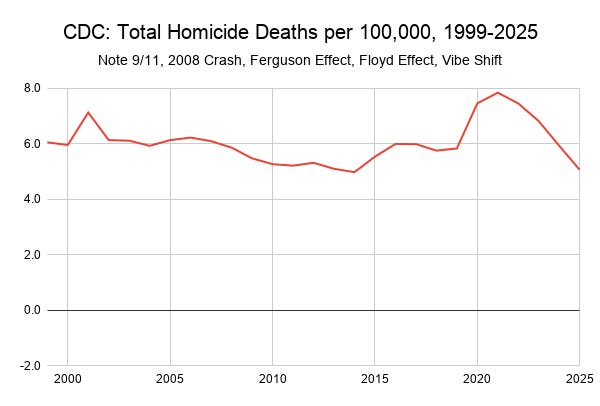
Homicide victimizations spike in 2001 (or, to be precise, on 9/11/2001) and were pretty flat until the Housing Bubble burst. The Great Recession induced a lot of depression, which lowers the homicide rate because people aren’t out partying with lots of money in their pockets as much. So, the homicide rate bottomed out in 2014, when Black Lives Matter got going at Ferguson on August 9, 2014. It then went up due to the Ferguson Effect in 2015-16. Then, homicides exploded in the days following George Floyd’s death on May 25, 2010.
Homicide explosions like the Floyd Effect tend to be self-liquidating as the likely shooters get shot. Lately, homicides are in sharp decline and the death toll in 2025 was almost back down to the 2014 death rate, and is likely to drop well below it in 2026 (unless we have an Autumn of George).
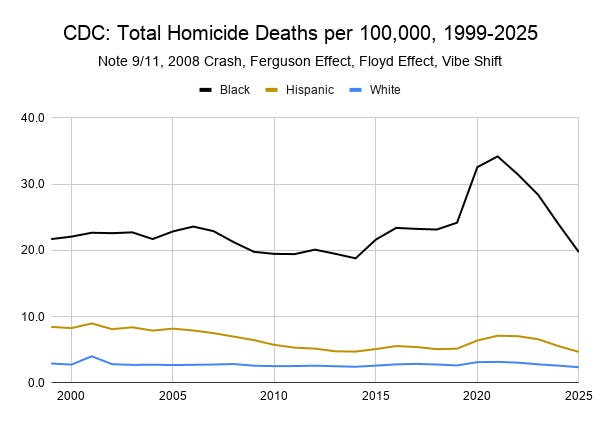
The black homicide victimization rate is extremely high. It didn’t do all that much between 1999 and Ferguson, then went up dramatically with Floyd, and now is dropping fast.
We can also look at homicide victimization rate trends for blacks and Hispanics as a ratio of the white rate:
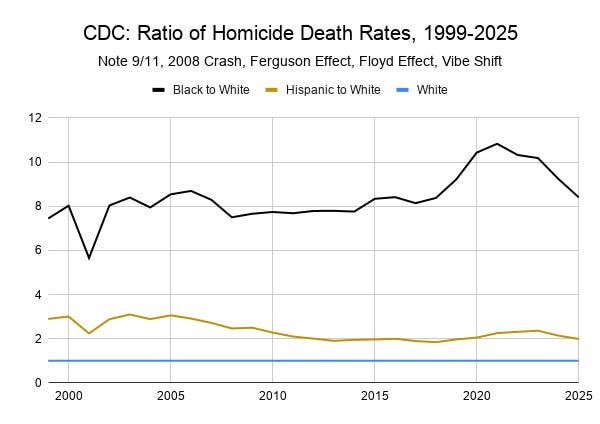
Blacks died by homicide about eight times as often per capita as did whites for most of the 21st Century until the Racial Reckoning, when blacks died over ten times as often as whites from 2020 through 2023. (My impression is that black murders started to rise quickly in mid-2019 for reasons that nobody quite understands.)
By 2025, the black-to-white ratio was edging down toward its old 8x ratio.
The Hispanic ratio is also interesting, but it’s hard to see on a graph dominated by the sky-high black ratio. So here is the Hispanic ratio without the black ratio:
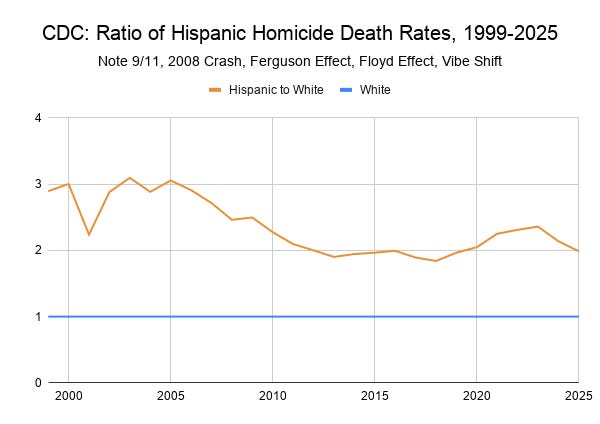
Hispanics died about three times as often by homicides as whites up through the Bush Housing Bubble. But when construction jobs started to dry up around 2007, the Hispanic homicide rate relative to the white rate fell to 1.8x before jumping up again during the Floyd Effect.
An alternative explanation for the big increase in white imprisonment relative to black imprisonment in recent years is …
Paywall here.
