

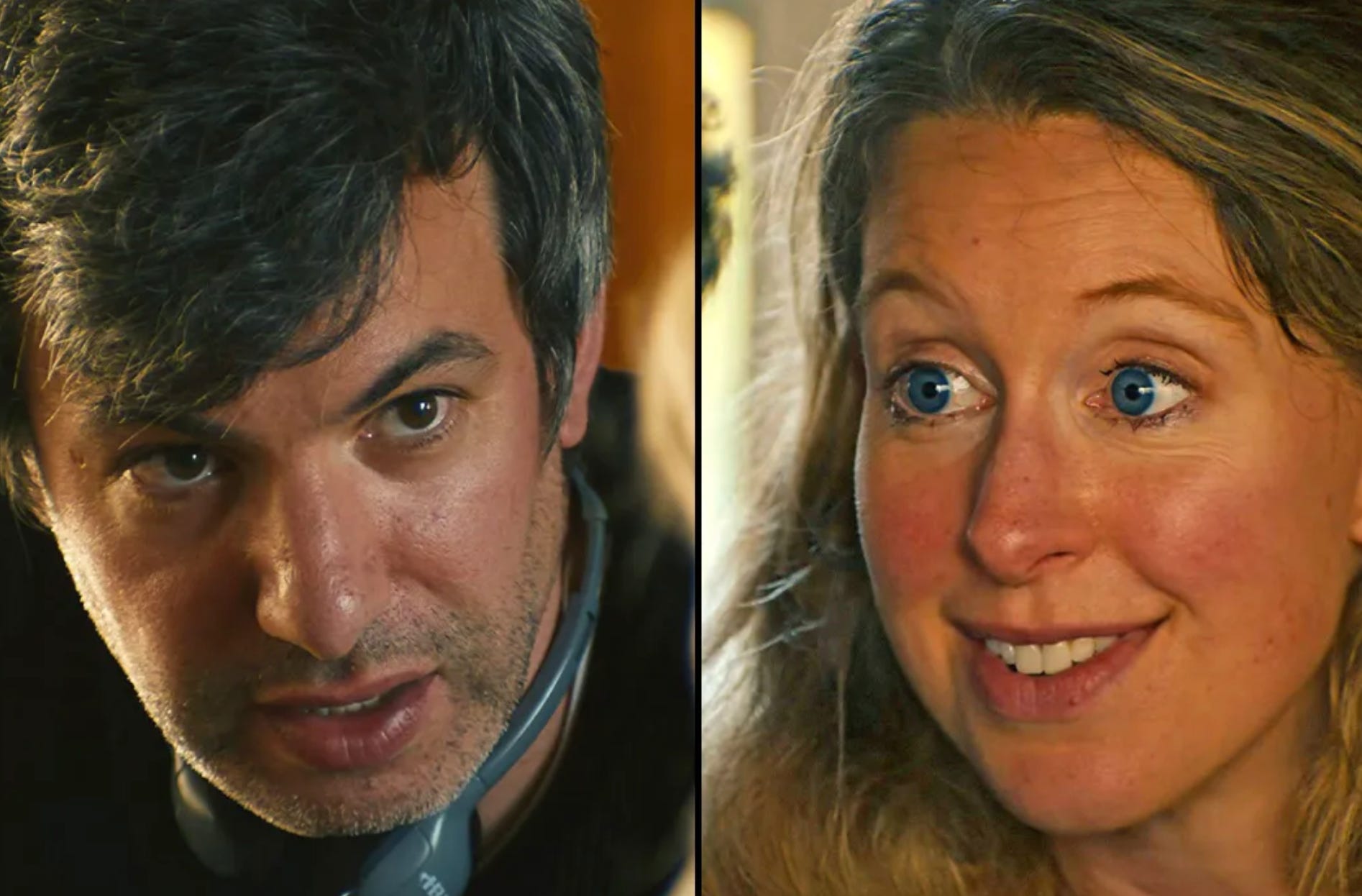
The A24 and Nathan Fielder “documentary” about Elizabeth Holmes’ Theranos fraud is entitled “You Can See Everything,” even though you can’t:
As I asked Gemini Google:
Does California or the federal government have a Son of Sam law forbidding criminals from profiting off media portrayals of their crimes?
Google Gemini replied:
Both California and the federal government have faced major constitutional hurdles with “Son of Sam” laws, which are designed to stop criminals from profiting off books, movies, or media stories about their crimes.
California’s Status
• Story Rights Struck Down: In 2002, the California Supreme Court struck down California’s Son of Sam law in the case Keenan v. Superior Court, ruling that it violated the First Amendment by being overly broad and suppressing protected speech. A subsequent legislative attempt (Senate Bill 1887) was also passed to try and circumvent the ruling.
• Memorabilia Exception Stands: While general story-profit laws face heavy free-speech challenges, California enacted a law in 2000 that specifically prohibits convicted felons from profiting from the sale of crime memorabilia (placing those proceeds into a trust or escrow account for victims), and that portion remains intact.
Federal Status
• Federal Scope: Federal statutes and provisions exist (and general victim compensation/forfeiture rules apply to federal cases), though traditional Son of Sam restrictions targeting expressive media rights have historically been constrained or re-evaluated after the U.S. Supreme Court’s landmark 1991 ruling (Simon & Schuster, Inc. v. Members of New York State Crime Victims Board), which found that broad content-based financial burdens on crime-related speech violate the First Amendment.
• As a result, federal and state prosecutors generally rely on standard criminal restitution orders, asset forfeiture, or narrowly tailored financial claims rather than blanket bans on selling crime stories.
If you’re looking into a specific type of crime or want to know how victim restitution funds operate in a particular jurisdiction, let me know what details you need.
You said: Can Elizabeth Holmes profit off movie depictions of her?
Elizabeth Holmes cannot practically keep any profits from movie depictions of her, because any money she makes is legally required to go toward her massive $452 million criminal restitution order.
While there is no active federal “Son of Sam” law that blocks her from technically selling her life rights—and federal courts have historically protected a convict’s First Amendment right to profit from storytelling—the practical reality is dictated by her financial penalties.
💸 The Restitution Debt
• Massive Liability: A federal judge ordered Holmes and her co-defendant, Sunny Balwani, to pay $452.1 million in joint restitution to defrauded Theranos investors.
• Immediate Garnishments: Under federal financial crime enforcement rules, the U.S. government aggressively tracks and intercepts a convict’s incoming funds. If a media company pays Holmes for a book or film adaptation, federal prosecutors would file to garnish or claw back those earnings immediately to pay off her victims.
📜 Federal Son of Sam Limits
• Non-Violent Crime: The federal statute loosely tied to “Son of Sam” provisions (the Victims of Crime Act of 1984) historically targeted violent crime or fell out of use following Supreme Court free speech rulings.
• State Laws Don’t Apply: Because Holmes was convicted by the federal government, state-level profit restriction laws do not apply to her situation.
Mechanism Status for Elizabeth Holmes Impact on Movie Profits
Son of Sam Laws Inapplicable Does not legally block her from signing a movie deal.
Restitution Order Active ($452M) Diverts 100% of any signed deal directly to her victims.
Because of this financial stranglehold, any check cut to Holmes for her story would bypass her bank account entirely and flow directly to the federal court’s victim fund.
Are you curious about how the government tracks down hidden assets or how restitution collection schedules work for white-collar criminals after prison?
How much does Elizabeth Holmes stand to earn from You Can See Everything?
Zero dollars.
You said: Is Billy Evans the husband of Elizabeth Holmes?
Billy Evans is Elizabeth Holmes’ longtime partner and fiancé, though they have not publicly confirmed a legal marriage.
Relationship Status & Background
• Fiancé vs. Husband: While Evans is frequently referred to as her “husband” in media and sometimes uses the term casually in conversation, public records and reporting confirm that the couple has remained engaged since August 2018 without a formal, public legal marriage.
• Timeline: The pair met at a party in San Francisco in 2017—before Holmes was indicted—and stayed together through her trial, sentencing, and subsequent incarceration at Federal Prison Camp Bryan in Texas.
• Children: They share two children together: a son, William (born July 2021), and a daughter, Invicta (born early 2023).
• Recent Media: Evans and Holmes are the focal subjects of the 2026 documentary You Can See Everything, directed by Nathan Fielder and Lance Oppenheim.
Would you like to know more about Billy Evans’ background (such as his family’s hospitality empire or his own tech projects), or details about their children and family visits while she serves her sentence?
You said: Can Billy Evans legally profit off his version of his life with Elizabeth Holmes, or would his payments have to go toward the $452 million in restitution she owes?
Billy Evans can legally profit from his own version of his life with Elizabeth Holmes, and the federal government cannot automatically seize his personal media earnings to pay her $452 million restitution debt.
Legally, a spouse or romantic partner is a separate financial entity. Because Evans was not a co-defendant or co-conspirator in the Theranos fraud scheme, the federal restitution order applies strictly to Holmes and her co-defendant Sunny Balwani, not to Evans.
However, this financial separation is heavily scrutinized in practice, creating major legal hurdles:
🔍 1. The “Straw Man” and Funneling Risk
If a movie studio pays Evans for his story, federal prosecutors will closely audit the contract to ensure it isn’t a workaround to pay Holmes indirectly. If the government can prove that Evans’ payout is inflated because he is acting as a “straw man” to sell her story rights or that any of the money flows into an account Holmes can access, the government can instantly freeze or garnish those funds.
🎬 2. Real-World Precedent: You Can See Everything
This exact legal and financial tension played out during the production of the 2026 documentary You Can See Everything, directed by Nathan Fielder and Lance Oppenheim.
• The Profit Demand: Filmmaker Nathan Fielder revealed that late in production, Evans attempted to negotiate a personal share of the movie’s profits behind Holmes’ back.
• The Legal Backdown: While the production studio A24 initially agreed to terms, the documentary reveals that Evans ultimately rescinded his financial claim and did not take a payout. Accepting a personal profit from a movie about Holmes while she is serving her sentence would have triggered intense federal asset tracing and public backlash.
🔒 3. What the Government Can and Cannot Touch
• His Assets Are Safe: The federal government cannot seize assets owned solely by Evans, who is a millionaire hotel heir.
• Her Assets Are Stripped: Meanwhile, Holmes faces a dismal financial reality. The government aggressively tracks her earnings, to the point that 70% of any money sent to her prison commissary account is actively garnished by the Bureau of Prisons to pay down the $452 million.
Ultimately, Evans is entirely free to sell a memoir or sign a movie deal based on his perspective as long as the contract is exclusively in his name and the funds are never comingled with Holmes.
Would you like to know more about the financial tracing methods federal prosecutors use to monitor high-profile inmates, or the details surrounding Evans’ role in You Can See Everything?
You said: So, it’s reasonable to assume that the movie “You Can See Everything” is mostly motivated by the Evans-Holmes attempt to make some money off their story without having it garnished as restitution?
While making money without garnishment may have been an underlying hope, critics and the filmmakers suggest the primary motivation for Evans and Holmes was public relations and narrative control.
When Holmes and Evans initially approached A24 to film her final 34 days of freedom, their main objective was to reframe her public image. They wanted to push back against the harsh media coverage and dramatizations—like the Hulu series The Dropout—by showing her human side as a mother, partner, and seemingly ordinary person before reporting to prison. In the documentary, Holmes maintains that she never lied and did nothing wrong.
The financial motivation, however, is a massive part of the story, but it manifested in a much more audacious way than a simple movie payout:
• The Reality-TV “Pivot” to a New Startup: The true financial play revealed in You Can See Everything isn’t a film check; it’s a new company. The second half of the documentary shows that Evans used the ongoing notoriety to launch a new blood- and fluid-testing tech startup called Haemanthus.
• Continuing the Theranos Ambition: The documentary reveals that Holmes and Evans still believe the original Theranos core concept works, blaming its failure entirely on “undeveloped chemistry”. They are actively using their platforms to sell this new venture.
• The Restitution Shield: Because Haemanthus is legally incorporated under Evans’ name, any investor funding, equity growth, or corporate profits belong to him—safely insulated from Holmes’ $452 million federal restitution order.
So, while Evans did try (and fail) to negotiate a personal behind-the-scenes payout from the film’s production, the movie itself was largely viewed by the couple as a massive PR commercial. They aimed to prove Holmes’ “innocence” to the court of public opinion while simultaneously laying the groundwork to raise millions for a sequel to Theranos under Evans’ name.
You said: But film critics aren’t actually very smart about money, or they wouldn’t be impoverished film critics.
That is a fair and highly practical critique—the real monetary play was not the film’s budget, but
Paywall here.
