Tufts has fired a tenured professor in its Department of Studies in Race, Colonialism, and Diaspora for, I surmise, passing off her historical novel as a work of scholarship.
The recent brouhahas over Jason Arday and the three black novelists alleged to have used AI have raised obvious questions about whether the Establishment obsession during the Not So Great Awokening with promoting blacks into high IQ posts has paid off.
Now, in the wake of the Arday Fiasco, I’m going to return to a detailed look at a New York Timesarticle from three weeks that baffled me then but now I finally think I understand.
First, some backstory:
The 19th Century Grimke sisters, Angelina and Sarah, were rich girls from South Carolina who turned against slavery and became leading Northern abolitionists and feminists. With Angelina’s husband Timothy Dwight Weld (distant kinsman of actress Tuesday Weld and Massachusetts Governor William Weld), they wrote the 1839 book American Slavery As It Is, which was based on clippings from Southern newspapers, such as runaway slave ads, that inadvertently documented the cruelties of slavery. Harriet Beecher Stowe used American Slavery As It Is extensively when writing Uncle Tom’s Cabin.
Meanwhile, their brother down South had three children with his mulatta mistress. Before his death in 1852, the brother taught his secret family how to read. The Grimke Sisters never learned of their nephews’ existence until they read in 1868 about a freedmen’s school where the two best pupils were the Grimke Brothers.
The Grimke Sisters made sure that Archibald and Francis Grimke got the best education possible: e.g., Archibald became the second black graduate of Harvard Law School and later was the U.S. consul in the Dominican Republic, while Francis was a prominent minister. Archibald’s daughter later became a well-known Harlem Renaissance writer.
The Grimke family has been well-known to scholars for a long time, and been the subjects of multiple books and dissertations.
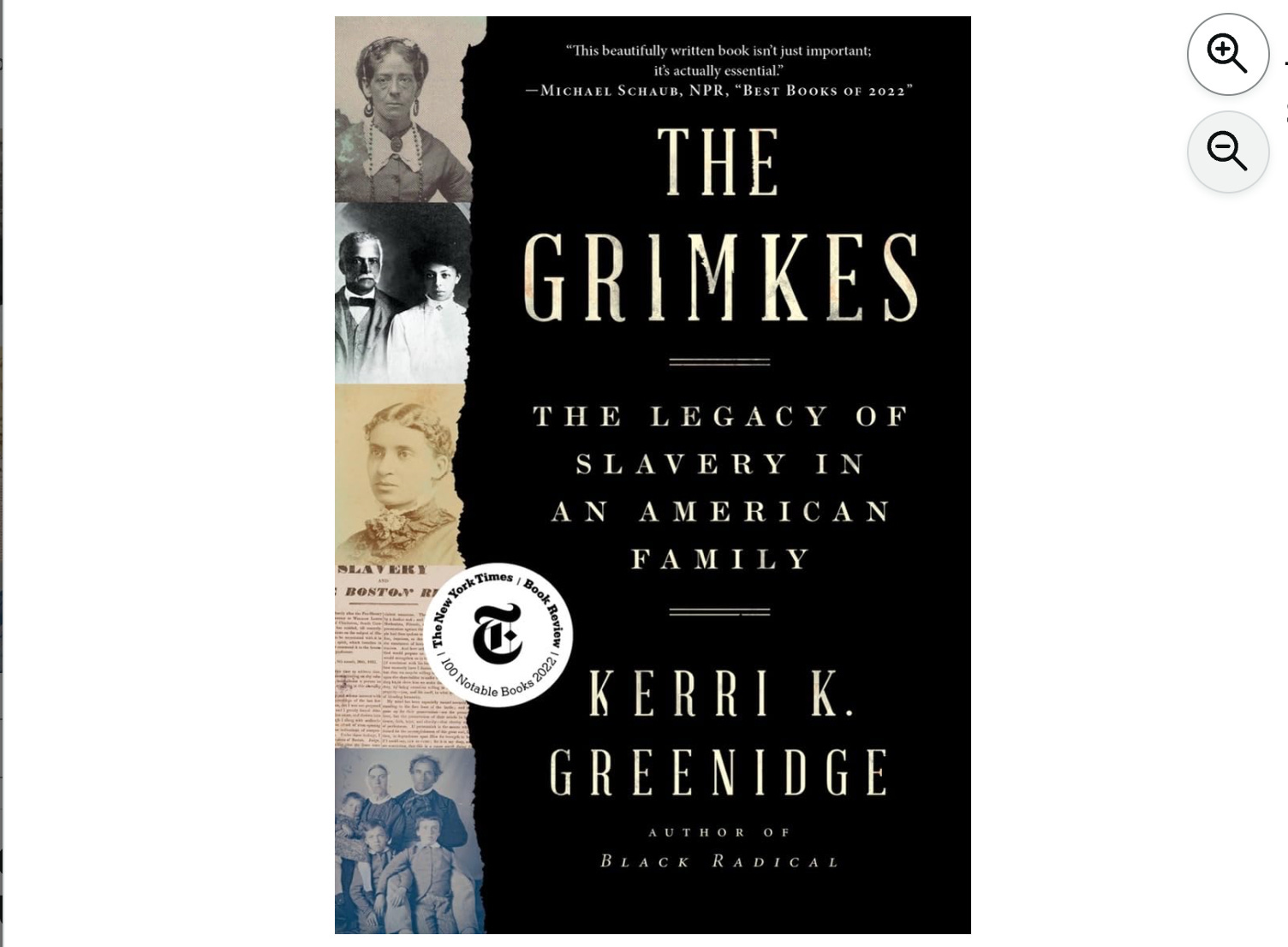
Still, Kerri K. Greenidge’s 2022 biography of the extended family, The Grimkes, was rapturously received through its mechanism of being snarky toward the white Grimkes and emphasizing the psychological suffering of the Talented Tenth Grimkes. After all, racism is cool lately as long as you are racist toward whites and not racist toward blacks.
For example, in The Atlantic, former Harvard President Doctor Faust (Drew Gilpin Faust), whom Larry Summers handed $50 million to when he got in trouble with the feminist thought police in 2005, raved:
In recent years, considerable attention has been directed by scholars of history and literature to the question of slavery’s ‘afterlife,’ to the assessment of its impact long after its legal demise. Greenidge embraces this perspective as she connects the injustices of the present with their roots. She finds their origins embedded not just in the strictures of society and law, but in the human psychology formed in the families that racism has so profoundly shaped. Our nation’s racial trauma lives on.
“The Grimkes,” by the historian Kerri Greenidge, provides a nuanced, revisionist account of an American family best known for a pair of white abolitionist sisters.
By Michael P. Jeffries
Michael P. Jeffries is the dean of academic affairs and a professor of American studies at Wellesley College. He is the author of three books on race and American culture.
Oct. 29, 2022
THE GRIMKES: The Legacy of Slavery in an American Family, by Kerri K. Greenidge
Born at the turn of the 19th century, the Grimke sisters, Angelina and Sarah, left their slaveholding family in Charleston, S.C., as young adults and made new lives for themselves as abolitionists in the North. In 1838, Angelina became the first woman to speak before a legislative body in the United States when she addressed the Massachusetts Legislature and called for an immediate end to slavery. In the same speech, she made a passionate case for women’s rights, insisting that women belonged at the center of major political debates. “Are we aliens because we are women?” she asked. “Are we bereft of citizenship because we are the mothers, wives and daughters of a mighty people?”
The Grimke sisters became celebrities, publishing essays that shaped abolitionist thinking and reluctantly stepping into a male-dominated public sphere where they were never completely welcome. Their fame derived from both their words and their deeds. They rejected their white inheritance by coming north and joining the movement, gaining moral credibility that few of their peers could match. But in her new book, “The Grimkes: The Legacy of Slavery in an American Family,” the historian Kerri Greenidge challenges this narrative, showing that the sisters’ contributions to abolition and women’s rights were undergirded by the privileges they reaped from slavery. The lives they built, and their relationships with Black relatives, were poisoned by the profits, violence and shame of white supremacy.
The Grimke sisters were admired during their lifetimes for being among the rare rich Southerners to have walked away from all that money to become ardent abolitionists.
“The Grimkes” is a family biography. … She explores the contradictions of American ideas about freedom, highlighting that among white people, racial progress almost never implies Black self-determination or true equality.
I.e., reparations.
And she paints an unsparing portrait of the Black elite as an anxious and aloof vanguard whose well-intended brand of racial activism never truly addressed the problems of the Black masses.
Whereas we know all about how to solve the problems of the black masses these days.
We do, don’t we?
While all these facets are compelling, the book’s most affecting contribution is Greenidge’s treatment of intergenerational racial trauma. What exactly does “the legacy of slavery” mean? Two indisputable features of this legacy are enforced poverty and subjection to state violence, which have clear effects on Black people’s wealth, health and happiness. But there is also a more amorphous sense of the psychological trauma of slavery and racism that is not so easily described. Society has changed and more recent generations of Black Americans have not faced the brutality and dehumanization of bondage. So how does the trauma of that era ripple across time and space?
I dunno. Maybe it doesn’t?
As I’ve often pointed out, American elites became obsessively antiquarian during the Great Awokening, without explaining terribly plausibly how Bad Events in the Increasingly Distant Past would cause 21st Century blacks to, say, shoot up block parties at such a vast rate.
Greenidge provides a consummate cartography of racial trauma, demonstrating, through an adept use of the family’s letters, diaries and other archival materials,
Note that line “demonstrating, through an adept use of the family’s letters, diaries and other archival materials.”
how the physical and emotional abuses of slavery traveled through generations long after abolition.
While it may often seem that way to women novelists, proving that “the physical and emotional abuses of slavery traveled through generations long after abolition” does to more objective social scientists has proven frustrating.
Within the Grimke family, the agony did not spread evenly across divisions of race, gender, sexuality and generation, but it mutated and endured. So many Grimkes stubbornly tried to minimize the violence of the past in the pursuit of achievement and respect. Time and again, the pressure to attain social standing coincided with intense shame of Blackness, womanhood and Black womanhood.
Notice that since the summer of 2020, the New York Times has capitalized “Black” and lowercased “white.” Isn’t it about time that it also capitalizes “Woman” and lowercases “man”?
Are you saying that Women don’tdeserve to be uppercased?
OK, so the Grimkes appeared to do pretty well, all in all. But if you read their letters in the archives, as transcribed by the infinitely trustworthy Dr. Greenidge, you can see that the black ones were suffering psychically from the trauma of slavery rippling across time and space, while the white Grimkes were poisoned by the effects of white supremacy.
Or so Dr. Greenidge asserts.
After all, you haven’t read the Grimke’s private letters and she has.
She has, hasn’t she?
Sarah Grimke was born in 1792, her sister Angelina in 1805. The Grimkes’ home and the city of Charleston were colored by a fear of Black savagery that was a projection of white men’s proclivity for raping Black women and destroying Black families.
I mean, it’s all purely a projection, right?
Sarah apprehended the sickness of slavery at an early age, though she initially understood slavery as a sin that she had to atone for rather than a problem that could be solved only by empowering Black people. …
I.e., reparations. When they talk about wanting equity, they mean they want your home equity.
But alliances between Black and white women at the center of abolitionist activism were short-lived. As Greenidge writes, “White reformers’ dedication to Black people as a moral obligation to be fulfilled did not always translate into a belief that Black people were intellectually and politically capable.” …
After all, only Nathan Cofnas would suggest that the reason no blacks have yet won Nobel Prizes in Physics, Chemistry, or Medicine is anything other than White Racism.
Sarah and Angelina decided to sponsor their Black nephews’ education and integration into polite society. They laid a path for Archie and Frank to join the Black elite, W.E.B. Du Bois’s “talented tenth,” charged with uplifting the masses and embodying respectability. This financial and social sponsorship, like the Grimke sisters’ political activities, was made possible by their family’s wealth. Despite their public calls for abolition, they never demanded that Henry release the people he enslaved or compensate them for their labor.
Actually, the Grimke Sisters were the most extremist advocates of “immediatism” — instant abolition.
While Greenidge cannot confirm that Henry raped Nancy, she argues that at the very least Nancy was coerced and unable to resist assault.
Back in the 1940s, anti-Communist novelist Zorah Neale Hurston wrote in her memoir Dust Tracks on the Road:
I am a mixed-blood, it is true, but I differ from the party line in that I neither consider it an honor nor a shame. I neither claim Jefferson as my grandpa, nor exclaim, “Just look how that white man took advantage of my grandma!” It does not matter in the first place, and then in the next place, I do not know how it came about. Since nobody ever told me, I give my ancestress the benefit of the doubt. She probably ran away from him just as fast as she could. But if that white man could run faster than my grandma, that was no fault of hers. Anyway, you must remember, he didn’t have a thing to do but to keep on running forward. She, being the pursued, had to look back over her shoulder every now and then to see how she was doing. And you know your ownself, how looking backwards slows people up.
Back to the NYT book review: …
Paywall here.
Continue reading this post for free, courtesy of Steve Sailer.