


The Black Lives Matter hashtag was coined during the Trayvon Martin brouhaha of 2012, but the phrase “Black Lives Matter” never appeared in the New York Times until a couple of weeks after Michael Brown’s death Ferguson, Missouri in August 2014:
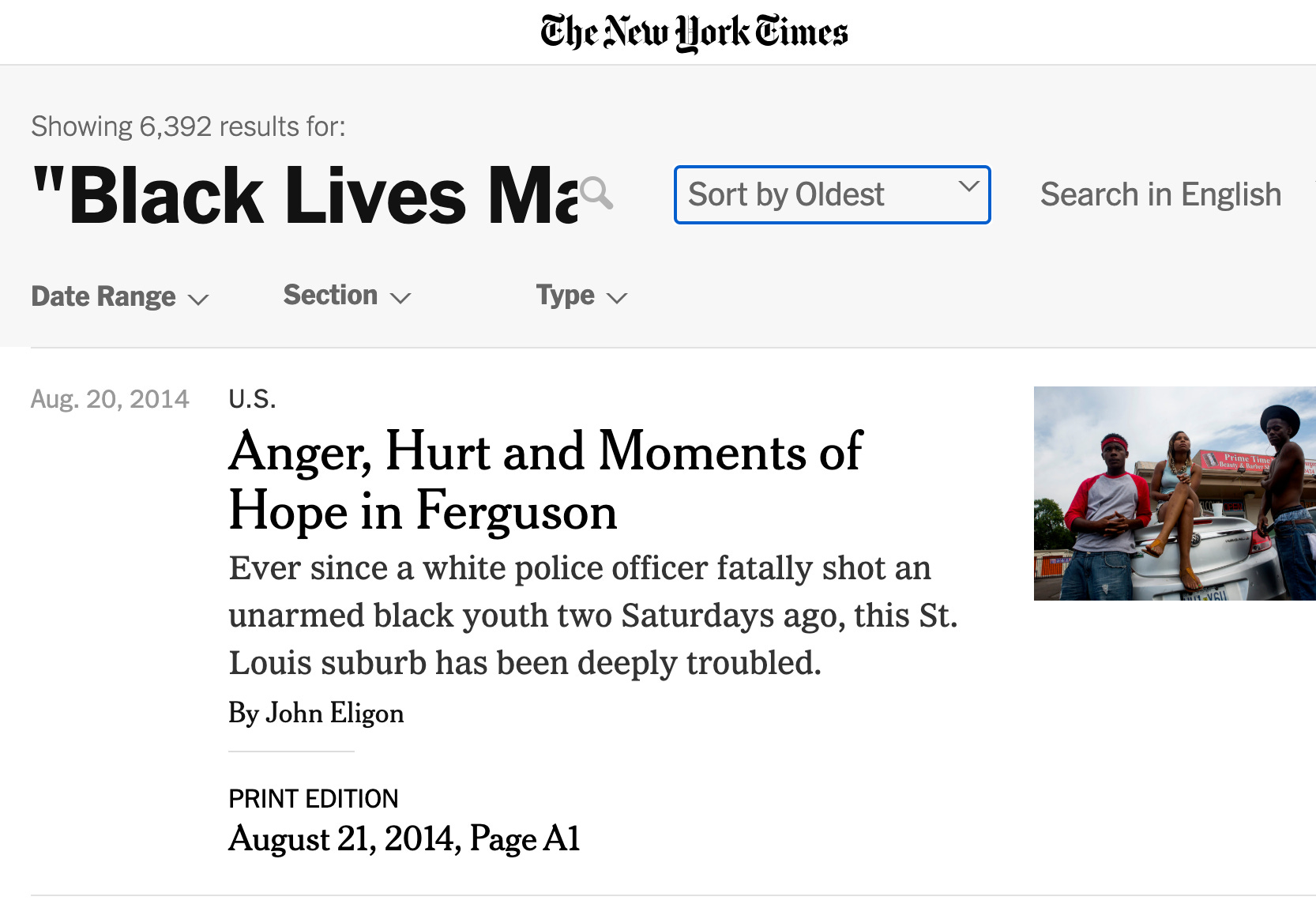
“Black Lives Matter” was then included in 29 more NYT articles in 2014, and now has been in 6,392 since Ferguson.
The peak was in 2020 with 2,298 articles referring to Black Lives Matter, more than six articles per day! Even 2021 saw three articles per days about BLM.
Since then, the NYT has managed to calm itself down to around one article per day or slightly less. (2025 is projected for the whole year at the recent rate.)
An important question is what impact did this national freakout over Black Lives Matter among, say, the 11 million paying subscribers of the NYT have on black lives (and deaths) on the street. (I’m using the New York Times to symbolize the respectable media in general.)
Offhand, there might not seem to be a direct connection. Murderers probably aren’t big New York Times subscribers on the whole. But the NYT and other respectable news media do have a sizable effect on policy.
So, measuring New York Times trends seems like a decent measure of how hysterical the American Establishment got over time.
Let’s also look at one up-to-date measure that correlates strongly with black on black gun violence: mass shootings with four or more killed and/or wounded.
Paywall here.
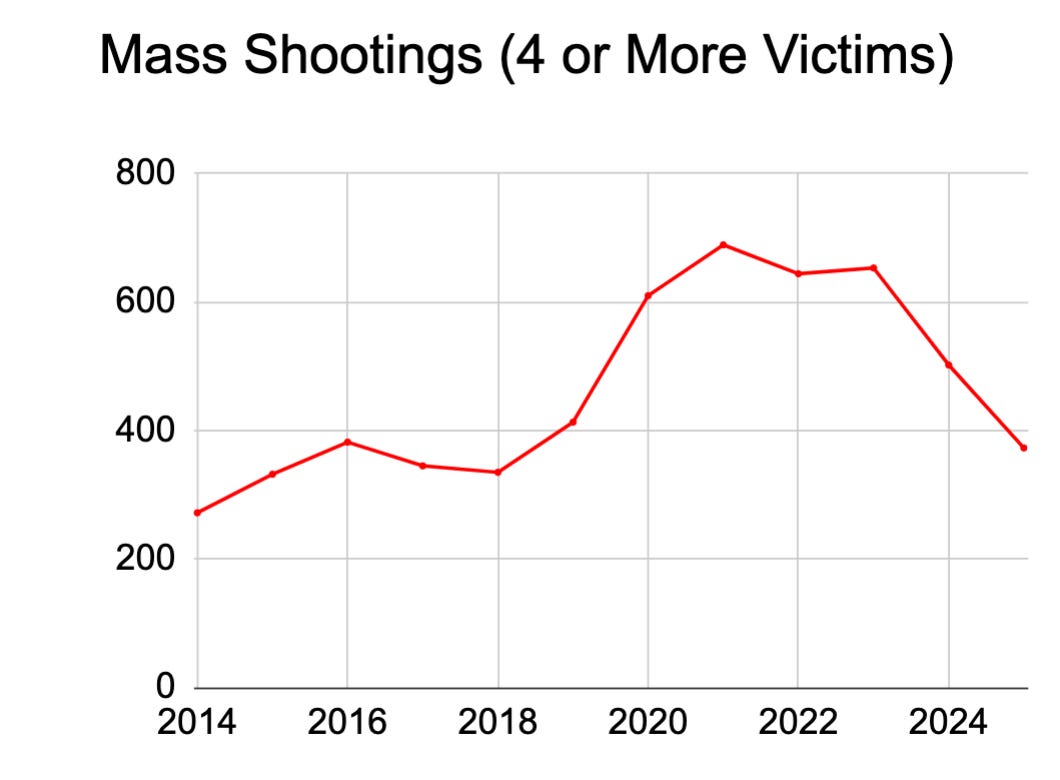
The Gun Violence Archive is a crowd-sourced website that tries to count all the shooting deaths in the country and all the mass shootings. It’s much faster than government sources such as FBI murder counts (which have a lag of over 8 months) and CDC homicide death counts (which are lagged by 6 months to let coroners have time to work — so we still don’t have CDC homicide totals for all of 2024 yet). The 2025 estimate is a projection that assumes the last 52% of 2025 will have the same rate as the first 48%.
As I’ve been pointing out for years, mass shootings come in two main varieties:
The rarer but more famous mass shootings where the shooter (almost always one person, although the most famous example, Columbine, featured two shooters) has made up his mind that he’s never coming home, so he hangs around to finish off the wounded. These are the highly publicized school shootings, church shootings, Going Postal workplace shootings, and the like. (There is also a less heavily covered subtype: the family extinction domestic slaughter.)
These type of mass shootings usually generate more dead than wounded.
They usually take place during the daytime. The shooters tend to be pretty representative demographically of younger males, with lots of white shooters, but also Asians, Hispanics, and blacks.
In contrast, the most common type of mass shootings generate more wounded than dead.
These tend to be ones where the shooter (or often shooters) wants to kill one or more particular people, but wants to get away with his crime. So, when he hears sirens, he skedaddles. The surviving wounded might be his intended targets that he didn’t have time to finish off, or they might just be random collateral damage.
Some of these are planned out (e.g., drive-by shootings) and others are spontaneous (e.g., somebody takes exception to a diss and starts shooting in the general direction of the disser).
These second type of mass shootings tend to take place at night, especially on weekends, often at social events: e.g., Saturday night outside a hip-hop nightclub.
The demographics of shooters and victims are extremely black: the New York Times did a study of all four or more wounded or dead mass shootings in 2015 and determined that “nearly three-fourths of victims and suspected assailants whose race could be identified were black.”
There’s one type of mass shooting that’s hard to categorize on these dimensions: the Kill All the Witnesses kind of money-driven crime, like the St. Valentine’s Day massacre of 1929, the Brown’s Chicken massacre of seven fast food employees in 1993, and the recent extermination of seven Laotians at a Southern California marijuana farm a few years ago. Fortunately, these kind of cold-blooded massacres haven’t really caught on in America.
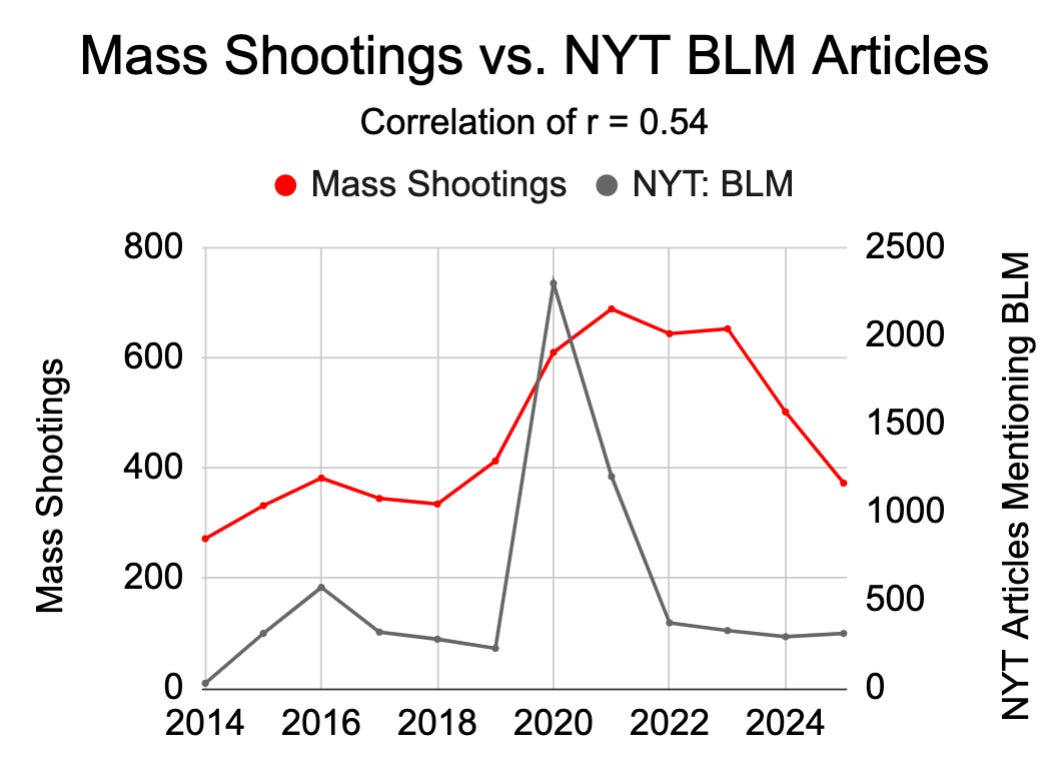
The giant number of Black Lives Matter articles in 2020-2021 coincided with a four year plateau from 2020 through 2023 of mass shootings, which has now fallen back to roughly the level of 2018.
In the social sciences, a correlation of 0.54 is often thought of as pretty strong. Not super-strong, but worth thinking about.
What about causality? Could the explosion of black on black mass shootings since Ferguson have caused the New York Times to run countless articles on the theme of how Black Lives Matter has led to huge increases in Black Lives Murdered?
Yeah, sure …
Seriously, that’s the kind of news that doesn’t fit.
Perhaps indirectly, in that nice liberal whites bought into the idea that hundreds of scholars and aspiring rappers were being mowed down by the cops every year, so depolicing is a great idea that will save innocent black lives and not have any negative downstream effects for society at large.
One of the hallmarks of elite whites and their institutions is that they really do not understand the people they claim to care about and adopt narratives that boost status but are divorced from unpleasant facts. Given their influence this has given fuel to massive errors in our culture and politics, and attempts to correct them are painted as retrograde bigotry.
Not sure too many Black shooters read the NYT. Maybe the cryptic crosstic but not much else