

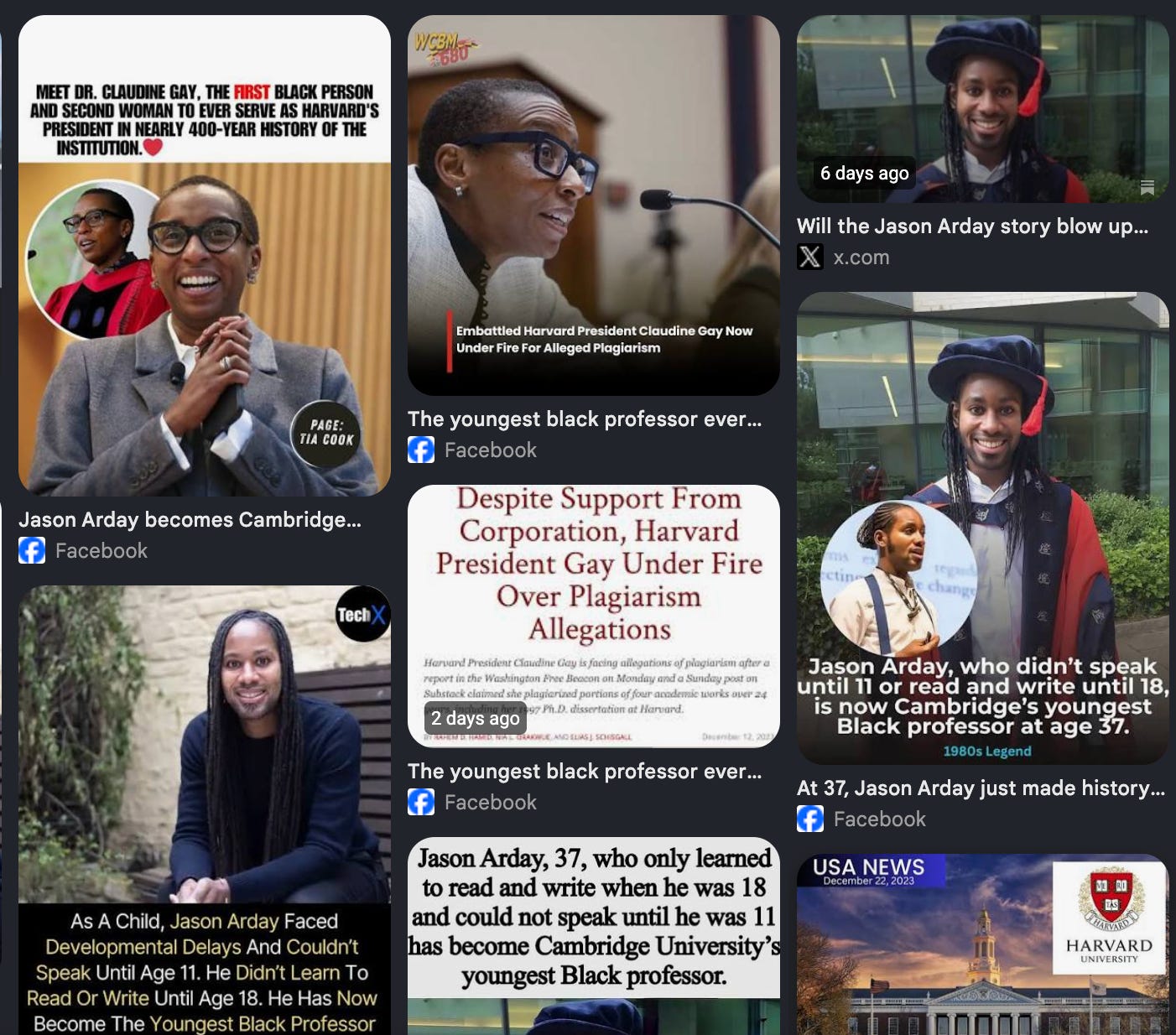
More on the hilarious Jason Arday scandal that I first wrote about in “Retarded Child Becomes Youngest Black Full Professor at Cambridge U.:”
From Retraction Watch on July 27, 2026:
Exclusive: News outlet killed story on plagiarism allegations after Cambridge prof hired law firm
Author: Brendan Borrell
In September 2025, Times Higher Education had a bombshell story in the works: A star sociology professor at the University of Cambridge had allegedly plagiarized parts of his Ph.D. thesis and several journal articles. In one of the articles, the borrowed text appeared in quotes from subjects the professor, Jason Arday, claimed to have interviewed himself.
But after Arday enlisted Carter-Ruck, one of the United Kingdom’s leading defamation law firms, to send Times Higher Education a letter, the publication spiked the story, according to three sources who spoke to Retraction Watch.
Carter-Ruck is a famous (and/or infamous) pit bull libel firm in London. From founder Peter Carter-Ruck’s 2003 obituary in the Telegraph:
Peter Carter-Ruck
22 December 2003 • 12:02am
Peter Carter-Ruck, the libel lawyer who died on Friday aged 89, had an unrivalled client list and a uniquely fearsome reputation in the offices of newspaper and magazine editors and rival solicitors. …
He was the author of the standard work on libel and slander. His clients included Princes Elizabeth of Toro, Stewart Granger, Robert Maxwell, Diana Lamplugh, Randolph Churchill, Sir James Goldsmith and Lucian Freud. He also acted for many members of the Conservative Party, including Neil Hamilton, Norman Lamont, Michael Heseltine, Norman Tebbit, Nigel Lawson, Cecil Parkinson and Edwina Currie.
Yet he was perhaps best known for is regular run-ins with Private Eye. “I’d feel neglected if a few weeks went by without a letter from Carter-Ruck,” the magazine’s editor Ian Hislop once said. Private Eye would retaliate to his writs by misspelling his last name. “It is a very, very amusing magazine,” Carter-Ruck admitted. “But they lack any sort of sensitivity and can sometimes be very hurtful.”
In 1989 Carter-Ruck publicly attacked the £600,000 damages awarded to Sonia Sutcliffe against the magazine and was invited to an Eye lunch, an occasion he attended with some trepidation. Not long afterwards, he asked if, in the new spirit of friendship, they would now stop printing the first letter of Ruck as an F. Their response, not unpredictably, was to print the first letter of Carter as an F as well. “I think my relationship with Private Eve is now definitely hate,” he said later.
Back to Retraction Watch:
One of the sources was David Sanders, a biochemist at Purdue University in Indiana, and a sleuth who contributes to the Times Higher Education on topics related to academic misconduct. He reviewed a 63-page dossier of text comparisons prepared by the publication last year and came back with his own findings. “There is no question that there is extensive plagiarism,” Sanders told us.
The allegations against Arday finally emerged last week following a Substack post from Nathan Cofnas, a philosopher at the University of Ghent in Belgium. Cofnas, who is known for his controversial writings on racial differences,
Cofnas got fired by Cambridge during the Racial Reckoning for endorsing a hereditarian perspective on racial differences in average IQ. A Belgian jurist recently demanded his arrest in an op-ed. He hasn’t been arrested … yet.
independently identified dozens of passages in Arday’s 2015 dissertation that were taken nearly verbatim from the 2009 dissertation of Paula Zwozdiak-Myers, a reader at Brunel University of London. Cofnas says he learned about the unpublished Times Higher Education story only after he began working on his own piece about Arday.
Arday is known for his work on topics related to race, inequality and education. His interest was more than scholarly: From humble beginnings as a nonverbal autistic kid in South London, he became, at age 37, the youngest Black person appointed to a professorship at Cambridge.
That achievement was covered by the BBC, CBS News, and Good Morning America. He is listed as a collaborator on more than $10 million in recent grants from two U.K. funding agencies, U.K. Research and Innovation and the National Institute for Health and Care Research.
Arday’s achievements have not been limited to academia. He has said he has raised more than $8 million for charity and performed impressive athletic feats, including running 30 marathons in 35 days. His forthcoming memoir, Great and Unfortunate Things, is slated to be published next month by Simon & Schuster.
Arday did not respond to three requests for comment sent to his Cambridge email address, but during a plenary he gave at the British Sociological Association conference in Edinburgh this April, he spoke vividly about recent attacks on Black academics.
“You get the email and they say you conducted academic misconduct. And you think to yourself, ‘Well this is incredible. I’m on the back foot here. How do I defend myself against this machine?” he said.
A whole bunch of the sociologists in the audience likely believed Professor Arday that there exists a giant machine out there to destroy black heroes like Arday.
Sociologists these days are …
Paywall here.
