

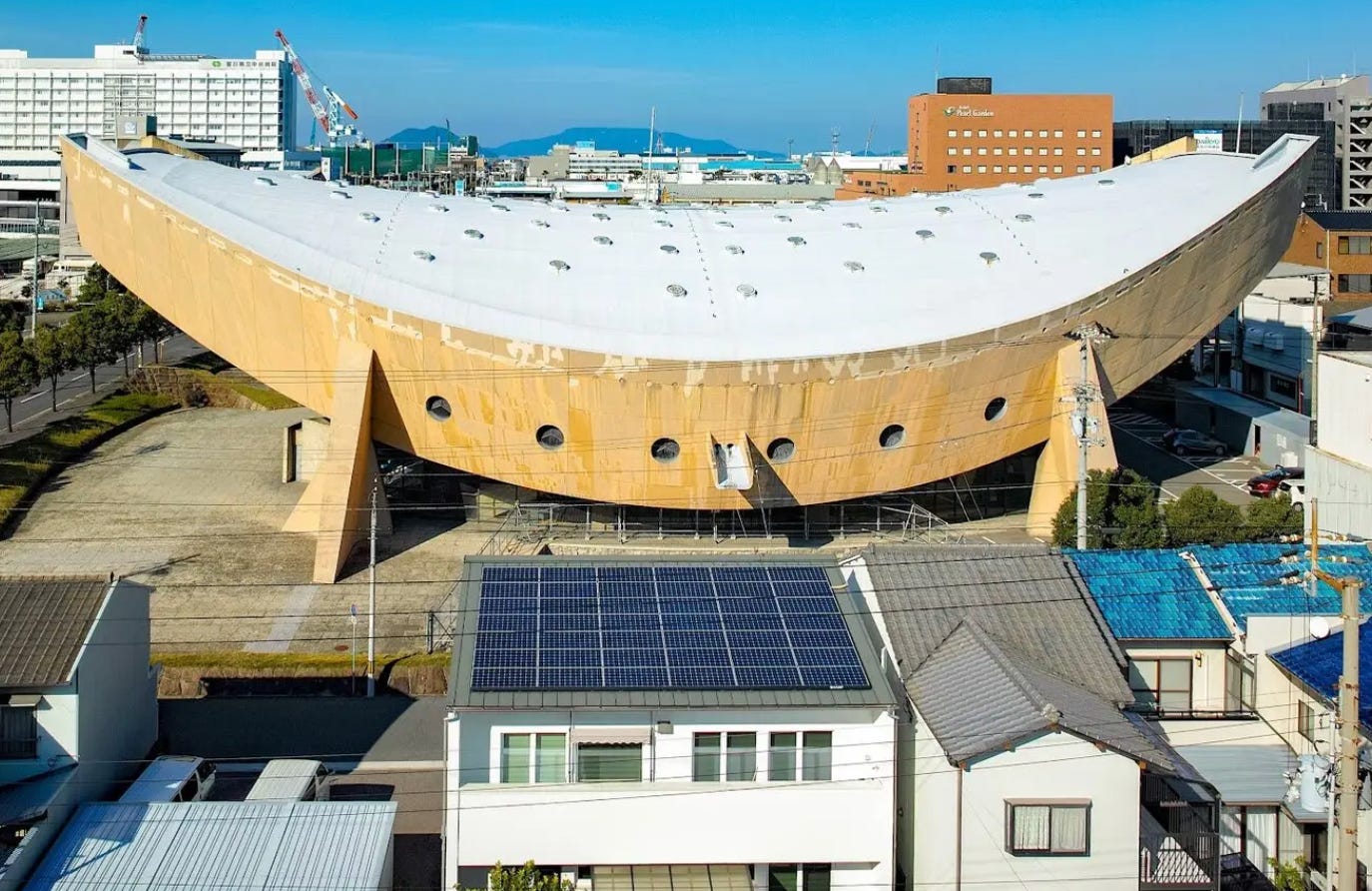
Looking like Noah’s ark just before the Flood, the Kagawa Prefectural Gymnasium, with seating for 2,500 spectators, was designed by architect Kenzo Tange and opened in 1964 in earthquake-prone Japan.
After a half-century of use, it was declared structurally unsound in 2014 and is currently scheduled for demolition.
In Japan, lots of modernist / brutalist buildings erected in the postwar era get torn down, even ones like this that are cute in a slow child’s refrigerator art sort-of-way, and are replaced by something new rather than be expensively renovated.
From the New York Times:
To Many, These Buildings in Japan Are Magnificent. They’re Doomed Anyway.
Why the country is quick to tear down its modern architectural masterpieces.
By Naomi Pollock
Reporting from Takamatsu, Japan
March 4, 2026
This article is part of our Design special section about buildings, objects and techniques that are fighting to stay alive.
But in the U.S., there’s more of an elite push to preserve aged modernist buildings as part of our heritage of tearing down our heritage in the name of modernism. Or something.
It’s hard to explain, but the fact that it’s hard to explain why Chesterton’s Fence explains why we must preserve Le Corbusier’s Fence (or Le Corbusier’s Bleak, Wind-Blown Plaza) adds to the appeal of preserving the more misbegotten designs.
Granted, in the U.S., however, some modernist designs, such as the Pruitt-Igoe (St. Louis) and Cabrini-Green (Chicago) housing projects have been blown up.
So have most of the multi-sports stadiums built around 1970, such as Three Rivers in Pittsburgh. During the 1970s, Three Rivers was a glamorous name, with the Steelers winning four NFL championships and the Pirates winning two MLB championships. Despite the nostalgia, it was imploded in 2001 with the Steelers and Pirates moving to their own purpose built stadiums.
But in America, there are strong lobbies to preserve even the most despised postwar public buildings that have modernist cachet, such as Paul Rudolph’s leaky tentacle porn brutalist Orange County Government Services Center. For instance, Mayor Michelle Wu recently designated the widely hated 1968 Boston City Hall a historic landmark.
Maybe the buildings designed by fashionable architects in the second half of the 20th Century weren’t so beautiful, but the theories rationalizing them were works of art. Hence, it’s prestigious in the U.S. to be nostalgic for Shock-of-the-New buildings from 60 or 70 years ago.
Paywall here.
