

Nathan Cofnas, the hero of the Jason Arday Fiasco, was the first academic brave enough to go public with what other academics had been talking about privately as far back as 2023 when Arday was made a full professor at the U. of Cambridge. Cofnas spilled the beans on Arday’s plagiarism and all-around thick-as-a-brickness on July 21, 2026 in his Substack post “DEI Fraud and Cover-Up at Cambridge.”
I started writing about Arday on July 26.
Around then, he became a big story in the right-of-center British press like the Telegraph, Times, and Daily Mail.
Over the weekend, the left-of-center Guardian weighed in with a devastating article by Lanre Bakare, “Playbooks, plagiarism and a pig’s head: new claims surrounding a star Cambridge professor,” that, after starting out as if it were going to blame Arday’s troubles on rightwingers pouncing, then revealed even more of Arday’s paranoid fantasies.
But for the first couple of weeks, almost nobody in the U.S. news media dared touch the Arday story.
When I’d point that out, some people would respond that nobody in America would care about some overseas college scandal.
After all, how many Americans have ever heard of the U. of Cambridge, when there are so many more famous universities in this world, such as Oxford, Harvard, and … and … uh … lemme get back to you on my list of more famous universities than Cambridge. I promise.
And who has ever been on the Cambridge faculty? I mean, besides Isaac Newton, Stephen Hawking, Alan Turing, C.S. Lewis, John Maynard Keynes, Bertrand Russell, and, now, Jason Arday?
Finally, after a couple of weeks, the New York Times has decided the Arday story is fit to print.
The NYT’s story is structured in its usual upside-down format where the opening paragraphs won’t undermine the median subscriber’s worldview, while a later section gets into some of the interesting facts. Newspapers used to put the important news at the top of an article, but the marketing department at the NYT didn’t get 13 million paying subscribers by letting reporters offend the customers who really don’t want to know.
But toward the end the article goes into heavy duty conspiracy theorizing mode, alleging “broader concerns about the ways accusations of plagiarism are being weaponized.”
Nathan Cofnas is denounced some more. Chris Rufo’s takedown of the absurd ex-president of Harvard, Claudine Gay (post-presidential compensation in 2024: $1.5 million), is cited as evidence of a pattern of targeting of black academics rather than as evidence of blacks often being promoted into posts over their heads during the recent Racial Reckoning.
The unexpected thing, however, is that the headline and subhead may give away the the more critical second part of the article. It appears that Arday blew off a scheduled interview with the NYT, so they may be personally mad at him.
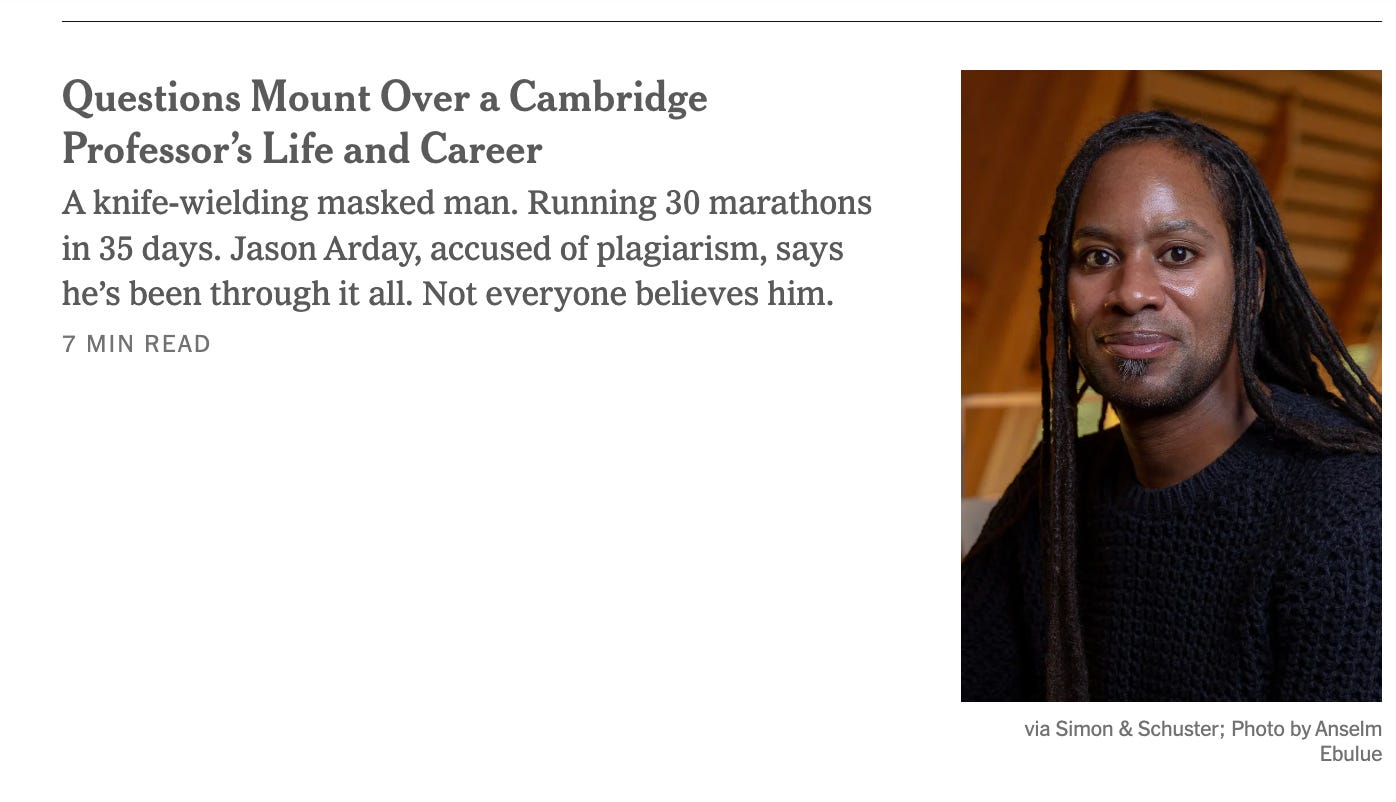
Questions Mount Over a Star Scholar’s Life and Career
A knife-wielding masked man. A pig’s head outside his parents’ door. Running 30 marathons in 35 days. The Cambridge professor Jason Arday, accused of plagiarism, says he’s been through it all. Not everyone believes him.
To you and I, this sounds pretty harsh toward Arday. After the left-of-center Guardian unloaded on Arday, the Times can’t defend him. The case is now closed in the eyes of any objective observer.
You can tell the NYT isn’t sure how hard they want to commit to this Arday guy because he isn’t pictured next to a window with a pensive look on his face.
But a lot of the 13 million paying subscribers will glance at Arday’s smiling black face and think, “How dare they question a star black scholar?”
The NYT hasn’t reached its dominant position in the Internet Age’s news media by undermining its paid readers’ world-views.
By Jennifer Schuessler and Alexandra Alter
Aug. 3, 2026, 8:08 p.m. ET
For Jason Arday, it has been a breathtaking climb to the top of the ivory tower.
Raised in South London by Ghanaian immigrant parents, Arday says he was diagnosed with autism at age 3, was nonverbal until he was nearly 12 and couldn’t read or write until he was 18. He went on to get his Ph.D. in education, and claims to have had to relearn the contents of his dissertation weeks before defending it after losing his memory following the removal of a benign brain tumor.
In 2023, when he was 37, Arday became the youngest Black professor at the University of Cambridge in its history. That appointment, trumpeted by Cambridge, inspired a spate of glowing media coverage on both sides of the Atlantic highlighting his dramatic life story, including his claims to have once run 30 marathons in 35 days to raise millions of British pounds for charity.
Arday has also told the press that his academic successes brought darker attention, including the delivery of a severed pig’s head to his parents’ home and repeated visits to his office by a masked intruder, once while wielding a knife.
Next week, Simon & Schuster will publish Arday’s memoir, “Great and Unfortunate Things,” under its 37 Ink imprint. In the lead-up to the book’s publication, Arday has found his academic integrity and claims about his biography increasingly under fire.
Concerns about some of Arday’s work had circulated quietly in scholarly circles since the appointment at Cambridge catapulted him to academic celebrity. But they exploded into public view late last month, after a scholar known for racist views about intelligence published a lengthy article in his newsletter questioning parts of Arday’s remarkable personal story and leveling extensive charges of plagiarism against him.
The link in the NYT goes to Nathan Cofnas’s 2020 article in Philosophical Psychology entitled “Research on group differences in intelligence: A defense of free inquiry.” Here’s Cofnas’s abstract:
In a very short time, it is likely that we will identify many of the genetic variants underlying individual differences in intelligence. We should be prepared for the possibility that these variants are not distributed identically among all geographic populations, and that this explains some of the phenotypic differences in measured intelligence among groups. However, some philosophers and scientists believe that we should refrain from conducting research that might demonstrate the (partly) genetic origin of group differences in IQ. Many scholars view academic interest in this topic as inherently morally suspect or even racist. The majority of philosophers and social scientists take it for granted that all population differences in intelligence are due to environmental factors. The present paper argues that the widespread practice of ignoring or rejecting research on intelligence differences can have unintended negative consequences. Social policies predicated on environmentalist theories of group differences may fail to achieve their aims. Large swaths of academic work in both the humanities and social sciences assume the truth of environmentalism and are vulnerable to being undermined. We have failed to work through the moral implications of group differences to prepare for the possibility that they will be shown to exist.
Racist, I tell you, racist!
Between you and me, of course, this Arday Fiasco sounds exactly like the kind of consequence Cofnas was talking about.
But that just makes Cofnas more racist. Or something. I mean, who thinks about such things? Sure, the extremely well-documented racial gap in average IQ would appear to a Man from Mars to be the skeleton key that unlocks countless conundrums that befuddle American Earthlings about their own society.
But that’s why you aren’t supposed to know about it.
Back to the new NYT news (i.e., supposedly not opinion) article:
The accusations quickly drew widespread media coverage in Britain, which initially broke down along familiar culture-war lines. To the right-wing media, Arday was a “diversity poster boy.” To supporters, including prominent academics and politicians who signed a petition of support that quickly drew thousands of signatures, he was the victim of a racist smear campaign.
Let’s not overstate how ardent the left-half of opinion in Britain was in defense of Arday. White leftists mostly seemed to want the whole thing to go away.
Of the 38 initial signatories of the Good Law Project’s letter standing up for Arday, only 6 were white. And how prominent were they? I don’t know much about Britain lately, but I only recognized the names of 2 of the 38: Green Party leader Zack Polanski and autism research Simon Baron-Cohen (comedian Sacha Baron-Cohen’s kinsman).
But over the weekend, as questions about his work and personal story continued to mount, a different debate emerged. Is Arday a victim of a campaign to discredit Black scholars? A fabulist whose tales of extreme adversity the academic establishment deemed too good to check? Or both?
So far, Arday’s publisher and university have stuck by him, even as the media has surfaced other questionable assertions — like an apparent claim in a 2022 interview that he had been part of the British documentary series that included the film “Seven Up!,” which began before he was born.
As I pointed out over the weekend.
The Daily Mail today features Arday’s new explanation for why he said he was in Seven Up, which is roughly the Ken Burns’ Civil War of British TV documentaries:
Last night Professor Arday said that when he talked of ‘Seven Up’, he didn’t mean ‘Seven Up’ the famous TV series, which followed children at seven-year intervals in the format he described. He says that in fact he was referring to ‘a local community and parent-led initiative developed around the Ubuntu principle that “it takes a village to raise a child”.
‘It was organised by Black women to support Black mothers raising children with complex learning needs.’
He asked that we attribute the quotes to ‘a source close to Professor Arday’.
‘The reference to “Seven Up” was used informally as a shorthand illustration of the concept. It was not intended as a literal comparison and should be understood in the context in which it was made. Attempts to present the phrase in isolation risk creating a misleading impression of both the initiative and Professor Arday’s comments,’ Professor Arday said.
It’s kind of like how I was in “Lawrence of Arabia” in 1962 with my good friends Omar, Alec, Anthony, and Claude, under the guidance of David.
What?
You are saying I was only 4 years old in 1962?
Yeah … well, … you know … look, it was like this: “Lawrence of Arabia” was what David, the high school boy who supervised our after-school playgroup in the local park’s sandbox, called us kids.
I never did figure out who Lawrence was.
… Arday has attempted to clarify or defend many of his claims, including that one. But at times, his responses have added to the controversy.
In an interview with The Times of London published on Friday, Arday appeared to acknowledge some errors in his early work, but blamed them in part on his autism
Is there any evidence that Arday has autism other than that his IQ is much lower than you’d expect for a Cambridge professor? For example, he seems like …
Paywall here.
