

The following post on the widely discussed Guardian ranking of the top 100 novels in world history was originally restricted to paying subscribers of SteveSailer.Net.
But I’m now sending it out to free subscribers so you can read and add to the 220 high quality comments by paid subscribers.
My hope is that you’ll realize that you want to participate in the community of SteveSailer.Net subscribers.
I realize a subscription to SteveSailer.Net is not cheap.
Hence, I now seldom send out un-paywalled posts in order to encourage you to become a paying subscriber. I notice that when I make good paywalled posts, The Line [i.e., my income] Goes Up. But when I make good un-paywalled posts, The Line Goes Down.
But, I regret that Substack doesn’t normally let me allow my 5-digits worth of free subscribers see how strong the comments submitted by my 4-digits worth of paying subscribers are.
So, I’m going to try sending out for free a recent paywalled post in the hope that Substack will allow free subscribers to notice how excellent the quality of my paying comment section is.
Here’s the full post, some of which you may already have seen. I regret the Persuasion/Possession screw-up.
But you have to admit, it’s pretty funny.
Social media accounts draw a lot of eyeballs with engagement-bait Top Ten lists, so lately the mainstream media has been doing it too.
They try to use their prestige to assemble a better panel of judges than one guy with a laptop. For example, the New York Times published a reasonable list of the Top 100 films of this century last June, as chosen by 200 people who have actually worked on movies (e.g., Mel Brooks) rather than critics who have merely opined about them.
Now The Guardian has followed up with a Top 100 novels of all time list, as chosen by “authors, academics, and critics.”
I’ve studied dozens of such lists of books, movies, albums, and so forth over my lifetime. And, being a counter-contrarian, I’ve benefited a lot from listening to the consensus of experts about how best to self-educate myself.
Here’s their top 30:
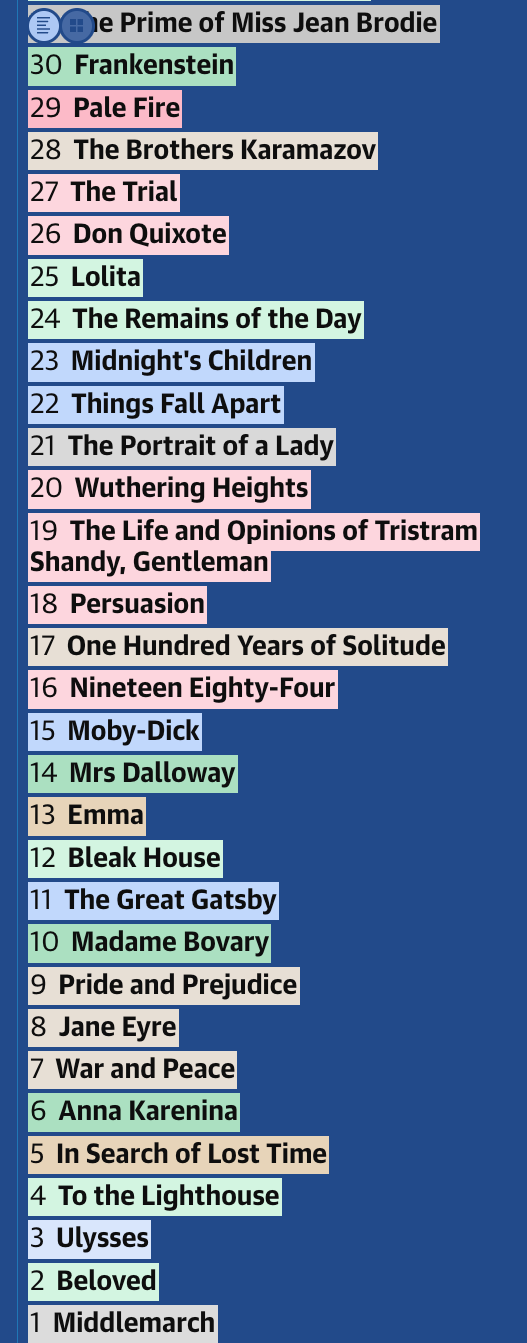
It’s kind of obnoxious to assume that these novels are so famous that The Guardian doesn’t need to publish the names of the authors. For example, #18 Persuasion is by A.S. Byatt, a distinguished authoress, but not a household name.
Still, I read Persuasion 35 years ago and thought it was tremendous. Tom Stoppard had read it a few months earlier and immediately stole its device — comically hapless 20th Century English lit grad students try to grasp great-souled 19th Century writers — for his masterpiece Arcadia.
Update: Commenter Blake Neff points out that Persuasion is by Jane Austen. A.S. Byatt’s masterpiece is Possession.
So, yeah, it is extremely obnoxious to not post the author’s name! It can lead to embarrassing mistakes.
You can find the link to the list of voters and their votes at the bottom of the Top 100 list. (For some reason, the voter list doesn’t have a separate URL). It’s pretty British so I don’t know most of the names. I do recognize Stephen King, William Boyd, by whom I’ve read several novels, Salman Rushdie, Ian McEwan (Atonement), Michael Chabon (The Adventures of Kavalier & Clay), John Lanchester, and Roxane Gay (oh dear).
The striking thing about the top 100 is how traditionalist it is.
It’s not all that much different from what The Guardian would have come up with in 1976, although the order would be rearranged. The highest ranking novel by a living author is 1981’s Midnight’s Children by Salman Rushdie, whom Islamists keep trying to murder.
The main difference between what a left-of-center mainstream publication would have come up with fifty years ago is that novels by women have drifted toward the top. Middlemarch by George Eliot (a.k.a., Mary Ann Evans) would have definitely made the top 100 a half century ago, but #1?
Still, Middlemarch is a 155 year old Victorian classic. It’s hardly some Woke flash in the pan.
(One methodological issue is that if an author has multiple books contending for his or her best, like Dickens does, he’s unlikely to make number one. When I was a kid, David Copperfield was assumed to be his best. Then, Great Expectations took over that role. Now, Bleak House comes in at #12. Who knows what the next generation will consider Dickens’ best?)
Seeing Middlemarch’s reputation rise throughout my lifetime, I started reading it a decade ago. But, I stopped after 100 pages. It’s very good, but it’s primarily a book by and for a woman, so it didn’t knock me dead. Plus, I’m old and my attention span is fried by Twitter.
I did read all of Thackeray’s Vanity Fair in 2022, which is a man’s book about a woman, Becky Sharp. I enjoyed it thoroughly. So, while my patience for giant 19th Century novels isn’t what it was when I was 17 and could devour Fielding’s 800 page Tom Jones from 1751 (which didn’t make this new Top 100), I’m not totally over the hill.
In a mostly genial companion essay, The Guardian’s book critic Lisa Allardice explains:
Who’s in, who’s out, and how many have you read? The story behind our 100 best novels list
Novels shooting out of a gold canon
Illustration: Lisa Sheehan/The Guardian
Jane Eyre or Wuthering Heights; Ulysses or Catch-22 … Find out which title came top, as chosen by authors, critics and academics worldwide
Lisa Allardice
Sat 16 May 2026
… The most striking difference between this list and its predecessors is an increase in female writers: 36 out of 100 compared with 21 in 2015 and a paltry 16 in 2003, with only Jane Austen’s Emma and Mary Shelley’s Frankenstein in the top 10 of both previous lists. The number of women rises as the decades go by; half of the contemporary writers are female.
Let me point out that the decline of male influence in literature is likely not at all a good thing, but it’s also inevitable if men stop reading and instead go obsessively for gaming. Computer games can be amazing, but they tend to be a cultural silo compared to books, music, and movies. The Beatles alone may have had more overt influence on world culture in 1964-1970 than all of computer gaming has ever had since.
So, men did this to themselves.
Women wrote a large fraction of American bestsellers in the first 40 years of the 20th Century, but World War II seemed to provide male writers with great material, so men dominated the postwar literary scene. But males have largely lost interest in reading and writing about war when they could be playing at war in first person shooter video games.
So women now have the whip hand in the literary world.
Unsurprisingly, this has not ushered in a golden age of literature, to say the least.
This might not announce the decline of the great white male, but it does signal a much-needed reset. …
As with all prize lists, the real fun is spotting who is out. Noticeably absent are the big beasts who stalked the late-20th century literary landscape in the US – Mailer, Updike, Roth – and their British descendants.
Jacob Savage would note that a lot of the dropped male heavyweights were Jews: Bellow, Roth, Mailer, Salinger, etc.
Update: Looking at just the top 30 above, Proust was half Jewish and Kafka was all Jewish. But that accounts for just 5% of the Top 30, much less than Nobel hard science laureates whereas my 2011 study found that Jewish scientists account for 20% to 25% of Nobel winners in physics, chemistry, and medicine.
So increasing diversity seems to be taking a toll on Jewish authors’ fame, which is inevitable, but also something that Jews should keep in mind.
Perhaps this reflects a post-#MeToo discomfort at so much female objectification, no matter how dazzling the prose.
The one high lit novel that high IQ young men have really identified with in the last 30 years — 1996’s Infinite Jest by David Foster Wallace — isn’t on this list. Wallace wrote a famous takedown of John Updike. And now the late Wallace has suffered the same fate at the hands of women who control literature in the 2020s.
Oh, well.
Men should have stuck together.
However, the morally contentious Lolita by Vladimir Nabokov, long hailed the supreme stylist of English prose, survives even the toxic endorsement of Jeffrey Epstein, who, we can safely assume, missed its dark ironies.
I find Lolita (#25) distasteful, but Nabokov’s Pale Fire at #29 is wonderful. His science fiction short stories Time and Ebb and Lance are fine introductions.
Updike, who succeeded in “giving the mundane its beautiful due”, will be missed by many. And as one born under the mark of Martin Amis, I can’t help but think there should be a place for an era-defining novel like Money. There’s a pang, too, for McEwan’s Atonement, which held me in its spell as fervently as LP Hartley’s 1953 The Go-Between (to which it owes a debt), which scrapes in at 99. Maybe these writers are just too recent: Amis only died in 2023, after all.
The same might be true of the now unfashionable postwar writers: there’s no CS Lewis, William Golding or Tolkien (The Lord of the Rings was the nation’s favourite in the BBC’s Big Read).
Likewise, the Lord of the Rings trilogy strikes me as the premier accomplishment of 21st Century film-making. Sure, it’s interesting to suggest Parasite is the greatest movie of the 21st Century. It’s certainly one of the most interesting movies, but is it greater than the 9 hours of Lord of the Rings?
… The comic novel, like science fiction and crime, rarely fares well in bookish horse races. Patricia Highsmith makes the cut, but not John le Carré – or Stephen King, for that matter. … There are no children’s novels, either – no Wind in the Willows, Charlotte’s Web or Harry Potter. It is a very grown-up list.
For example, Robinson Crusoe, Gulliver’s Travels and Treasure Island don’t make the Top 100 list. One of the greatest cultural accomplishments of the British is children’s literature. (Obviously, Gulliver’s Travels isn’t child lit. On the other hand, isn’t it great that smart English-speaking children pick up Gulliver’s Travels to read about a giant?)
I think that restricting each judge to voting for his or her top 10 and nothing else makes it a little top-heavy with big, serious novels. For example, I looked at the votes of a man of letters named Marcel Theroux, wondering if he was another member of the giant Theroux dynasty of talented people.
Yes, he’s the son of travel writer Paul Theroux and a relative of a whole bunch of other moderately well-known Therouxs. For example, Marcel's younger brother Louis Theroux recently released a documentary on Netflix called Inside the Manosphere that got a lot of right wing influencers angry, but sounds fun.
The interesting thing about the Theroux clan is that they emerged out of lower middle class American Catholic obscurity. Marcel’s grandfather was a French-Canadian shoe salesmen. It’s like if Al and Peg Bundy on Married with Children spawned a half dozen fine writers, translators, documentarians, and actors.
Here’s Marcel Theroux’s votes:
1 War and Peace (#7) by Leo Tolstoy
2 Middlemarch (#1) by George Eliot
3 Madame Bovary (#10) by Gustave Flaubert
4 Pride and Prejudice (#9) by Jane Austen
5 David Copperfield (#33) by Charles Dickens
6 Nineteen Eighty-Four (#16) by George Orwell
7 Gulliver’s Travels by Jonathan Swift
8 The Great Gatsby (#11) by F Scott Fitzgerald
9 The Master and Margarita (#66) by Mikhail Bulgakov
10 Kim by Rudyard Kipling
That’s a really good list. (Like most of the Therouxs, Marcel appears to be slightly right of center: note the two anti-Communist books out of ten.) Seven of his ten votes made the top third of the list, with another in the second third. And his two outlier votes were for the masterpieces of Jonathan Swift and Rudyard Kipling. (Two Tories whom The Guardian is likely implicitly biased against. This is not to say that The Guardian’s list is Woke, it largely isn’t. It’s just that The Guardian has been progressive rather than conservative for two centuries, so conservative geniuses like Swift and Kipling are not its favorites for reasons well over 100 years old.)
I’ve read all of Pride and Prejudice, 1984, Gulliver’s Travels (including rereading it during Covid), The Great Gatsby a few times, and Kim, plus the first 100+ pages of War and Peace, Middlemarch, Madame Bovary, and the The Master and Margarita. (I paid a lot of attention to critical opinion, so I’ve started a lot of great books that I haven’t finished.) I read David Copperfield in Classics Illustrated comic book form when I was nine or ten.
On the other hand, given, say, 50 votes, I bet Theroux would slip some more books in that he really enjoys along with this list of ten books that he really admires. There are a lot of fun books like, say, King Solomon’s Mines or A Confederacy of Dunces that would probably attract votes if judges didn’t have to restrict themselves to voting for The Ten Greatest Novels in the History of the World.
The Guardian asked for your three favorites. I voted for three novels that weren’t on their list:
Try to guess which three I put following this paywall:
I wrote on The Guardian’s page:
I liked your list a lot. It was strikingly traditionalist and post-woke. (I guess the Trump Vibe Shift really has happened.) My choices are by some centrist-to-reactionary authors that The Guardian would likely admit to being slightly prejudiced against.
Evelyn Waugh, Scoop
I’ve read it ten times: Waugh’s prose at its peak combined with a satire on journalism and an African setting. How could I not love it?
Tom Wolfe, The Bonfire of the Vanities
The most insightful novel about the 2020 George Floyd Racial Reckoning in the U.S., yet it was published in 1987. There is no Great American Novel, but this is The Great New York Novel, which is a very good thing to be.
John Updike, The Coup
Updike at his best in 1978, working very hard to get outside his usual settings to explain Africa and why America was going to win the Cold War.
Obviously, I like comedy and satire, politics and public affairs, prose stylists, books about Africa for the insight they provide into African Americans, 20th Century prose, and centrist (Updike) to reactionary (Waugh) geniuses.
Note that I’m not angry at The Guardian for not sharing my exact tastes. Still, I think that my precise predilections are also pretty good.
How would you vote?
As soon as I saw that you had submitted three alternates to the Guardian, I knew one would be The Bonfire of the Vanities. I reread it every few years, just to see how much today's New York resembles the novel's gloomy outlook. Wolfe correctly predicted that minorities -- blacks and Hispanics -- would eventually elect minority mayors and district attorneys. He might be mildly surprised that NYC hasn't had a Hispanic mayor yet, although he would recognize that blacks vote more reliably as a bloc than Latinos, who are nowhere near as monolithic as they're commonly thought to be. (Legal immigrants are often violently opposed to illegal immigrants, whom they view as queue-jumpers. Then there's the tension among the various Hispanic subgroups: Mexicans and Dominicans don't necessarily see themselves as brothers; the same holds true for Hondurans, Salvadorans and Guatemalans; and none of the above particularly like Puerto Ricans, whose language they don't recognize as truly Spanish.)
Finally, Wolfe's masterpiece failed to account for the disappearing Jewish presence in NYC (and state) politics. From Ed Koch to Eric Adams (and his Ugandan successor, whose ascendancy might have shocked even Wolfe), from Robert Abrams to Letitia James, from Robert Morgenthau to Alvin Bragg: where did the Jewish politicians go? Chuck Schumer's the last high-level one standing, and this is likely to be his final term in the Senate: right now, Occasional Cortex would beat him in a primary. And she's probably not the only one.
Sorry, it may not be Woke at a superficial level but the list is a hot mess, and the product of an unseemly blend of a half educated middlebrow and, in fact, a pious Woke sensibility.
I won’t waste much time on this pointless parlour game, but “Beloved” at #2 and two unreadable Virginia Woolf novels in the Top Twenty is indefensible and disqualifying.
I’m a big fan of your work but we’ll have to agree to (strongly) disagree about the value of The Guardian’s list.