


The current events in Poland in which the liberal prime minister, feuding with the conservative president, sent armed men to surround the Polish equivalent of the conservative Supreme Court in an effort to impose new judges, aren’t getting much coverage in the U.S. mainstream media. That’s probably because it’s so easy to picture a U.S. Democratic president and Congress doing something similar to the Republican-dominated Supreme Court a few years from now.
Thus, the timing of Donald Tusk’s introduction of force into Polish politics just before the midterms elections in the U.S. is awkward, to say the least. So, the New York Times’ coverage today tries to distract its 13 million subscribers, who aren’t paying to have their worldviews subverted by embarrassing events, by directing their attention instead 800 miles to the east of Warsaw to the all-purpose Bad Guy in that general part of the world:
Russia Senses Opportunity in Polish Political Turmoil
After its sometime allies were ousted in elections in Hungary and Serbia, Moscow has seized on Poland’s constitutional standoff in its effort to weaken Europe’s support for Ukraine.
By Andrew Higgins
Reporting from Warsaw
Nov. 2, 2026
When Poland’s centrist government sent the riot police late on Friday to seal off the country’s Constitutional Tribunal amid a long standoff over control of the court, its right-wing enemies accused it of staging a criminal “coup d’état.”
Now, Russia has jumped in, too,
Russia sent armed men into the heart of Warsaw to surround a major organ of the Polish state? Why was I not informed?
fanning claims of a putsch by Prime Minister Donald Tusk and amplifying attacks on Poland’s pro-European government by hard-right politicians at home and abroad.
Oh, sorry. Instead of invading Poland, Russia has, apparently, issued some press releases and more than one tweet trolling Donald Tusk.
Mr. Tusk, long reviled by Moscow because of his strong support for Ukraine, sent police officers to the court after right-wing protesters gathered outside to denounce the suspension of its chief justice, an ally of Poland’s former governing party, Law and Justice.
Dmitri Medvedev, a former Russian president who is now vice chairman of the Kremlin’s security council and a close ally of President Vladimir V. Putin, declared on Sunday that “a constitutional coup is underway in Poland.”
Claims of a coup at the Constitutional Tribunal, the focus of a decade-long political struggle over the Polish judiciary, have dominated attacks in recent days on Mr. Tusk by his right-wing enemies at home and Kremlin-friendly European politicians like Marine Le Pen of France, Nigel Farage of Britain and Geert Wilders of the Netherlands.
The entire implication of this article — that the struggle within Warsaw is between Law & Justice’s pro-Putin Bad Guys and Tusk’s anti-Putin Good Guys over policy toward Russia — is intentionally misleading.
It’s fun for the NYT to hype its conspiracy theory of an international conspiracy of nationalists.
But one notorious problem traditionally besetting nationalists in northern Europe is that they tend to get on each other’s nerves, especially Poles and Russians.
Thus, Poland’s populist nationalist Law & Justice party, which was in power from 2015-2023 before peacefully giving up parliamentary power after losing the 2023 parliamentary election, but then retaining some degree of power by winning the 2025 presidential election, is one of the most fanatically anti-Russian parties in all of Europe.
Its official leader and chief strategist, Jarosław Kaczyński, hates Putin with a deep-seated passion not just for ancient Pole vs. Russian reasons, and not just for Putin invading Ukraine either.
Jarosław Kaczyński also believes that Vlad Putin had his identical twin brother Lech Kaczyński, the president of Poland, murdered in the 2010 plane crash of Polish dignitaries flying to Russia to memorialize the 22,000 Polish officer POWs murdered at Katyn by the Soviets shortly after Stalin (in alliance with Hitler) conquered Poland in 1939.
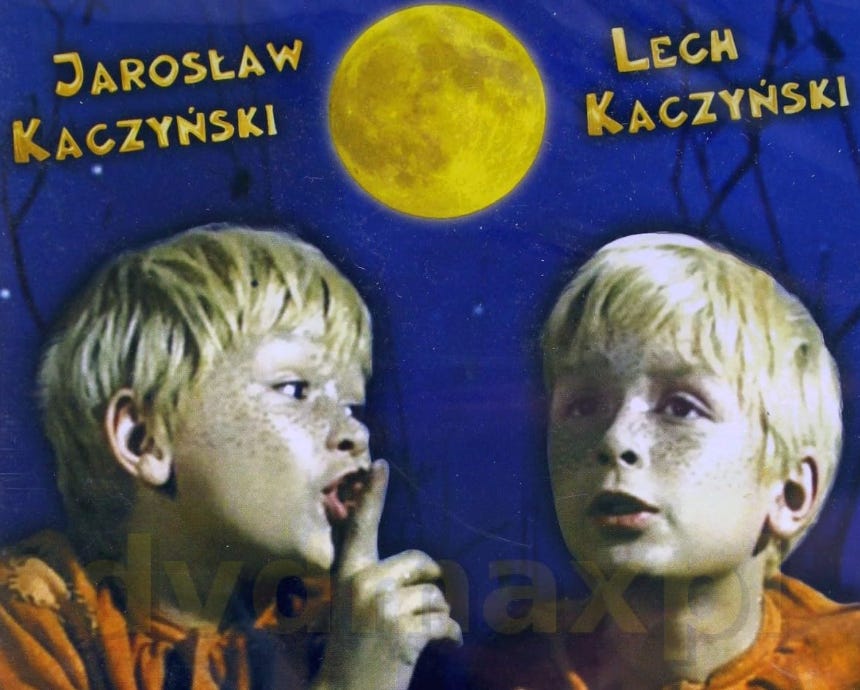
The Kaczyński twins had been popular child movie stars in 1960s Poland. But as grown-ups, they tried to avoid being photographed together as the leaders of the Law & Justice party because, while children like identical twins, in their experience, adults tend to be creeped out by them.
Personally, that is the kind of thing I find interesting, but the NYT doesn’t want to touch it, at least not until after Tuesday’s election. Subscribers are not paying for a lot of details that would complicate their understandings of who, exactly, are the Good Guys and who are the Bad Guys:
Stay focused, people!
Right-wing allies of the suspended chief justice, Bogdan Swieczkowski, who over the weekend still controlled the tribunal’s social media account, accused their rivals of “committing the crime” of a putsch, a charge quickly taken up by a swarm of commentators on X, Telegram and internet bulletin boards.
Referring in a speech over the weekend to often false claims on social media of violence and police brutality at the court, Mr. Tusk said, “They are using an army of Russian bots on the internet.”
Russia and Europe’s E.U.-skeptic hard right seem eager to inflame Polish tensions in the hope of weakening Poland’s staunchly pro-Ukraine and pro-European Union government at a time when Moscow is working hard to undermine Europe’s support for Ukraine.
Those efforts suffered setbacks with the election defeat in April of Prime Minister Viktor Orban of Hungary, a longtime opponent of helping Ukraine; and of Aleksandar Vucic, Serbia’s longtime leader, on Oct. 25. …
In the 12th paragraph, the NYT alludes to Poland’s opposition to Russia, but fails to tell readers that the Law and Justice party is at least as anti-Russian as Tusk’s coalition.
Poland stands at the opposite end of the spectrum from Serbia in relation to Russia and has been a frequent target of abuse, disinformation campaigns and sabotage operations by Moscow.
My guess is that 90+% of the NYT’s American readers will assume from how this article is framed that Tusk’s coalition is the only Polish party resisting Putin.
Maria Zakharova, the Russian foreign ministry spokeswoman, said on Sunday in a lengthy post on Telegram that Poland faced “collapse and tragedy” akin to the 2014 political crisis in Ukraine that led to the downfall of President Viktor F. Yanukovych.
Mr. Yanukovych fled to Russia in February 2014 after months of street protests against him in Kyiv, opening the way for a new government that Russia immediately denounced as dominated by Nazi nationalists, a false claim used by Mr. Putin to justify his full-scale invasion of Ukraine in February 2022.
Mr. Tusk’s government, the foreign ministry spokeswoman said, was struggling “to steer away from a bloody downward spiral and back into a legal framework.”
There has been no bloodshed at the Polish court, only minor scuffles between police officers and a small group of protesters who support Law and Justice, a hard-right nationalist party.
Russian officials and propaganda outlets have frequently amplified the accusations of European nationalists and far-left groups of brutal repression by mainstream political forces, cheering on the Alternative for Germany party as well as rioters in France and Albania.
Besides Moscow, the New York Times also gave a lot of verbal aid and comfort to students in France who were forced by budget cuts to burn down their schools and break into Louis Vuitton boutiques to obtain the glue sticks, pencil sharpeners, protractors, Pee-Chee folders, and other essential school supplies they so desperately need to further their educations. So I guess the Times is part of the Kremlin’s conspiracy too.
Mr. Tusk, in his speech over the weekend defending the deployment of riot police officers outside the court, said of the widespread accusations by Polish right-wing politicians of a coup: “It’s no coincidence they are finding support among pro-Russian forces worldwide.”
My Polish opponents have Russian cooties!
Accusing Polish officials of hypocrisy, Ms. Zakharova said the standoff at Poland’s Constitutional Tribunal “is essentially the very same thing they supported and blessed among their Ukrainian neighbors 12 years ago.”
Mr. Medvedev, the former Russian president, also compared Poland’s fracas over the court to events in Ukraine, claiming on X that “liberals — protégés of Brussels-backed Tusk — are hounding the conservatives from the Law and Justice party” and that “the method used is exactly the same as in neo-Nazi Ukraine.”
The dispute over the Constitutional Tribunal dates back a decade to when Law and Justice came to power in 2015 and refused to seat justices already appointed by Parliament, naming its own right-wing judges instead.
Polish politics revolves in large measures over Jobs for the Boys squabbles, with both sides looking for loopholes in the laws to fire from government jobs their opponents’ supporters and replace them with their own, or, when out of power, prevent the democratically-elected side from putting their people in office.
For instance, a decade ago, I often read accusations that recently democratically-elected Law & Justice party was “undemocratically” dismissing from government media jobs its opponents and replacing them with its supporters.
Nobody in the English-language media would ever bother to explain to American readers what was supposed to be undemocratic about this exercise in democracy. It was simply assumed that you understood that “democracy” no longer means “majority rule.” It now instead means “rule by our Good Guys, not their Bad Guys.”
Years later, Europe’s highest court, the European Court of Justice, ruled this illegal and declared the tribunal’s decision invalid.
Does the European Court of Justice have jurisdiction over internal Polish constitutional disputes?
Paywall here.
