

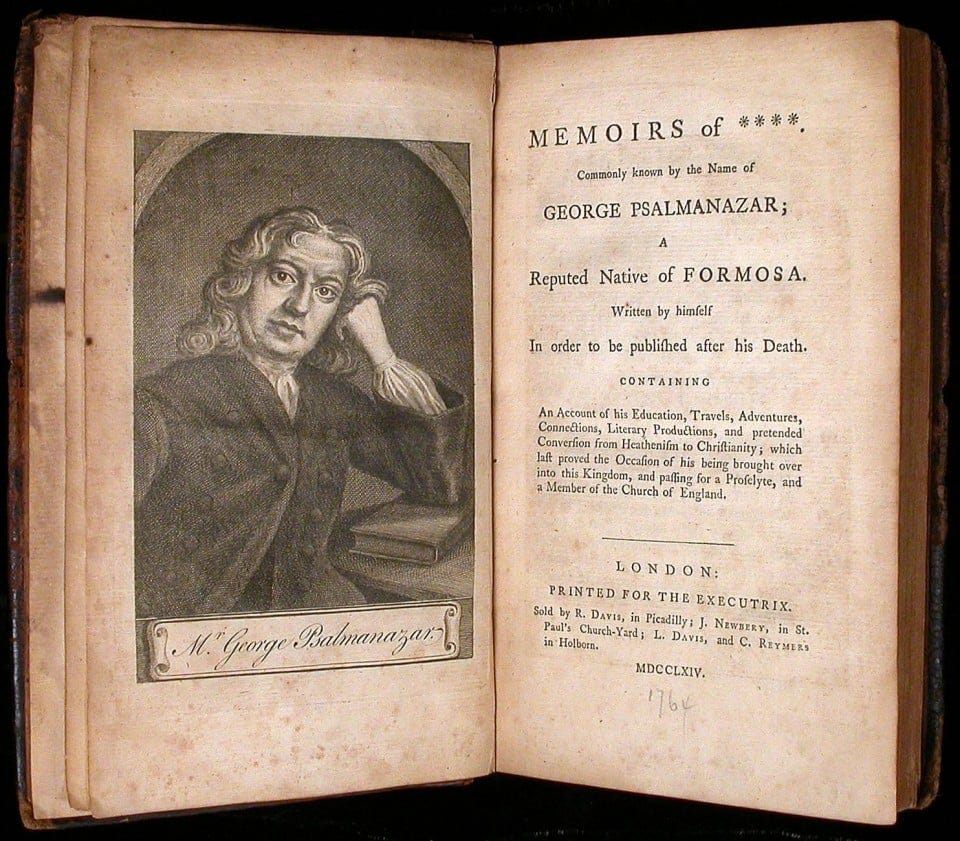
A much more impressive racial conman than Jason Arday was George Psalmanazar, a briefly famous impostor Formosan nobleman in Queen Anne’s England. Despite being a blond white man, Psalmanazar was a popular lecturer on what he claimed was his native tongue of Formosan (Taiwanese).
Like Arday’s professorship at Cambridge on the sociology of education, Psalmanazar was proposed for a lectureship at Oxford on, uh, Formosaology. (But, unlike Arday, he didn’t get the job.)
In truth, Psalmanazar, whose real name remains unknown almost three and a half centuries after his birth, had never been east of Germany.
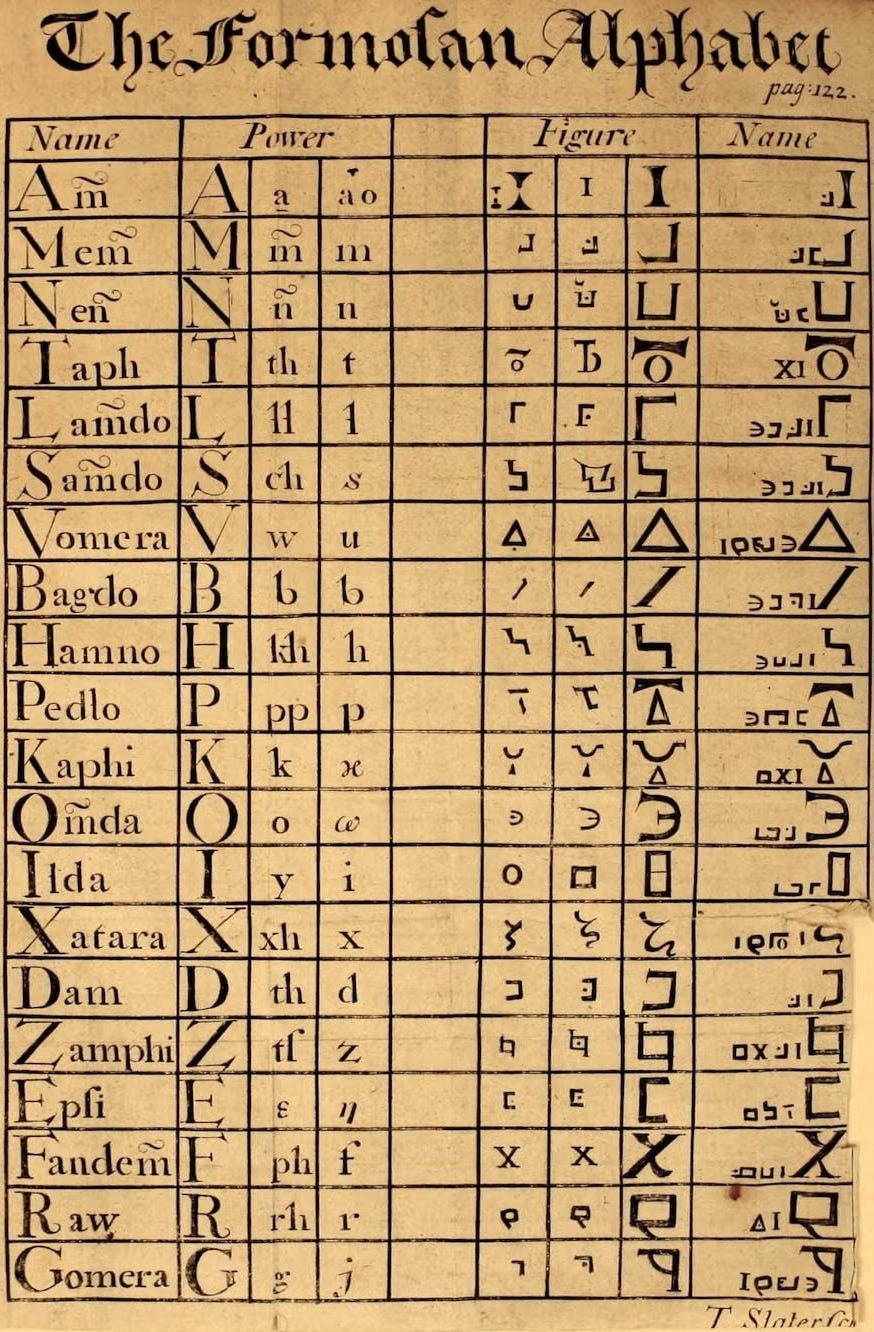
While Arday merely repeats the orthodoxies of the Age of Kendi, Psalmanazar concocted his entire “Formosan” language. And he did it so assiduously and artfully that some pedantic German linguists continued to list it as a real language for well over a century.
He had been a sensation in London in the early 1700s, where he debated astronomer Edmund Halley (of Halley’s Comet fame) at a Royal Society meeting headed by Sir Isaac Newton. His tales of Taiwanese cannibalism (e.g., cuckolded husbands were allowed to eat their adulterous wives) inspired Jonathan Swift’s A Modest Proposal.
From The Atlantic a dozen years ago:
The Fake ‘Asian’ Who Fooled 18th-Century London
George Psalmanazar, a blond-haired man with blue eyes, convinced English intellectuals that Jesuit priests had kidnapped him from the savage island of Taiwan.
By Kembrew McLeod
April 22, 2014
… In eighteenth-century England, Psalmanazar gained the same level of fame or infamy as a modern-day reality-television-star train wreck. Nobles and rich merchants invited him to their dinner tables, where he spoke gibberish while inhaling mouthfuls of bloody food. (According to imaginary custom [invented by Psalmanazar], Formosans ate their meat raw.) He impressed many, but Psalmanazar also had “a much greater number of opposers to combat with.”
This demonstrates a big difference between the era of Defoe and Swift vs. our own Great Awokening, when nobody until Nathan Cofnas ever publicly challenged Arday’s tall tales.
At a meeting of the Royal Society—which on that day included discussions of ovarian cysts, possum penises, and this blond, blue-eyed specimen from Formosa—he was questioned by the group’s resident astronomer. Edmund Halley asked detailed questions about how long twilight lasted on the island, the amount of time the sun shone down chimneys, and other quantifiable queries. Psalmanazar calmly told Halley that Formosan chimneys were bent and, therefore, the sun couldn’t shine down them. He remained fast on his feet and had an explanation for everything that was thrown his way, turning each objection against his story into evidence that it was for real.
Can you imagine Arday being exposed to and standing up to that quality of hostile questioning?
After fending off attacks from astronomers, botanists, and possum-penis enthusiasts, Psalmanazar was confronted by Father Fontenay. “You are a fraud,” he declared, noting that Formosa was a province of China, not Japan. “You are wrong,” replied Psalmanazar, who then asked if there were any other ways people referred to Formosa. “Tyowan”—that is, Taiwan—Fontenay said. Ahhhh, he told the Jesuit, that was a different island colonized by the Dutch! Psalmanazar said people from China referred to Formosa as Pak-Ando and natives such as himself called it Gad-Avia. Fontenay protested that “Pak” wasn’t even a Chinese word.
Sounds Chinese to me. I’m starting to like this Psalmanazar kid. He’s got moxie.
Other Royal Society members questioned why Psalmanazar had such light skin. “My complexion, indeed, which was very fair,” Psalmanazar recalled, “appeared an unanswerable objection against me.”
(The Royal Society report on him noted that “he looked like a young Dutchman.”)
In the face of this skepticism, Psalmanazar told an elaborate story about how …
Paywall here.
